
2026's Record U.S. Banknote Auction Prices Explained
Market Reference · July 2026 · 8 min read
Rare U.S. Banknotes Are on a Tear in 2026: Inside the Records That Just Fell at Auction
A single $100 bill sold for $180,000. A $500 Gold Certificate brought $204,000. One spring sale made nearly $3.6 million — and it says something important about where the paper-money market is headed.
Quick Answer
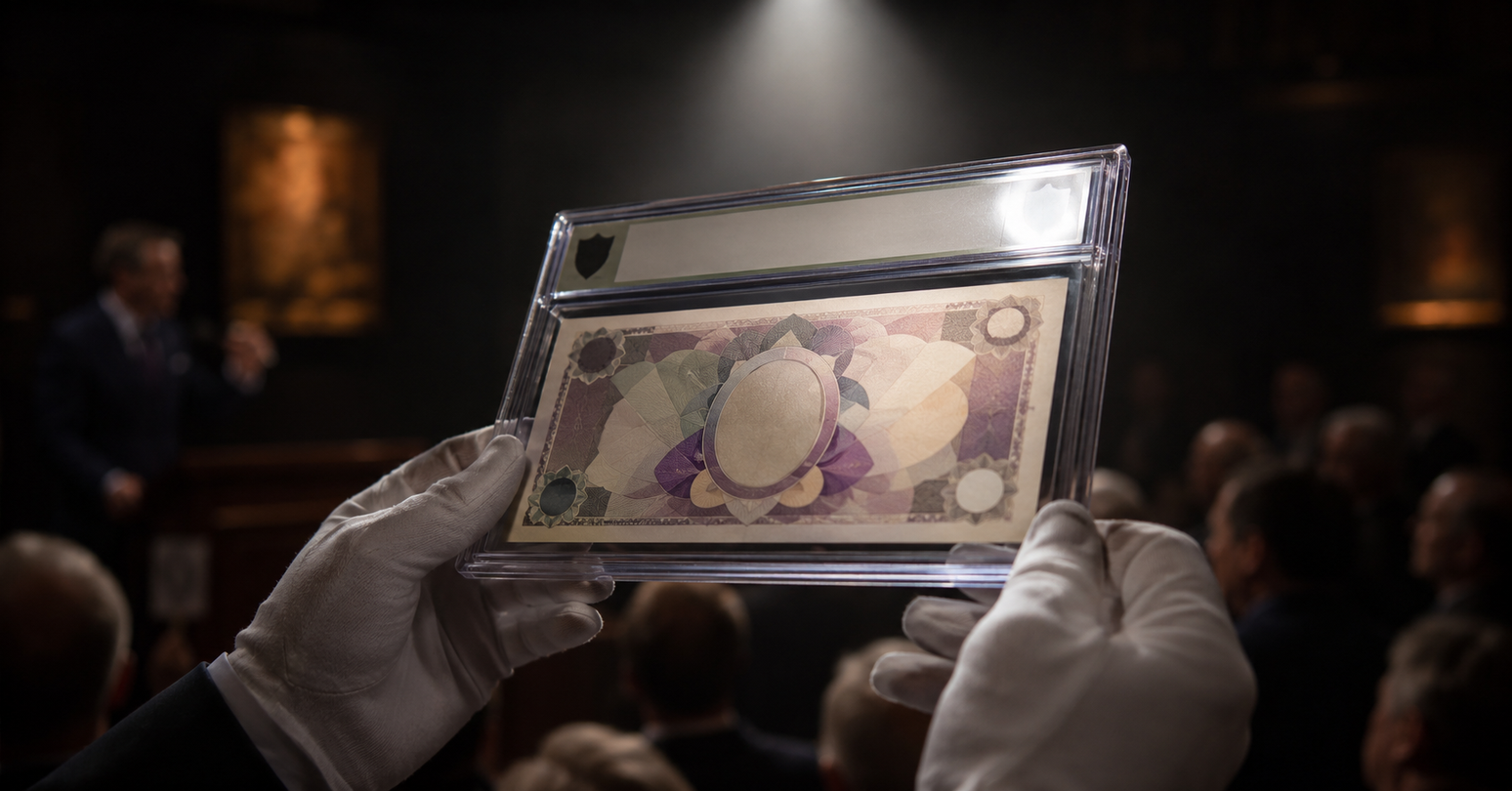
At its Spring 2026 Showcase U.S. Currency Sale, Stack’s Bowers Galleries realized nearly $3.6 million and set numerous auction records. The top results included a 1928 $500 Gold Certificate at $204,000, a 1934 Serial Number 1 $100 Federal Reserve Note at $180,000 (crushing the prior $88,000 record from 2013), a 1934 $5 Hawaii emergency star note at $84,000, an 1880 $10 Silver Certificate at $55,200, and a 1922 $20 Gold Certificate at $38,400. The pattern is clear: the finest, rarest U.S. notes are in unusually strong demand.
What happened at the Stack’s Bowers Spring 2026 currency sale?
In its Spring 2026 Showcase U.S. Currency Sale, Stack’s Bowers Galleries — one of the oldest and largest auction houses in American numismatics — realized nearly $3.6 million across a wide range of categories, with what the firm described as “numerous records broken.” The sale was anchored by two named collections: the Manhattan Beach Collection of United States Small Size Type, and the Caine Collection of Obsolete Bank Notes.
What makes the result notable isn’t just the headline total. It’s that record after record fell for individual notes — the kind of trophy material that, in the words of the auctioneer, “trades only once in a decade or more.”
“The strength of the auction proves that the finest and rarest material remains in high demand, especially for notes that trade only once in a decade or more.” — Peter Treglia, Stack’s Bowers Galleries
The record-breaking notes (and what they sold for)
| Note | Grade | Price |
|---|---|---|
| Fr. 2407 — 1928 $500 Gold Certificate | PMG Gem Unc 65 EPQ | $204,000 |
| 1934 $100 Light Green Seal — Serial No. 1 (Cleveland) | PMG Gem Unc 66 EPQ | $180,000 |
| 1934 $5 Hawaii Emergency Star Note (mule) | PMG Gem Unc 65 EPQ | $84,000 |
| Fr. 289 — 1880 $10 Silver Certificate | PMG Gem Unc 65 EPQ | $55,200 |
| Fr. 1187 — 1922 $20 Gold Certificate (mule) | PCGS Superb Gem 68 PPQ | $38,400 |
| Kirtland Safety Society Bank 1837 $10 (obsolete) | PMG Choice Unc 63 EPQ | $15,600 |
What is a “Serial Number 1” note, and why did a $100 bill bring $180,000?
The 1934 $100 Light Green Seal that sold for $180,000 carried Serial Number 1 — the very first note of its run from the Federal Reserve Bank of Cleveland, and a replacement (star) note at that. Serial Number 1 notes are the numismatic equivalent of a first-off-the-line collectible: there is exactly one per issue, and collectors prize them accordingly. This example had been estimated at $75,000 to $125,000. It not only cleared the high end — it obliterated the prior auction record of $88,000, set back in 2013.
That jump — from $88,000 to $180,000 in roughly a decade — is the single clearest snapshot of how much demand for true trophy notes has intensified. Grade matters enormously here: this was a Gem Uncirculated example with the eye appeal that top collectors compete for. If you’re new to how professional grading drives value, our complete guide to PMG grading explains the 1–70 scale and the EPQ designation that appears on so many of these records.
Why is rare U.S. paper money climbing in 2026?
Several currents are running in the same direction. First, 2026 is the year of America’s Semiquincentennial — the 250th anniversary of the nation’s founding — and that milestone has renewed collector interest in tangible pieces of U.S. history, a dynamic we explored in Money Through America’s 250 Years. Second, this is a moment when collectors across many categories are gravitating toward scarce, physical objects with documented provenance. Third, and most specific to results like these: the supply of finest-known examples is fixed. When a note that surfaces once a decade finally crosses the block, the bidding reflects years of pent-up demand.
None of this is a promise about future prices — auction results describe what has already happened, not what will. But the direction of travel in 2026 is unmistakable: condition rarity and historical significance are being rewarded more than ever.
Obsolete bank notes are having a moment too
It wasn’t only the six-figure rarities. The Caine Collection of Obsolete Bank Notes — currency issued by individual American banks in the 1800s, before national paper money — set its own records. An 1837 $10 from the Kirtland Safety Society Bank in Ohio realized $15,600, and 19th-century proofs from small Minnesota banks brought five figures each. It’s a reminder that the “hometown” corners of U.S. paper money have deep, active collector bases of their own. Collectors drawn to that world often graduate into National Bank Notes, the charter-numbered notes that put a town’s name right on the currency.
What this means for everyday collectors
You don’t need $180,000 to participate in the same market forces. The lesson embedded in these records is one any collector can apply: buy the best example you can afford, favor notes with documented authenticity, and treat grade and eye appeal as central rather than incidental. A well-chosen, certified note in a popular series is how most collections are actually built — and it’s the same logic, at a different scale, that drove these headlines.
Own a piece of U.S. history
From classic large-size type to modern stars, every U.S. note we sell is authenticated, graded where noted, and shipped with a Certificate of Authenticity.
Shop U.S. Banknotes →Frequently asked questions
How much did the Stack’s Bowers Spring 2026 currency sale make?
The Spring 2026 Showcase U.S. Currency Sale realized nearly $3.6 million and set numerous individual auction records.
What was the most expensive note in the sale?
A Fr. 2407 1928 $500 Gold Certificate graded PMG Gem Uncirculated 65 EPQ realized $204,000, the top single result of the sale.
Why did a 1934 $100 bill sell for $180,000?
It was a Serial Number 1 Light Green Seal replacement (star) note from the Federal Reserve Bank of Cleveland, graded PMG Gem Uncirculated 66 EPQ. Serial Number 1 status plus top-tier grade drove it far past its $75,000–$125,000 estimate and past the prior record of $88,000 set in 2013.
What is an EPQ or PPQ designation?
EPQ (“Exceptional Paper Quality,” used by PMG) and PPQ (“Premium Paper Quality,” used by PCGS Banknote) indicate a note’s paper is original and undisturbed — a designation that meaningfully affects value at the high end.
Does this mean rare banknotes are a good investment?
Auction records document past sales, not future performance. Rare notes are collected for their history, rarity, and beauty; strong recent results reflect demand for finest-known material but are not a guarantee of future prices.
Sources
- Greysheet / CDN Publishing — “Stack’s Bowers Galleries’ Spring 2026 Showcase U.S. Currency Sale Realizes Nearly $3.6 Million, with Numerous Records Broken” (April 1, 2026)
- Stack’s Bowers Galleries — Spring 2026 Showcase U.S. Currency Sale lot results
Explore Popular Articles

Consecutive Serial Numbers: How to Buy Banknote Lots
Collector's Guide · Buying Guide · Updated October 7, 2026 Consecutive Serial Numbers, Explained: H...

Venezuela 200 Bolívares = 200 Million Old Bolívares
Collector's Guide · World Banknotes · Updated October 7, 2026 Venezuela's 200 Bolívares Note Equals...

Yugoslavia October Dinar 1993: All 10 Notes, Pick 128–137
Monetary History · September 30, 2026 · 8 min read Yugoslavia’s October Dinar, 1993: Six Zeros Off...

Venezuela 1,000,000 Bolívar Note (Pick 114), Explained
Collector’s Guide · September 29, 2026 · 7 min read Venezuela’s 1,000,000 Bolívar Note, Explained:...