
Lebanon's 2026 Currency Reset: New Banknotes Explained
Numismatic Reference · July 2026 · 9 min read
Lebanon’s 2026 Currency Reset: The New 500,000–5 Million Livres Notes and What They Mean for Collectors
After nearly six years of financial collapse, Lebanon has authorized its first higher-denomination banknotes in a generation — a decision that instantly reframes the 100,000 livres note as the closing chapter of an era.
Quick Answer
In 2026, Lebanon’s Parliament approved a law authorizing the Banque du Liban (BDL) to issue banknotes of 500,000, 1 million, 2 million, and 5 million livres, plus new coins of 1,000, 5,000, 10,000, and 20,000 livres. The move follows a currency collapse in which the Lebanese pound lost roughly 98% of its value after 2019. Until these notes circulate, the 100,000 livres remains the highest denomination in daily use — and the defining collectible of Lebanon’s crisis years.
What did Lebanon change about its currency in 2026?
In 2026, after nearly two years of legislative wrangling, the Lebanese Parliament passed a draft law — introduced by MP Ziad Hawat — granting the Banque du Liban the legal authority to print far larger denominations than the country has ever circulated. The approved notes are 500,000, 1 million, 2 million, and 5 million livres. Alongside them, Parliament authorized a new set of coins in 1,000, 5,000, 10,000, and 20,000 livres.
For context, the largest note Lebanese citizens currently carry is the 100,000 livres. A single new 5 million livres note will be worth fifty of them. It is one of the sharpest single-step jumps in denomination any modern central bank has authorized outside of an outright redenomination.
Why did Lebanon need bigger banknotes?
The short answer is arithmetic. Since the financial crisis began in 2019, the Lebanese pound has lost roughly 98% of its value. The old official peg of 1,507.5 livres to the U.S. dollar — held since 1997 — gave way as the currency cratered on the parallel market. On February 15, 2024, the BDL formally moved the official rate to 89,500 livres per dollar, part of the exchange-rate unification the IMF had set as a condition for financial support.
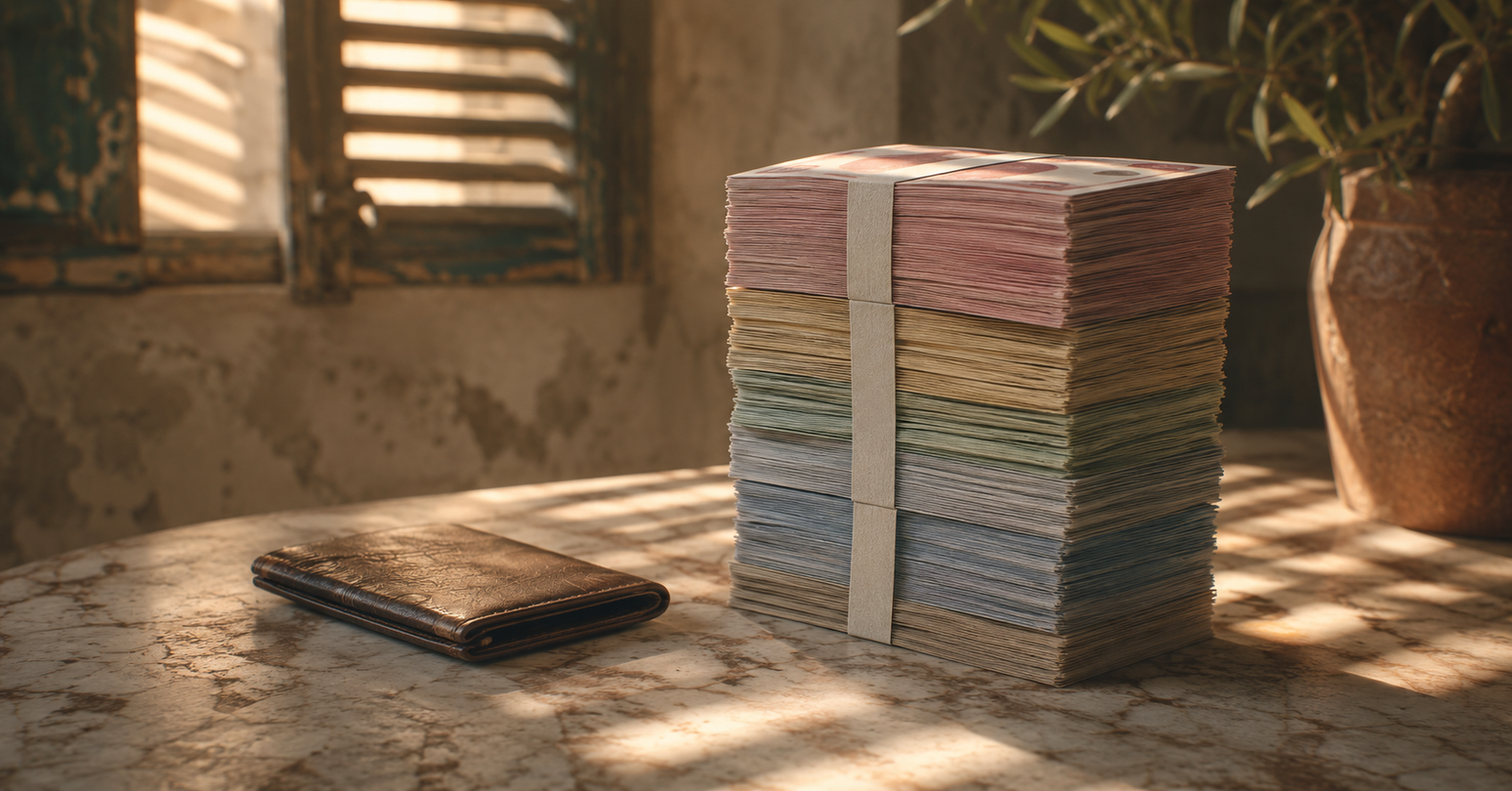
When a country’s largest note is worth barely a dollar, everyday life turns into an exercise in counting bricks of paper. Lebanese shoppers have grown used to carrying bags of 100,000 livres notes to cover ordinary purchases. The new denominations are meant to end that — to let a wallet, rather than a duffel bag, hold a day’s cash.
When the biggest bill in your pocket is worth about a dollar, the size of your wallet becomes a measure of the crisis.
What is the highest Lebanese banknote right now?
Until the new notes reach circulation, the 100,000 livres note is the top of the ladder — and it dominates the money supply to a degree few currencies ever see. According to BDL figures, Lebanon’s total money supply stands around 157.6 trillion livres, and roughly 94% of that is held in 100,000 livres notes. Another 4.5% sits in 50,000 livres notes. Every other denomination — 20,000, 10,000, 5,000, and 1,000 — together makes up just 1.5% of the cash in circulation.
That concentration is exactly why the 100,000 livres note is the emblem of this period. It is, in practical terms, the note that carried an entire economy through its hardest years.
The new Lebanese banknote denominations at a glance
| Denomination | Type | Status |
|---|---|---|
| 1,000 – 20,000 livres | New coins | Authorized 2026 |
| 50,000 livres | Existing note | ~4.5% of money supply |
| 100,000 livres | Existing note | ~94% of money supply — current top note |
| 500,000 livres | New note | Authorized 2026 |
| 1,000,000 livres | New note | Authorized 2026 |
| 2,000,000 livres | New note | Authorized 2026 |
| 5,000,000 livres | New note | Authorized 2026 — new top note |
The BDL has signaled it will introduce the notes gradually and in a controlled manner, with the stated aim of keeping the currency in circulation stable rather than expanding it — and of quietly withdrawing some smaller denominations as the new ones arrive.
What happens to the old 100,000 livres note?
This is where the story turns from economics to collecting. Every time a country introduces a new tier of currency, the note that used to sit at the top becomes a bookmark in monetary history. The Lebanese 100,000 livres note is now positioned to become exactly that: the defining artifact of the 2019–2026 crisis, the bill that families counted out by the stack, and the last “old ceiling” before the reset.
Notes like this are collectible for the same reason hyperinflation notes from history’s worst currency collapses are collectible: they are tangible, dated records of a moment a nation lived through. A crisp, uncirculated 100,000 livres note preserves that moment in a way no headline can.
How the Lebanese pound collapsed: a short timeline
- 1997–2023 — The peg era
- The livre is pegged at 1,507.5 to the U.S. dollar, a rate that holds for more than two decades and becomes a fixture of Lebanese daily life.
- 2019 — The break
- A banking and debt crisis triggers the collapse. Depositors lose access to savings; the parallel-market rate begins a steep, sustained slide.
- February 15, 2024 — Official rate reset
- The BDL raises the official rate to 89,500 livres per dollar (from 15,000), unifying rates as part of IMF-linked reforms.
- 2026 — New denominations authorized
- Parliament approves the 500,000 through 5 million livres notes and new coins — the first meaningful denomination increase of the crisis.
Is the Lebanese 100,000 livres note a good note to collect?
For collectors of modern crisis currency, the appeal is straightforward. The 100,000 livres note is affordable, historically significant, and tied to a specific, well-documented economic episode — the three qualities that tend to define a durable collectible. It also sits comfortably alongside the other great modern “crisis notes,” from Venezuela’s redenominations to Syria’s 2026 reset, giving it a natural place in a themed collection. If you’re weighing where a crisis note sits on the spectrum, our guide to the difference between a hyperinflation note and a high-denomination note is a useful companion read.
Collect the note that carried a nation
Before the reset rewrites the ladder, the 100,000 livres note is the defining bill of Lebanon’s crisis years — crisp, authenticated, and shipped with a Certificate of Authenticity.
Shop Lebanon Banknotes →Frequently asked questions
What are Lebanon’s new banknote denominations in 2026?
Lebanon authorized new banknotes of 500,000, 1 million, 2 million, and 5 million livres, along with new coins of 1,000, 5,000, 10,000, and 20,000 livres.
Why is Lebanon issuing higher-denomination notes?
Because the Lebanese pound has lost roughly 98% of its value since 2019. With the 100,000 livres note worth only about a dollar, citizens must carry large stacks of cash; higher denominations are intended to simplify everyday transactions.
What is the highest Lebanese banknote currently in circulation?
The 100,000 livres note is currently the highest denomination in daily use, and it accounts for about 94% of the country’s money supply.
What is the Lebanese pound’s official exchange rate?
On February 15, 2024, the Banque du Liban set the official rate at 89,500 livres per U.S. dollar, up from 15,000 and far above the old 1,507.5 peg that held from 1997 to 2023.
Will the old 100,000 livres note still be worth collecting?
Yes. As the highest denomination of Lebanon’s crisis era, the 100,000 livres note is a dated, tangible record of a major monetary event — the kind of note collectors of modern crisis currency actively seek.
Is it legal to collect Lebanese banknotes in the United States?
Yes. Lebanese banknotes are ordinary numismatic collectibles and are freely bought and sold by U.S. collectors and dealers.
Sources
- This Is Beirut — “Farewell to Wads of Cash: Lebanon Unveils Banknotes of LBP 500,000 and 1 Million”
- L’Orient Today — “Almost six years after the crisis, Lebanon finally decides to issue new banknotes”
- Credit Libanais / Central Banking — Banque du Liban official exchange-rate amendment (89,500 LBP/USD, February 15, 2024)
- Banque du Liban (BDL) — Banknotes & Coins and money-supply figures
Explore Popular Articles

Consecutive Serial Numbers: How to Buy Banknote Lots
Collector's Guide · Buying Guide · Updated October 7, 2026 Consecutive Serial Numbers, Explained: H...

Venezuela 200 Bolívares = 200 Million Old Bolívares
Collector's Guide · World Banknotes · Updated October 7, 2026 Venezuela's 200 Bolívares Note Equals...
Yugoslavia October Dinar 1993: All 10 Notes, Pick 128–137
Monetary History · September 30, 2026 · 8 min read Yugoslavia’s October Dinar, 1993: Six Zeros Off...
Venezuela 1,000,000 Bolívar Note (Pick 114), Explained
Collector’s Guide · September 29, 2026 · 7 min read Venezuela’s 1,000,000 Bolívar Note, Explained:...