
The 5 Worst Hyperinflations in History | Collector's Guide 2026
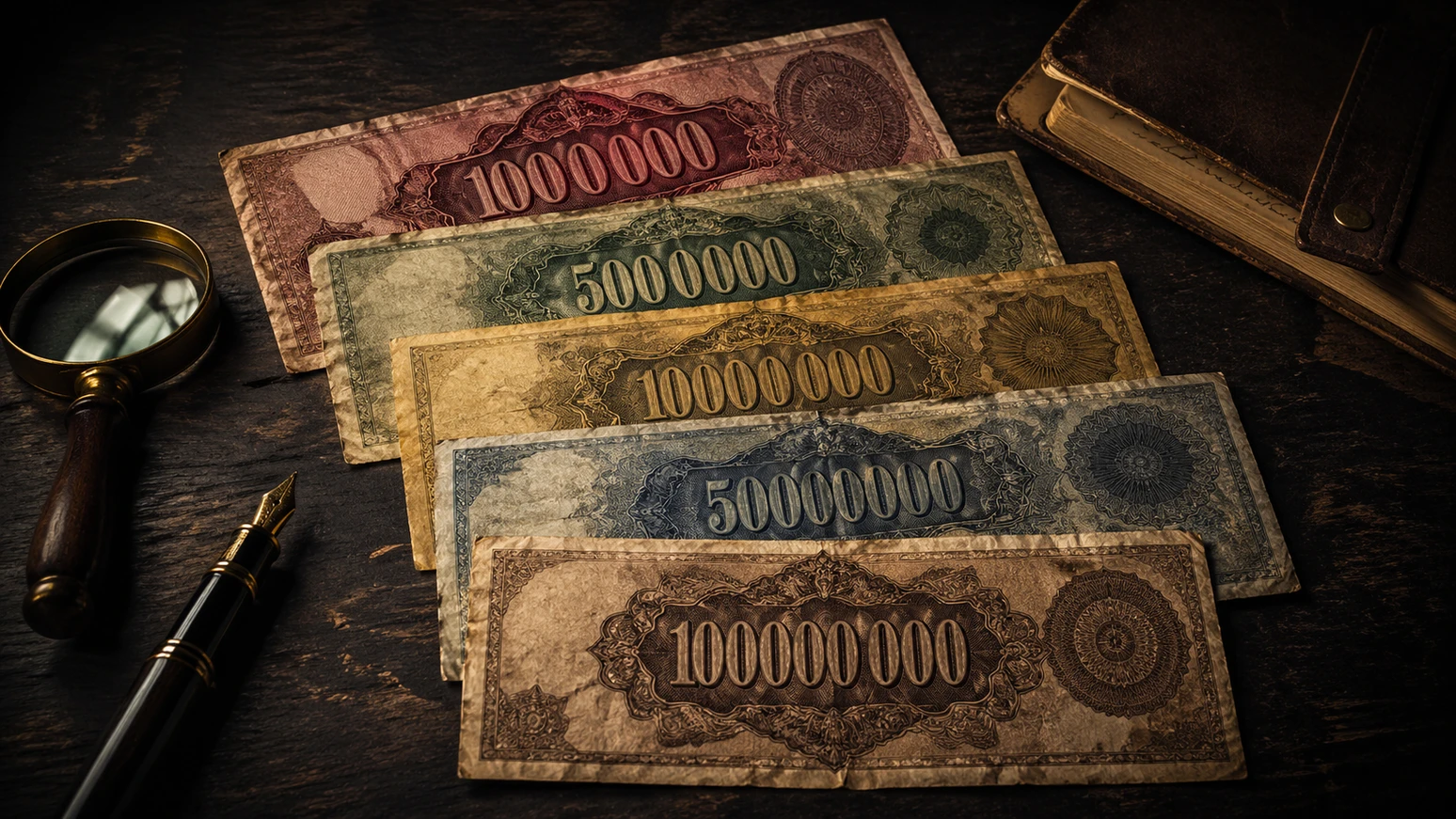
The 5 Worst Hyperinflations in History — and the Banknotes That Survived Them
A Collector’s Guide to the Most Extreme Currency Collapses Ever Recorded — Hungary, Zimbabwe, Yugoslavia, Weimar Germany, and Venezuela — and the Historic Notes They Left Behind
Of the 62 hyperinflation episodes documented in the academic record, only a handful left behind a body of currency that is still actively collected today. Most were short-lived events whose notes either disappeared into bonfires or remain locked away in central bank archives. But the worst of the worst — the episodes where prices doubled in days, hours, or even faster — produced banknotes so visually arresting and historically significant that they have become permanent fixtures in modern numismatics. A collector who owns examples from all five of the episodes covered below holds, in physical form, the most extreme monetary events in human history.
This guide ranks the top five hyperinflations using the academic gold-standard Hanke-Krus World Hyperinflation Table — the most widely cited reference in monetary economics for ranking these events. We’ll cover what happened, why it happened, the highest denominations issued, and the specific banknotes that today’s collectors actively pursue.
How Hyperinflations Are Ranked
Economists Steve Hanke (Johns Hopkins / Cato Institute) and Nicholas Krus published the definitive Hanke-Krus World Hyperinflation Table in 2012, applying a strict, replicable definition: an episode qualifies as hyperinflation only when monthly inflation exceeds 50% and remains there for at least 30 consecutive days. Their methodology has since become the academic standard. The five episodes covered in this guide are ranked in order of peak monthly inflation rate.
| Rank | Country | Peak Month | Daily Rate at Peak | Doubling Time |
|---|---|---|---|---|
| #1 | Hungary | July 1946 | 207% | ~15 hours |
| #2 | Zimbabwe | November 2008 | 98% | ~24 hours |
| #3 | Yugoslavia | January 1994 | 64.6% | ~1.4 days |
| #5 | Weimar Germany | October 1923 | 20.9% | ~3.7 days |
| #14 | Venezuela (1st episode) | 2018 | ~4.7% | ~17 days |
A note on Venezuela: while it ranks 14th by peak rate, we’ve included it as the fifth entry in this guide because it is the only major hyperinflation of the modern collector era and produced a substantial body of widely available, actively traded banknotes. Rank #4 in the Hanke-Krus table belongs to the Republika Srpska, a Serb-majority entity within Bosnia that issued its own dinar from 1992 to 1994 — an extraordinary numismatic specialty, but not one most collectors pursue as a primary collecting area.
#1 — Hungary, 1945–1946: Prices Doubling Every 15 Hours
Hungary holds the title for the most extreme hyperinflation ever recorded by a margin no other episode comes close to matching. At its peak in July 1946, prices in Hungary were doubling every 15 hours. The daily inflation rate hit 207%. Monthly inflation reached the almost incomprehensible figure of 4.19 × 10¹⁶ percent — that is, 41.9 quadrillion percent per month.
The cause was a perfect storm of post-war devastation: Hungary lost approximately 40% of its national wealth during World War II, was occupied by Soviet forces, faced massive Allied reparations obligations, and had its industrial capacity reduced to a fraction of its pre-war level. To finance government operations and reconstruction, the Hungarian National Bank (Magyar Nemzeti Bank) resorted to the printing press — and once started, the cycle could not be stopped.
As inflation accelerated, Hungary repeatedly renamed its currency units to keep the digits manageable. The original pengő was joined by the milpengő (1 milpengő = 1 million pengő) in May 1946, then the b.-pengő or bilpengő (1 b.-pengő = 1 trillion pengő, using the European long scale) in June 1946. By July, even these abbreviations couldn’t keep up — the highest note issued was the 100 million b.-pengő, which equaled 100 quintillion (1020) pengő: the highest denomination banknote ever circulated in any country.
The story doesn’t end there. The Hungarian Banknote Printing Corporation also produced an even larger note — the 1 milliard b.-pengő, equal to one sextillion (1021) pengő. Printed on June 3, 1946, this note was never released into circulation because the entire pengő currency was abolished on August 1, 1946, and replaced by the modern Hungarian forint at a rate of 400,000 quadrillion pengő to 1 forint. The 1 milliard b.-pengő note holds the record for the highest denomination of any banknote ever printed anywhere, ever.
Key collector pieces: The most popular Hungary hyperinflation notes for collectors today are the 10,000 B-Pengő (Pick #132), 100,000 B-Pengő (Pick #133), 1 Million B-Pengő (Pick #134), 10 Million B-Pengő (Pick #135), and the trophy-tier 100 Million B-Pengő (Pick #136). The unissued 1 Milliard B-Pengő (Pick #137) is the holy grail — rarely available and highly prized when it appears. The adópengő (tax pengő) parallel currency notes from January through July 1946 are a fascinating sub-specialty.
For a complete deep-dive into the Hungarian hyperinflation, including the role of the adópengő and the transition to the forint, see our dedicated guide: Hungary’s 1946 Hyperinflation: The Worst Inflation in History.
#2 — Zimbabwe, 2007–2008: Prices Doubling Every 24 Hours
Zimbabwe’s hyperinflation peaked in November 2008, when the daily inflation rate hit 98% and prices doubled approximately every 24 hours. Monthly inflation reached 79.6 billion percent, making this the second-worst hyperinflation in recorded history — and far and away the most famous one of the modern era.
The roots of the crisis trace to the controversial land reform program initiated in 2000, which dismantled the country’s commercial agricultural sector and triggered a cascading collapse of foreign investment, currency reserves, and government revenue. Faced with severe budget shortfalls, the Reserve Bank of Zimbabwe (RBZ) under Governor Gideon Gono printed currency at an accelerating pace through the mid-2000s. By 2007, hyperinflation had set in. By late 2008, it had become a global numismatic spectacle.
On January 16, 2009, the Reserve Bank of Zimbabwe issued the now-iconic 100 Trillion Dollar note (Pick #91). With a face value of Z$100,000,000,000,000 — that’s 100 trillion in the American short scale, or 1014 Zimbabwe dollars — it remains the highest denomination of currency ever issued in the modern collecting era. At the time of issue, a single 100 Trillion note was worth roughly US$0.30 in real purchasing power. Today, the same note routinely sells for $80–$200 raw and $500–$5,000+ in top PMG-graded condition. All standard production 100 Trillion notes carry the AA prefix.
Zimbabwe’s entire denomination cascade is one of modern numismatics’ most striking visual collections. The complete “trillion series” from 2008 includes the 10 Trillion (P-88), 20 Trillion (P-89), 50 Trillion (P-90), and 100 Trillion (P-91). All four feature the iconic Chiremba balancing rocks of Epworth on the obverse — a natural landmark that has become synonymous with the entire hyperinflation episode.
The Zimbabwean dollar was effectively abandoned on April 12, 2009, when the government suspended it in favor of a multicurrency system. Formal demonetization came on June 15, 2015. Zimbabwe has since attempted multiple currency reintroductions, most recently the gold-backed Zimbabwe Gold (ZiG) launched in April 2024 and substantially redesigned in April 2026 — covered in our companion piece: Zimbabwe’s New BiG5 ZiG Banknotes.
Key collector pieces: The trillion series (P-88 through P-91) is the cornerstone of any hyperinflation collection. Lower denominations from the same era — 1 Million through 5 Trillion — are also actively collected and provide complete-set opportunities. For our full guide to the 100 Trillion note specifically, including authentication, grade tiers, and counterfeit detection, see Collector’s Guide to the Zimbabwe AA 100 Trillion Dollar Banknote.
#3 — Yugoslavia, 1992–1994: 313 Million Percent Per Month
The Federal Republic of Yugoslavia — what remained of the former Socialist Federal Republic of Yugoslavia after Slovenia, Croatia, Bosnia, and Macedonia declared independence — experienced one of the longest and most severe hyperinflations in history. The episode peaked in January 1994, when the daily inflation rate hit 64.6% and monthly inflation reached 313 million percent.
The causes were a combination of economic mismanagement, the dissolution of the Yugoslav federal economy, the cost of the Yugoslav Wars, and crippling United Nations sanctions imposed in May 1992. With foreign trade strangled and federal revenues collapsing, the National Bank of Yugoslavia financed government operations through monetary expansion. The dinar lost value at a pace that approached the Hungarian and Zimbabwean records.
The denomination cascade from this period is staggering. The National Bank of Yugoslavia issued notes in increasingly absurd denominations through 1993 and into early 1994:
- 500,000,000 dinara (500 Million) — Pick #134
- 10,000,000,000 dinara (10 Billion) — Pick #136
- 50,000,000,000 dinara (50 Billion) — Pick #136a
- 500,000,000,000 dinara (500 Billion) — Pick #137a — the highest denomination of the entire episode
The 500 Billion Dinara note (Pick #137a), issued in 1993, features a portrait of Jovan Jovanović Zmaj — a beloved 19th-century Serbian poet, physician, and translator whose work shaped modern Serbian literary identity. The deliberate choice to feature a cultural figure rather than a political one on the highest-denomination note of a collapsing currency speaks to the surreal mood of the period.
The hyperinflation was halted almost overnight on January 24, 1994, when the National Bank of Yugoslavia introduced the “novi dinar” (new dinar) at a rate of 1 novi dinar = 13 million 1993 dinara, pegged to the Deutsche Mark at 1:1. The stabilization program, designed by economist Dragoslav Avramović, became one of the most successful currency stabilizations in monetary history.
Key collector pieces: The 500 Billion Dinara (P-137a) is the headline note and the trophy-tier piece. The full denomination cascade from 500 Million (P-134) through 500 Billion (P-137a) makes a visually striking complete-series collection. Planet Banknote stocks select Yugoslavia notes with our exclusive Planet Banknote PMG Pedigree labels.
#4 — Weimar Germany, 1922–1923: The Hyperinflation Everyone Remembers
The Weimar Republic’s hyperinflation is the most historically famous episode on this list — the one taught in every economics textbook, dramatized in countless films, and burned into the collective memory of the 20th century. By the standards of pure monthly inflation rate, however, it ranks only fifth: peak monthly inflation in October 1923 was 29,500%, with daily inflation at 20.9% and prices doubling roughly every 3.7 days. By comparison, both Hungary and Zimbabwe at peak experienced rates orders of magnitude higher.
What makes Weimar Germany historically pivotal is not the depth of the inflation but its political consequences. The destruction of the German middle class’s savings, the radicalization of public opinion, and the failure of the Weimar Republic to maintain monetary credibility set the stage for political instability that would reshape European history over the following two decades.
The cause was a tangled combination of factors: war reparations imposed by the Treaty of Versailles, the loss of industrial regions, the French and Belgian occupation of the Ruhr in January 1923 (which led the German government to subsidize a worker’s strike by printing currency), and a Reichsbank under Rudolf Havenstein that lacked both the tools and the political will to halt monetary expansion.
Pre-war Germany’s highest banknote denomination was 1,000 marks. By 1923, the Reichsbank was issuing:
- 10,000 mark (early 1922)
- 100,000 and 1 million mark (February 1923)
- 50 million mark (July 1923)
- 10 milliard (10 billion) mark (September 1923)
- 100 trillion mark (1014) — Pick #128, issued October 26, 1923
- A 1,000 trillion mark note was even produced in February 1924, though by then the Rentenmark had taken over.
To produce the staggering volume of paper required, the government commissioned approximately 60 to 133 private printing companies (sources vary) to operate as auxiliary printers under Reichsdruckerei supervision. Between July 25 and October 26, 1923, alone, 28 different banknote types were issued. Many were single-sided to save time. Security features were minimal — there was no time for them.
The hyperinflation ended on November 15, 1923, when the new Rentenmark was introduced under Chancellor Gustav Stresemann at a conversion rate of 1 trillion papiermark = 1 Rentenmark. The stabilization was nearly instantaneous: the Rentenmark held its value, and German prices stabilized within weeks. The Rentenmark was replaced by the gold-backed Reichsmark on August 30, 1924.
Key collector pieces: The 100 Trillion Mark (P-128) is the trophy denomination from this episode. The complete inflation cascade from 1922–1923 spans more than 30 distinct issued denominations and provides one of numismatics’ richest type-set collecting opportunities. The separately collectible Notgeld (emergency money) issued by German cities, states, and private companies during this period is its own deep specialty — tens of thousands of distinct issues exist, often with extraordinary artistic designs.
#5 — Venezuela, 2016–Present: 14 Zeros and Counting
Venezuela holds a unique place on this list as the only modern hyperinflation that current collectors have lived through in real time. Hanke ranks Venezuela’s first episode (November 2016 to February 2019) as the world’s 14th-most-severe by peak rate, with a 27-month duration that makes it the fifth-longest on record. A second episode began in April 2020 and continues today.
The crisis traces to the economic policies pursued under presidents Hugo Chávez and Nicolás Maduro: heavy reliance on oil revenue, expansive social spending financed through monetary expansion, exchange controls that fueled black markets, and the seizure of private enterprises that disrupted production. When global oil prices collapsed in 2014–2015, the underlying fragility was exposed and inflation accelerated rapidly.
Venezuela’s response to its hyperinflation has been three currency redenominations in 13 years — collectively removing 14 zeros from the bolívar:
| Date | Currency | Zeros Removed | Conversion Rate |
|---|---|---|---|
| January 1, 2008 | Bolívar Fuerte (VEF) | 3 | 1,000 old = 1 new |
| August 20, 2018 | Bolívar Soberano (VES) | 5 | 100,000 VEF = 1 VES |
| October 1, 2021 | Bolívar Digital (VED) | 6 | 1,000,000 VES = 1 VED |
The single most iconic note from the Venezuelan crisis is the 1,000,000 Bolívar Soberano, issued in 2020 as the highest denomination of the soberano series. Its obverse features Simón Bolívar, the South American independence leader for whom the currency is named; its reverse depicts the Battle of Carabobo, the decisive 1821 victory that secured Venezuelan independence from Spain. After the 2021 redenomination, this million-bolívar note became worth exactly 1 bolívar digital — a stark visual artifact of monetary collapse.
Venezuela’s subsequent Bolívar Digital series introduced new low-denomination notes (5, 10, 20, 50, 100 VED) in 2021. By June 2025, all the high-denomination soberano notes (the 200,000, 500,000, and 1,000,000) had been effectively withdrawn or rendered worthless within Venezuela’s domestic economy — though they remain technically legal tender. For collectors outside Venezuela, this means clean uncirculated examples of the soberano series are increasingly difficult to source from primary channels.
Key collector pieces: The 1,000,000 Bolívar Soberano (2020) is the headline note. Complete sets of the soberano series (2018–2020) and the digital series (2021–present) are achievable and visually striking. Multiple-redenomination collections that include all three currency families — fuerte, soberano, and digital — tell the complete crisis story in physical form.
Why These Banknotes Matter
Hyperinflation banknotes are among the most evocative artifacts in modern numismatics. Each one is simultaneously a piece of currency, a historical document, and a visual record of monetary failure. They are physical evidence of moments when the basic financial infrastructure of an entire society broke down — and the specific design choices, denomination cascades, and security features they exhibit reveal how central banks responded under conditions of extreme stress.
Several factors distinguish hyperinflation banknotes as a collecting category:
Visual immediacy. A 100 Trillion Dollar bill or a 100 Quintillion Pengő note communicates the scale of monetary collapse instantly, in a way that no statistic can match. These are the most successful conversation pieces in all of numismatics.
Historical density. Hyperinflation episodes are typically short and chaotic, producing many denominations in compressed timeframes. The result is a rich body of collectible material with clear chronological structure.
Authentication concerns. Counterfeits exist for every famous hyperinflation note, particularly the Zimbabwe 100 Trillion. PMG certification is the standard solution — certified examples eliminate authentication risk and command substantial premiums over raw notes.
Educational value. Few collecting areas teach more about economics, history, and politics in tangible form. Each note is a physical reminder of why monetary discipline matters.
Building a Hyperinflation Collection
For collectors interested in this area, here is a practical roadmap:
- Start with the iconic anchor pieces. A complete “Five-Country Set” consisting of one trophy-tier note from each episode — Hungary 100 Million B-Pengő, Zimbabwe 100 Trillion, Yugoslavia 500 Billion Dinara, Weimar 100 Trillion Mark, and Venezuela 1 Million Bolívar Soberano — is achievable and provides immediate visual and educational impact.
- Prioritize PMG-graded examples for trophy notes. Top-tier hyperinflation notes appreciate substantially in graded form. Raw notes are acceptable for budget-conscious collectors and lower denominations.
- Build country-specific complete denomination sets. Once you have the anchor pieces, complete denomination cascades for each country provide depth and historical narrative.
- Explore parallel currencies and emergency issues. Hungarian adópengő notes, Weimar German Notgeld, and Yugoslav novi dinar transitional notes each offer rich sub-specialty collecting.
- Store properly. Most hyperinflation notes from the 20th century were printed on poor-quality wartime or wartime-adjacent paper. Use archival semi-rigid sleeves — the kind PBGrade manufactures specifically for modern world currency — for raw notes, and keep PMG holders out of direct sunlight. See our complete storage guide for details.
Frequently Asked Questions
The highest denomination banknote ever circulated was the Hungarian 100 Million B-Pengő (Pick #136) issued in July 1946, with a face value of 100 quintillion (1020) pengő. The highest denomination ever printed was the Hungarian 1 Milliard B-Pengő (Pick #137) at one sextillion (1021) pengő, but it was never released into circulation. In the modern collecting era, the Zimbabwe 100 Trillion Dollar note (Pick #91) holds the record at 1014 Zimbabwe dollars.
By peak monthly inflation rate, Hungary 1945–1946 was the worst hyperinflation in recorded history. At its peak in July 1946, prices were doubling approximately every 15 hours, with daily inflation at 207% and monthly inflation at 4.19 × 10¹⁶ percent. Zimbabwe 2008 ranks second, with prices doubling roughly every 24 hours at peak.
The academic definition used by Hanke and Krus, building on the original Cagan (1956) framework, requires a monthly inflation rate exceeding 50% sustained for at least 30 consecutive days. By this standard, only 62 hyperinflation episodes have ever been documented, the earliest being France in 1795–1796.
In most cases, no. The Hungarian pengő was demonetized in 1946. The Yugoslavia 1993 dinar was replaced by the novi dinar in 1994. The Weimar papiermark was demonetized in 1924. The Zimbabwe dollar was formally demonetized on June 15, 2015. The Venezuelan bolívar fuerte and bolívar soberano remain technically legal tender but have effectively no purchasing power. All of these notes are collected today as historical artifacts only.
Yes — particularly for the Zimbabwe 100 Trillion Dollar note, which is the most counterfeited modern collectible banknote. PMG certification is the most reliable defense against counterfeits, as PMG’s authentication process detects forgeries that would deceive most collectors. Buying from established dealers with documented sourcing is the second-best defense for raw notes.
The Republika Srpska — a Serb-majority entity within Bosnia-Herzegovina that issued its own dinar from 1992 to 1994 — technically ranks fourth on the Hanke-Krus table by peak inflation rate. We’ve omitted it from the main list because its notes are an extreme specialty area pursued by a much smaller collector base than the five episodes covered above. Republika Srpska notes are genuinely fascinating numismatic artifacts and worth exploring once a collector has built foundational holdings in the better-known episodes.
The Bottom Line
The five hyperinflations covered in this guide produced some of the most remarkable banknotes in human history — physical artifacts from moments when the basic infrastructure of money itself failed. For collectors, they offer something rare: visually arresting, historically significant, broadly available, and deeply meaningful pieces of currency that anchor any serious world banknote collection.
Planet Banknote stocks hyperinflation notes from all five countries covered in this guide, with select trophy-tier examples available with our exclusive Planet Banknote PMG Pedigree labels. Whether you’re acquiring your first hyperinflation note or completing a comprehensive five-country set, our inventory provides authenticated, certified, and properly preserved examples ready for display or long-term holding.
Explore Popular Articles

Consecutive Serial Numbers: How to Buy Banknote Lots
Collector's Guide · Buying Guide · Updated October 7, 2026 Consecutive Serial Numbers, Explained: H...

Venezuela 200 Bolívares = 200 Million Old Bolívares
Collector's Guide · World Banknotes · Updated October 7, 2026 Venezuela's 200 Bolívares Note Equals...

Yugoslavia October Dinar 1993: All 10 Notes, Pick 128–137
Monetary History · September 30, 2026 · 8 min read Yugoslavia’s October Dinar, 1993: Six Zeros Off...

Venezuela 1,000,000 Bolívar Note (Pick 114), Explained
Collector’s Guide · September 29, 2026 · 7 min read Venezuela’s 1,000,000 Bolívar Note, Explained:...