
PMG Grading Explained: The 70-Point Scale, EPQ & Value
What Is PMG Grading? The Complete Collector’s Guide to Banknote Certification
Inside the 1–70 Grading Scale, EPQ and Star Designations, the 2026 Submission Process, and Why a PMG Label Can Multiply a Note’s Value Tenfold
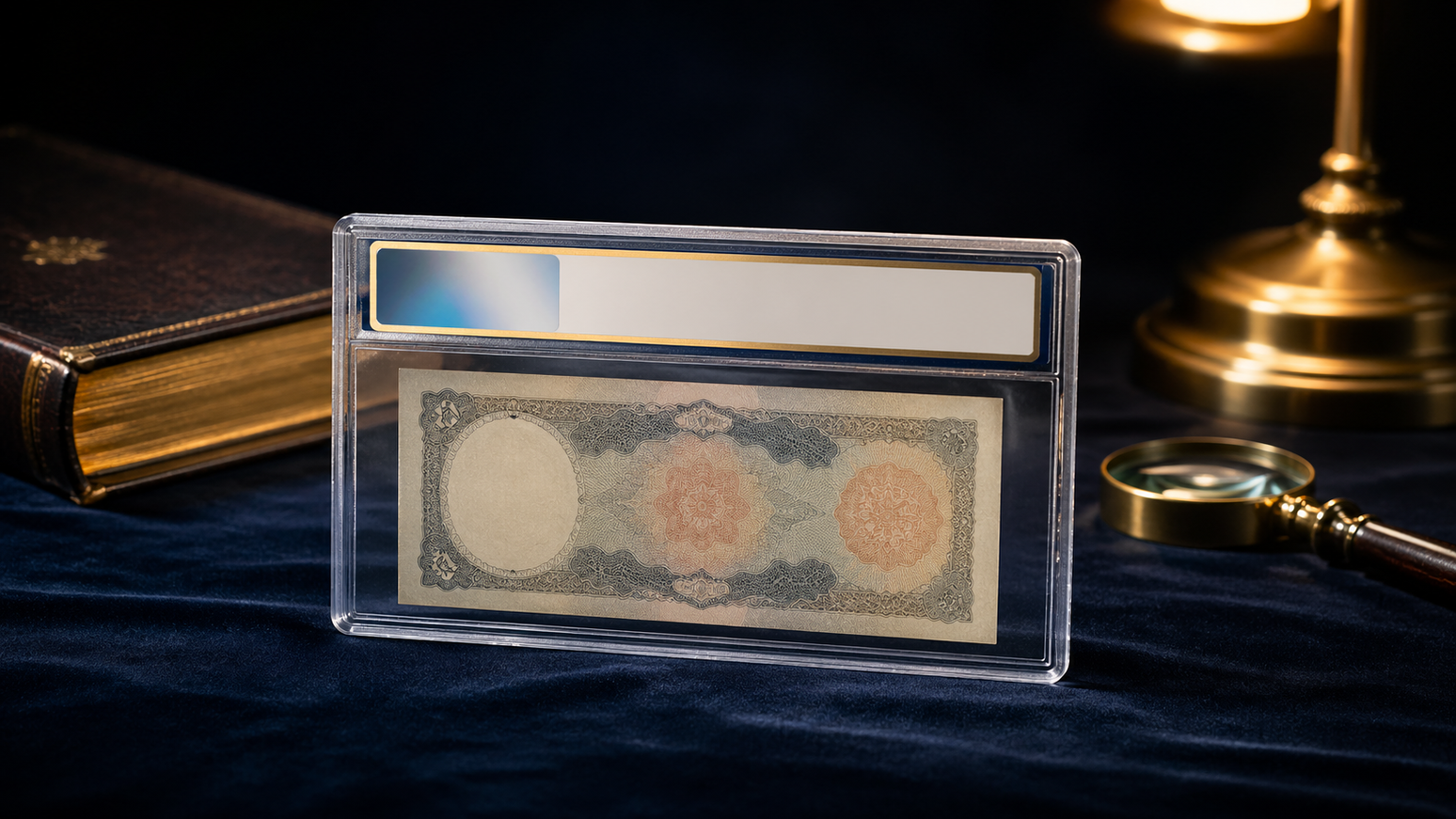
If you’ve spent any time browsing world banknotes, you’ve seen them: rectangular plastic holders sealed at the edges, a colorful certification label across the top, and a crisp note inside that looks like it just came off the printing press. Those are PMG holders — and the difference between a raw banknote and one certified by PMG can be the difference between a $15 collectible and a $500 asset.
For new collectors, professional grading often feels like a black box: a numeric score and a few abbreviations on a label, with very little explanation of what any of it actually means. This guide pulls back the curtain. We’ll walk through who PMG is, how the 1–70 grading scale works at every tier, what the EPQ and Star designations actually represent, what it costs and takes to submit a note for grading in 2026, and — most importantly — why PMG certification consistently produces value multiples of 3x to 10x over raw notes for serious collectors.
Who Is PMG and Why Does Their Grade Matter?
PMG stands for Paper Money Guaranty. Founded in 2005 and headquartered in Sarasota, Florida — the same city as Planet Banknote — PMG is the world’s leading third-party grading service for banknotes. It is a member of the Certified Collectibles Group (CCG), the same parent company that operates NGC for coins, CGC for comics and trading cards, and several other industry-leading authentication services.
To put PMG’s scale in perspective, the company has graded more than 10 million banknotes since its founding. PMG is the official grading service of both the American Numismatic Association (ANA) and the Professional Numismatists Guild (PNG) — the two most prestigious organizations in American numismatics. In international banknote collecting, PMG is widely regarded as the gold standard, with broader market acceptance for world currency than any competing service.
A PMG-certified banknote comes with three guarantees backed by the full weight of the company: (1) authenticity — the note is genuine, not a counterfeit; (2) grade accuracy — the assigned grade has been determined by trained graders using consistent industry standards; and (3) encapsulation — the note is sealed in a tamper-evident, archival-quality holder that protects it from physical, chemical, and environmental damage indefinitely. If a PMG-certified note is later proven to be counterfeit or mis-graded, PMG generally compensates the holder for the fair market value.
This combination of authentication, standardized condition assessment, and physical preservation is why PMG-graded notes consistently command significant premiums over raw notes in the same condition. The market trusts the label, and that trust translates directly into value.
The 1–70 Grading Scale: Every Tier Explained
PMG grades banknotes on a 70-point numerical scale derived from the internationally recognized Sheldon scale, originally developed for U.S. coin grading and adapted for paper money. Higher numbers indicate better condition. Here is what each tier actually means in collector-relevant terms:
| Grade | Designation | What It Means |
|---|---|---|
| 70 ★ EPQ | Gem Uncirculated 70 | The highest grade assigned. No evidence of handling visible at 5x magnification. Margins and registration must appear centered to the unaided eye. Must qualify for both EPQ and Star designations. Effectively perfect. |
| 69 EPQ | Superb Gem Unc | Nearly visually indistinguishable from a 70. Margins and registration may appear slightly off-center, but no evidence of handling is visible to the unaided eye. |
| 68 EPQ | Superb Gem Unc | Margins and registration are slightly off-center. May exhibit very minor handling. Still considered exceptional. |
| 67 EPQ | Superb Gem Unc | Above-average margins and registration. May exhibit minor handling. The most common “trophy grade” for modern world banknotes — difficult to achieve, commands strong premiums. |
| 66 EPQ | Gem Uncirculated | Slightly more handling than a 67. Centering must be above average. The standard target grade for serious collectors of modern world notes. |
| 65 EPQ | Gem Uncirculated | May have one or two minor distractions from minor handling. Still considered Gem condition. Entry-level “Gem” grade and the minimum threshold to receive the EPQ designation in this tier range. |
| 64 (CU) | Choice Uncirculated | Centering is off on one or two sides. Some handling may be evident. There must be no folds in the design. Eligible for EPQ if the paper is original. |
| 63 (CU) | Choice Uncirculated | Centering is imperfect; the design may appear flat. Several minor flaws are permitted but no folds. Still considered uncirculated. |
| 60–62 | Uncirculated | No folds, but may show counting smudges, slight fading, small stains, or minor problems with the tips/corners. |
| 50–58 | About Uncirculated (AU) | Nearly new appearance. May show a corner fold or light handling. Often the highest practical grade for older or scarcer notes. |
| 40–45 | Extremely Fine (XF/EF) | Light, even wear with a few faint folds. Strong eye appeal for circulated notes. Good balance of condition and affordability. |
| 20–35 | Very Fine (VF) | Strong detail with obvious circulation. Solid “collector grade” for scarce historical issues. EPQ designation begins to be available at VF 25 and above. |
| 15 | Choice Fine | Heavy circulation; significant wear but most details still visible. |
| 12 | Fine | Substantial wear; design elements partially worn but identifiable. |
| 4–10 | Very Good / Good | Heavy wear; significant damage possible but still collectible for rare issues. |
| 1–3 | Poor | Below collectible standard except for extremely rare or historically significant notes. |
For most modern world banknote collectors, the grades that matter most are 65 EPQ through 68 EPQ. These represent the sweet spot of attainable quality and meaningful preservation. Notes graded 67 EPQ and 68 EPQ are particularly prized as “Superb Gem” examples, while 70 grades remain genuinely rare across most issues.
EPQ: The Most Important Three Letters on the Label
If you remember nothing else from this guide, remember EPQ. Those three letters — standing for “Exceptional Paper Quality” — are the single most important designation on a PMG label, and they often matter more than the numeric grade itself.
An EPQ note, in PMG’s definition, is one that is completely original. The paper has not been physically, chemically, or materially processed in any way to give the appearance of a higher grade. No washing. No pressing to flatten folds. No chemical bleaching to brighten the color. No re-margining or restoration. The note left the printing press in this condition and has been preserved that way ever since.
- Notes graded Very Fine 25 and higher are evaluated for the EPQ designation.
- A note must qualify for the EPQ designation to receive any grade of Gem Uncirculated 65 or higher.
- Notes that have been processed in any way are disqualified from EPQ regardless of how good they look.
- EPQ status applies independently of the numeric grade — a 64 EPQ is more valuable to most collectors than a 64 without EPQ.
The reason EPQ matters so much is that processed notes, even when they look pristine, are considered fundamentally compromised by serious collectors. A pressed note may show a flatter surface than the original wave of the paper would naturally produce. A washed note may have lost some of the subtle ink vibrancy that fresh paper retains. These changes are often invisible to a casual eye but readily apparent to a trained grader. Without EPQ, a note’s history of preservation cannot be guaranteed — and in numismatics, originality is everything.
This is why, when comparing two notes at the same numeric grade, the EPQ note will consistently sell for more — sometimes substantially more. It’s also why every premium graded note in our inventory at PlanetBanknote.com’s PMG Graded category carries the EPQ designation.
The PMG Star Designation and the NET Label
Beyond the numeric grade and the EPQ designation, two additional labels appear on certain PMG holders. Both communicate important information that can dramatically affect value.
The PMG Star (★) Designation is awarded to notes that exhibit exceptional eye appeal for their assigned grade. To earn the star, a note must demonstrate very strong plate or overprint embossing, vibrant ink color, and pristine paper quality that exceeds even the EPQ standard. All U.S. and world notes are automatically evaluated for the Star Designation when submitted — collectors do not need to request it. However, a note that does not qualify for EPQ is automatically disqualified from the Star Designation. Notes graded 70 must qualify for the Star to receive that grade. The Star is genuinely rare and adds substantial premium value when it appears on a label.
The NET Designation is the opposite end of the quality spectrum. NET indicates that a note has problems more severe than the numeric grade alone would reflect — for example, a previously repaired tear, internal staining, or evidence of chemical processing. When NET is applied, the specific problems are listed on the label. The note is still authenticated as genuine, but PMG’s grade guarantee does not apply to NET-designated notes. Collectors should approach NET notes with caution and price them well below problem-free examples at the same numeric grade.
Star and replacement notes are a separate collecting category in their own right — see star notes and replacement notes explained.
The Real Value Impact: What PMG Grading Does to a Note’s Price
Theoretical explanations of grading are useful, but concrete numbers are more persuasive. Here’s what PMG certification actually does to the market value of three popular collectible banknotes — all of which are stocked at PlanetBanknote.com:
| Note | Raw Uncirculated | PMG 66 EPQ | PMG 67–68 EPQ |
|---|---|---|---|
| Zimbabwe 100 Trillion (P-91) | $80–$200 | $300–$500 | $500–$5,000+ |
| Hungary 100,000 B-Pengo (P-133) | $30–$260 | $120–$180 | $200–$400 |
| Yugoslavia 500 Billion Dinara (P-137a) | $25–$250 | $100–$150 | $175–$300 |
Across these examples and across most of the world banknote market, the pattern is consistent: PMG grading typically multiplies a note’s value by 3x to 10x or more, depending on the grade achieved and the rarity of high-grade survivors. For a deep dive into how this dynamic plays out for one specific note, see our Collector’s Guide to the Zimbabwe AA 100 Trillion Dollar Banknote, which traces the price evolution of P-91 from roughly $2 in 2010 to $80–$200 raw and $500–$5,000+ in top PMG-graded condition today.
Three factors drive the substantial price differential between raw and PMG-graded notes:
- Authentication risk eliminated. Counterfeits exist for every popular collectible banknote. PMG’s authentication guarantee removes this risk entirely.
- Condition is verified, not claimed. A seller can describe a note as “uncirculated” loosely. PMG’s numeric grade is precise and standardized across the industry.
- Population scarcity. Very few notes survive at top grades. PMG’s population reports (publicly available on pmgnotes.com) make this scarcity quantifiable, which the market prices in.
Population Reports: How Collectors Quantify Rarity
One of the most powerful tools PMG provides to collectors is the public PMG Population Report, available free at pmgnotes.com. The Population Report shows, for any given catalog number (Pick or Friedberg), exactly how many notes PMG has graded at each grade level. Collectors use this data to evaluate rarity, set fair market expectations, and identify undervalued opportunities.
The shorthand “top pop” refers to a note tied for the highest grade currently recorded in the population report for its catalog number. A “top pop with none higher” designation means that no PMG-graded example exists at any higher grade — effectively the finest known graded specimen. These notes command significant premiums over even other graded examples at slightly lower grades.
For example: if a particular country’s 1,000-unit banknote has a population of 412 graded examples at 66 EPQ but only 18 at 67 EPQ and 2 at 68 EPQ, the 68 EPQ examples are not just “a little better.” They are statistically rare in a quantified, verifiable way that the broader collector market recognizes and prices accordingly.
The 2026 Submission Process: Tiers, Fees, and Turnaround
PMG submissions are organized into tiers based on the value of the note being submitted. Each tier has a different fee, maximum declared value per note, and turnaround time. As of January 20, 2026, PMG implemented updated services and fees that apply to all U.S. submissions. Here’s the practical structure collectors need to understand:
| Tier | Maximum Value Per Note | Best For |
|---|---|---|
| Bulk | Up to $300/note | Large quantities of low-value notes (50-note minimum). Consecutive serial numbers preferred. |
| Modern | Up to $300/note | Notes issued 1957–present. Most modern world banknotes fit here. |
| Economy | Up to $750/note | Mid-value modern and vintage notes. Most common tier for serious collectors. |
| Standard | Up to $3,000/note | Higher-value notes. Common for premium graded specimens. |
| Express | Up to $10,000/note | High-value collectibles requiring faster turnaround. |
| WalkThrough / Premium | Up to $25,000+/note | Top-tier rarities. Fastest turnaround. Priority handling. |
A $10 handling fee applies to every submission, and shipping is additional. Pick or Friedberg catalog numbers must be referenced on the submission form — failing to do so triggers a $5 per catalog number fee. The maximum is 50 notes per non-bulk submission form (100 for bulk).
Fast Track service, introduced in February 2025, allows collectors to cut the turnaround time of Economy, Modern, or Bulk tier submissions in half for an additional $15 per note. Current standard turnaround estimates are approximately 22 working days for U.S. notes and 15 working days for world notes, with Fast Track cutting these in half.
Direct submission to PMG requires a PMG Collector membership. Various membership tiers are available, with annual fees that include a number of complimentary submissions depending on tier. Many collectors choose instead to submit through an authorized PMG dealer (such as Planet Banknote), which can offer faster turnaround through volume submission and avoid the membership fee for occasional grading needs.
PMG vs. PCGS Banknote: How They Compare
PMG’s primary competitor in banknote grading is PCGS Banknote, operated by Professional Coin Grading Service (Collectors Universe). Both services use the 1–70 Sheldon-derived scale, both authenticate and encapsulate notes in tamper-evident holders, and both are widely accepted in the marketplace. There are, however, meaningful differences:
| Feature | PMG | PCGS Banknote |
|---|---|---|
| Originality designation | EPQ (Exceptional Paper Quality) | PPQ (Premium Paper Quality) |
| Eye appeal designation | Star (★) Designation | No equivalent |
| Problem note label | NET | Details |
| World banknote dominance | Significant majority of certified world notes | Smaller world banknote share |
| U.S. banknote share | Strong | Strong; particularly for U.S. small-size notes |
For world banknote collectors — which describes nearly the entire Planet Banknote inventory — PMG holds a clear market position advantage. Their population reports for world notes are deeper, dealer acceptance is broader, and resale liquidity is generally higher. This is why every premium graded note in our inventory is PMG-certified rather than PCGS-certified.
For collectors of U.S. paper money specifically, both services are widely accepted and often interchangeable in market value at equivalent grades. Some U.S. specialists prefer PCGS for certain series; most world banknote specialists prefer PMG across the board.
The Planet Banknote Pedigree: An Exclusive Provenance Marker
One particularly valuable PMG service is the Pedigree designation, which permanently identifies a note as part of a specific named collection or dealer’s inventory. When a Pedigree label is applied, the provenance becomes a permanent part of the note’s record, displayed on every PMG holder for that specimen indefinitely.
Planet Banknote is one of the few world banknote dealers with an exclusive PMG Pedigree label. This means our hand-selected inventory submitted directly to PMG is returned with a label that permanently identifies the note as part of the Planet Banknote Pedigree series. Serious collectors actively seek out Pedigree-labeled notes when building registries and complete sets, particularly for marquee issues like the Zimbabwe 100 Trillion (P-91), the BiG5 ZiG series, and other high-demand modern world rarities.
Pedigree provides three durable benefits beyond what a standard PMG label offers: (1) verified provenance — the note’s history of careful selection and direct submission is documented; (2) collector recognition — advanced collectors and registry participants give Pedigree notes priority in set-building; and (3) resale advantage — Pedigree-labeled notes from established dealers consistently realize stronger prices than identically-graded examples without provenance markers. Browse our exclusive Pedigree inventory at PlanetBanknote.com/planet-banknote-pmg-labels/.
Should You Submit Your Notes for Grading?
Not every banknote benefits from professional grading. The submission decision is fundamentally an economic one: will the value lift from grading exceed the total cost of grading, including fees, shipping, insurance, and time? Here’s how to think about it:
- Grade notes worth $100 or more raw. The fee structure makes grading less economical for notes below this threshold unless they carry exceptional rarity or are part of a set being assembled.
- Grade notes you intend to keep long-term. The encapsulation alone provides preservation value that improves with time as raw notes degrade.
- Grade notes you may sell. Certified notes sell faster, at higher prices, and across broader markets than raw equivalents.
- Grade notes where authenticity questions exist. If counterfeits are known to exist for a given catalog number, certification eliminates buyer hesitation entirely.
- Grade key notes in a registry set. If you’re building a complete denomination or country set, certified examples create a coherent presentation and PMG’s registry program offers competitive set-building communities.
Conversely, common circulated notes worth $10–$25 raw are generally not strong grading candidates, as the fee will exceed the marginal value lift. Modern bulk notes purchased in volume should typically remain raw unless individual specimens prove to be in exceptional Gem condition.
For collectors who want the benefits of PMG-graded inventory without managing the submission process themselves, buying pre-graded notes from established dealers is the simpler path. Our entire PMG Graded Notes inventory is hand-selected, certified, and priced based on current market data — no submission, no waiting, no risk.
After Grading: Protecting Your Investment
A PMG-graded note in its sealed holder is already well-preserved against most environmental threats. However, even encapsulated notes benefit from proper long-term storage practices. Keep PMG holders out of direct sunlight, store them in a climate-controlled environment between 60–75°F with relative humidity of 40–55%, and avoid stacking holders directly on top of each other in ways that could stress the seals.
For raw notes — whether awaiting submission or kept ungraded by choice — archival semi-rigid sleeves are essential. The acid-free, PVC-free sleeves manufactured by PBGrade are designed specifically for modern world currency and provide the same archival-grade protection that professional collectors rely on for long-term preservation. For more on long-term banknote care, see our companion guide: How to Store and Preserve Your Banknotes.
Frequently Asked Questions About PMG Grading
PMG stands for Paper Money Guaranty. It is a third-party banknote grading service founded in 2005, headquartered in Sarasota, Florida, and operated as a member of the Certified Collectibles Group (CCG).
EPQ (Exceptional Paper Quality) is PMG’s designation for completely original, unprocessed notes. PPQ (Premium Paper Quality) is the equivalent designation used by PCGS Banknote. The standards are similar but not identical. Both designations serve the same fundamental purpose: certifying that the note has not been chemically or physically processed.
For notes worth $100 or more raw, almost always yes. PMG certification typically multiplies a note’s market value by 3x to 10x or more, while also providing authentication, preservation, and resale liquidity benefits. For notes worth less than $50 raw, the economics are usually not favorable unless the note is part of a registry set or carries unusual significance.
PMG provides a free verification tool at pmgnotes.com. Enter the certification number printed on the holder label along with the assigned grade, and the database will confirm the description, grade, and (when available) display official PMG images of the note. This tool can detect counterfeit holders and confirm that the encapsulated note matches PMG’s records.
Standard turnaround estimates are approximately 22 working days for U.S. notes and 15 working days for world notes. Fast Track service ($15 additional per note) cuts turnaround in half. Higher-tier services (Express, WalkThrough) offer significantly faster turnaround for high-value submissions. All turnaround times are estimates based on business days excluding weekends and holidays.
Direct submission requires a PMG Collector membership at one of several available tiers. Alternatively, collectors can submit notes through an authorized PMG dealer such as Planet Banknote, which simplifies the process and avoids the membership requirement for occasional grading needs.
The PMG Star Designation indicates exceptional eye appeal for the assigned grade — specifically, very strong embossing, vibrant color, and paper quality that exceeds even the EPQ standard. All notes are automatically evaluated for the Star, but most do not qualify. Star-designated notes carry significant premiums over identically-graded examples without the Star.
No. Removing a note from its PMG holder voids the grade guarantee and authentication, eliminates resale premium, and typically damages the holder beyond reuse. The only legitimate reason to remove a note is to resubmit it to PMG (for ReGrade or ReHolder services), which PMG performs as part of those services. Once cracked, a note’s PMG provenance is broken permanently.
The highest grade is 70 Gem Uncirculated ★ EPQ. To qualify, a note must show no evidence of handling visible at 5x magnification, must have margins and registration appearing centered to the unaided eye, and must qualify for both the EPQ and Star designations. Grade 70 examples are genuinely rare and command substantial premiums.
The Bottom Line
PMG grading is the single most powerful value multiplier in modern banknote collecting. The combination of authentication, standardized condition assessment, and archival encapsulation transforms a fragile piece of paper into a verified collectible asset with documented provenance. For serious collectors building long-term sets, PMG certification is not optional — it is the foundation of how the modern world banknote market actually works.
Every premium graded note at Planet Banknote is PMG-certified, and our hand-selected inventory of Planet Banknote Pedigree notes adds documented provenance that serious collectors actively seek. Whether you are starting your first graded set or completing a registry-level collection, our inventory of PMG-certified world banknotes is the starting point.
Explore Popular Articles
Venezuela Banknotes: Fuerte, Soberano, and Digital
Collector's Reference · July 2026 · 10 min read Venezuelan Bolívar Banknotes: Fuerte, Soberano, and...

How to Spot a Fake Zimbabwe 100 Trillion Dollar Note
Buyer's Guide · July 2026 · 10 min read How to Spot a Fake Zimbabwe 100 Trillion Dollar Note The mo...

What Is a Bank Pack? Bricks and Consecutive Runs Explained
Collector's Guide · July 2026 · 9 min read What Is a Bank Pack? Packs, Bricks, and Consecutive Runs...

Fancy Serial Numbers on Banknotes: Odds & Guide
Collector's Guide · July 2026 · 9 min read Fancy Serial Numbers on Banknotes: The Complete Collecto...