
Why Gold Keeps Breaking Records in 2026 | Hard Money
Numismatic Reference · June 2026 · 9 min read
Why Gold Keeps Breaking Records in 2026, and What “Hard Money” Means for Collectors
In January 2026, gold did something it had never done before. It touched roughly $5,600 an ounce, an all-time high. It has cooled since, but the price was never the real story. The real story is the instinct underneath it, and it’s thousands of years old: when money feels shaky, people reach for something they can hold. Here is what drove gold’s run, what “hard money” really means, and why collectors understood the appeal long before the headlines did.
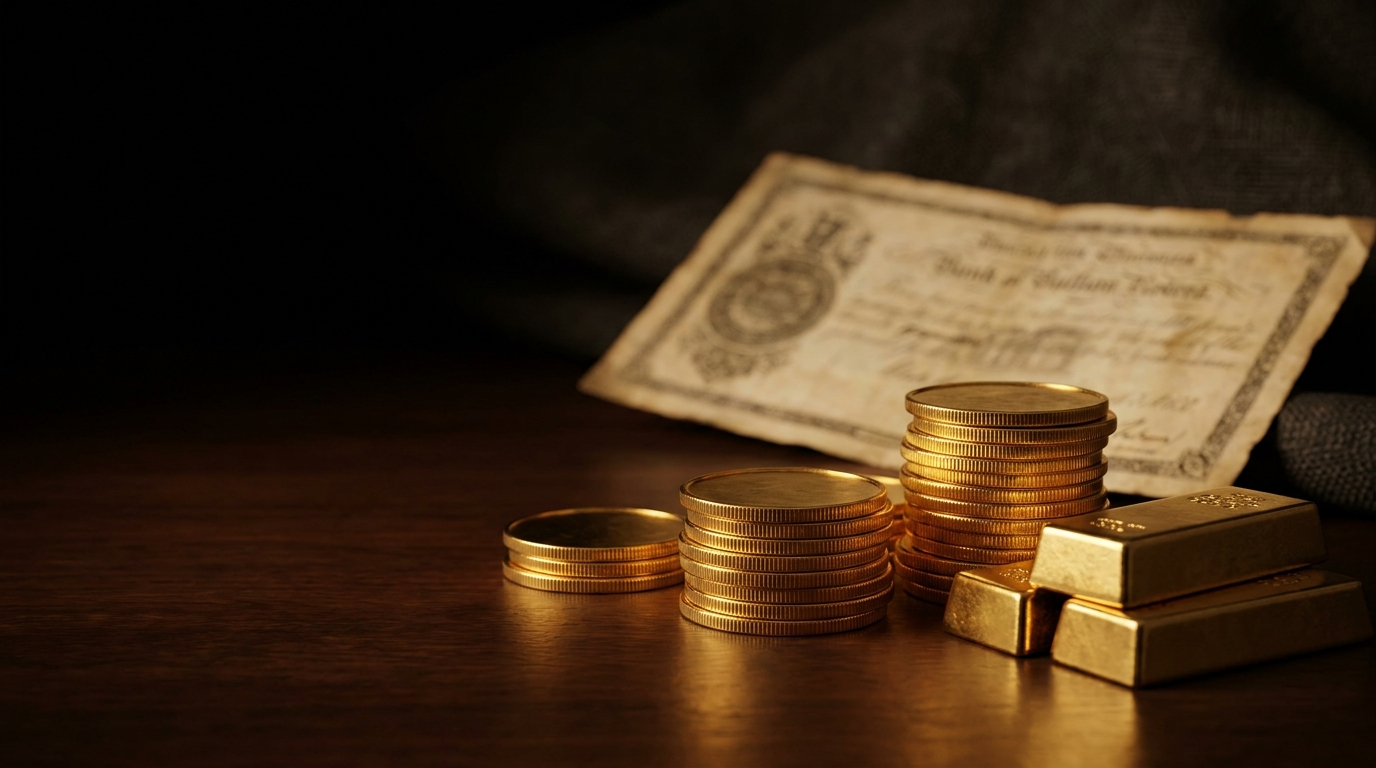
Gold’s 2026 run has revived an old question: what makes money real?
A note before we start: this is historical and educational content, not financial or investment advice. Planet Banknote is not a financial advisor, and nothing here is a recommendation to buy or sell gold or any asset. Prices and forecasts are reported from public sources as of June 2026 and will change.
The short answerGold has surged in 2026 on three forces: heavy central-bank buying, persistent inflation and geopolitical uncertainty, and plain scarcity. It set a record near $5,600 an ounce in late January before easing to roughly $4,000–$4,200 by midyear; J.P. Morgan has maintained a year-end target near $6,000. “Hard money” means money whose value rests on a scarce physical thing (historically gold and silver) rather than on a promise.
Why is gold at record highs in 2026?
Three forces pushed gold to historic levels this year, and they reinforce one another.
Central banks are buying. The world’s central banks have been accumulating gold at roughly double their pace from the prior decade, on the order of 200-plus tonnes a quarter in recent years, with China’s central bank among the most active lately. When the very institutions that issue paper currency are themselves stockpiling metal, the market reads the signal.
Inflation and uncertainty linger. Years of elevated inflation and a run of geopolitical shocks have sent buyers hunting for a store of value that no government can print at will. Gold has played that role for thousands of years, and old habits resurface fast when confidence wobbles.
Supply barely moves. All the gold ever mined would fit in a single cube about 22 metres (72 feet) on a side, and new supply grows only about 1–2% a year. Demand can spike overnight; the supply of gold cannot. That asymmetry is the whole point.
The result: gold reached an all-time high near $5,600 an ounce on January 28, 2026, then settled into a consolidation around $4,000–$4,200 by June, still far above where it traded just a few years ago. J.P. Morgan, for its part, has maintained a year-end 2026 target near $6,000, citing that central-bank demand. That is their forecast, not ours, and forecasts are not guarantees.
What does “hard money” mean?
“Hard money” is money whose value is anchored to a scarce physical commodity, historically gold and silver, rather than to a government’s promise. Its opposite is “fiat” money (from the Latin for “let it be done”): currency that is legal tender because the state declares it so, backed by confidence rather than metal. Every banknote in your wallet today is fiat. For most of recorded history, though, money simply was the metal: coins were valued by their silver or gold content, and paper notes were often just claim checks you could redeem for the real thing. The enduring appeal of hard money fits on a bumper sticker: you can’t print more gold.
What hard money has meant across 250 years of American history
America’s own money tells this story plainly. The Coinage Act of 1792 defined the dollar as a specific weight of silver, and the U.S. Mint’s early coins were valued by their actual precious-metal content. For generations, paper money was a promise you could cash in: silver certificates were redeemable for silver dollars, and gold certificates for gold coin. The country ran on a gold standard for much of its history. That ended in two steps: gold coin was pulled from circulation in 1933, and in 1971 the United States ended the dollar’s convertibility to gold, opening the fully modern, all-fiat era. Those redeemable notes and precious-metal coins didn’t disappear. They became some of the most collected objects in American numismatics: tangible relics of the hard-money age, and the subject of our look at the money Americans carried across 250 years.
“A gold coin and a hyperinflation note are two halves of the same lesson: the difference between money you trust and money you can hold.”
The mirror image: what happens when paper money dies
Here is the part collectors grasp instinctively. The flip side of gold’s enduring appeal is what happens when paper money loses its anchor completely. In Weimar Germany in 1923, prices doubled every few days. In Zimbabwe in 2008, the central bank printed a one-hundred-trillion-dollar note that couldn’t buy a loaf of bread. The pattern always repeats: as confidence in the paper collapses, people reach for anything with intrinsic, tangible value. A gold coin and a hyperinflation banknote are two sides of one truth. One is the instinct working; the other is the warning of what happens without it. That is exactly why a defunct note from Zimbabwe and a gleaming gold coin sit so comfortably in the same collection.
Hard money vs. fiat money, at a glance
| Hard money | Fiat money | |
|---|---|---|
| Backed by | A scarce physical commodity (gold/silver) | Government decree and public confidence |
| Supply | Grows slowly; can’t be printed | Can be created at will |
| Collect it as | Gold/silver coins, silver & gold certificates | Today’s notes (and, at the extreme, hyperinflation issues) |
Holding history, not chasing a trade
None of this is a reason to “play” gold, and we’re not the people to ask if you want to. We’re collectors and historians, not financial advisors. What we can tell you is that the instinct behind 2026’s headlines is the same one that gives this hobby its meaning: the human pull toward money you can actually hold. And you don’t have to time a market to own a piece of that story. A silver certificate or a genuine gold-content coin from the hard-money age, or a hyperinflation note that proves the point in reverse, is tangible monetary history. You own it for what it is and what it witnessed, not for a price target. In a year when the whole world is rediscovering why hard money matters, that’s a fitting thing to collect.
Related reading
· Money Through 250 Years: What Americans Carried at Every Milestone
· Hyperinflation Banknotes: What Happens When Money Loses Its Anchor
Frequently asked questions
Why is gold at record highs in 2026?
Mainly three forces: central banks buying gold at roughly double their prior-decade pace, persistent inflation and geopolitical uncertainty, and limited supply. Gold peaked near $5,600 an ounce in late January 2026, then eased to roughly $4,000–$4,200 by midyear.
What is “hard money”?
Money whose value is anchored to a scarce physical commodity, historically gold and silver, rather than to a government’s promise. Its opposite is fiat money, which is legal tender by decree and confidence, with no metal backing. Every modern banknote is fiat.
Is gold a good investment?
We’re collectors and historians, not financial advisors, so we don’t give investment advice. What we can say is that gold has served as a store of value for thousands of years; how it fits any individual’s finances is a question for a licensed professional.
What’s the difference between hard money and fiat money?
Hard money’s value rests on a physical commodity in limited supply; fiat money is legal tender by government decree, with no metal backing. The U.S. dollar was tied to metal for much of its history and became fully fiat in 1971.
How can collectors own a piece of “hard money” history?
Through genuine gold- and silver-content coins, historic silver and gold certificates (paper once redeemable for metal), and, as the mirror image, authentic hyperinflation banknotes that show what happens when money loses its anchor.
Did gold really hit a record in 2026?
Yes. Gold reached an all-time high near $5,600 per ounce on January 28, 2026, before consolidating to around $4,000–$4,200 by midyear. J.P. Morgan has maintained a year-end target near $6,000, though forecasts are not guarantees.
Sources
· Fortune: Current Price of Gold (June 2026)
· J.P. Morgan Global Research: Gold Price Predictions for 2026 and 2027
· World Gold Council: Gold Prices & Central-Bank Demand
Hold Something Real
The world spent 2026 relearning why hard money matters. Hold a real piece of it:
Shop Silver, Gold & Historic CurrencyExplore Popular Articles

Consecutive Serial Numbers: How to Buy Banknote Lots
Collector's Guide · Buying Guide · Updated October 7, 2026 Consecutive Serial Numbers, Explained: H...

Venezuela 200 Bolívares = 200 Million Old Bolívares
Collector's Guide · World Banknotes · Updated October 7, 2026 Venezuela's 200 Bolívares Note Equals...

Yugoslavia October Dinar 1993: All 10 Notes, Pick 128–137
Monetary History · September 30, 2026 · 8 min read Yugoslavia’s October Dinar, 1993: Six Zeros Off...

Venezuela 1,000,000 Bolívar Note (Pick 114), Explained
Collector’s Guide · September 29, 2026 · 7 min read Venezuela’s 1,000,000 Bolívar Note, Explained:...