
Weimar Notgeld: German Emergency Money 1914–1923
Numismatic Reference · German Hyperinflation · Updated August 2026
Weimar Notgeld: Germany's Emergency Money, 1914–1923
When the German mark collapsed, thousands of towns, companies, and even churches printed their own money — on paper, silk, leather, and wood. Notgeld is the most artistically rich body of paper money ever created, and one of the most affordable ways to collect a world-historical event. Here's the full story, era by era.
Quick answer: Notgeld ("emergency money") is locally issued currency printed in Germany and Austria between roughly 1914 and 1923, when official Reichsbank money was scarce or worthless. Towns, banks, and businesses issued it in waves: small-change notes during WWI, colorful collector series (Serienscheine) in 1920–22, and billion- and trillion-mark notes during the 1923 hyperinflation. Tens of thousands of distinct designs exist, most remain inexpensive, and the miniature-artwork quality of the Serienscheine makes Notgeld one of collecting's best entry points.
What is Notgeld?
Notgeld translates literally as "emergency money" (Not = need or emergency, Geld = money). It was currency issued not by Germany's central bank, but by whoever needed money to exist and couldn't get it: city governments, savings banks, chambers of commerce, factories, mining companies, even POW camps. Legally it occupied a gray zone — tolerated by authorities because the alternative was commerce grinding to a halt.
The phenomenon began in the opening days of World War I. In August 1914, Germans hoarded gold and silver coinage, small change vanished, and towns began printing their own low-denomination notes to keep shops trading. What started as a wartime stopgap evolved over the next decade into something no one planned: the largest, strangest, most artistically ambitious body of paper money ever produced.
What are the main types of German Notgeld?
| Type | Era | What It Is |
|---|---|---|
| 1914 emergency issues | 1914 | Hastily printed small-change notes from the war's first weeks — plain, functional, scarce today |
| Kleingeldscheine | 1916–1922 | Pfennig-denominated small change issued as coins disappeared from circulation |
| Grossgeldscheine | 1918–1921 | Mark-denominated notes covering the postwar cash shortage |
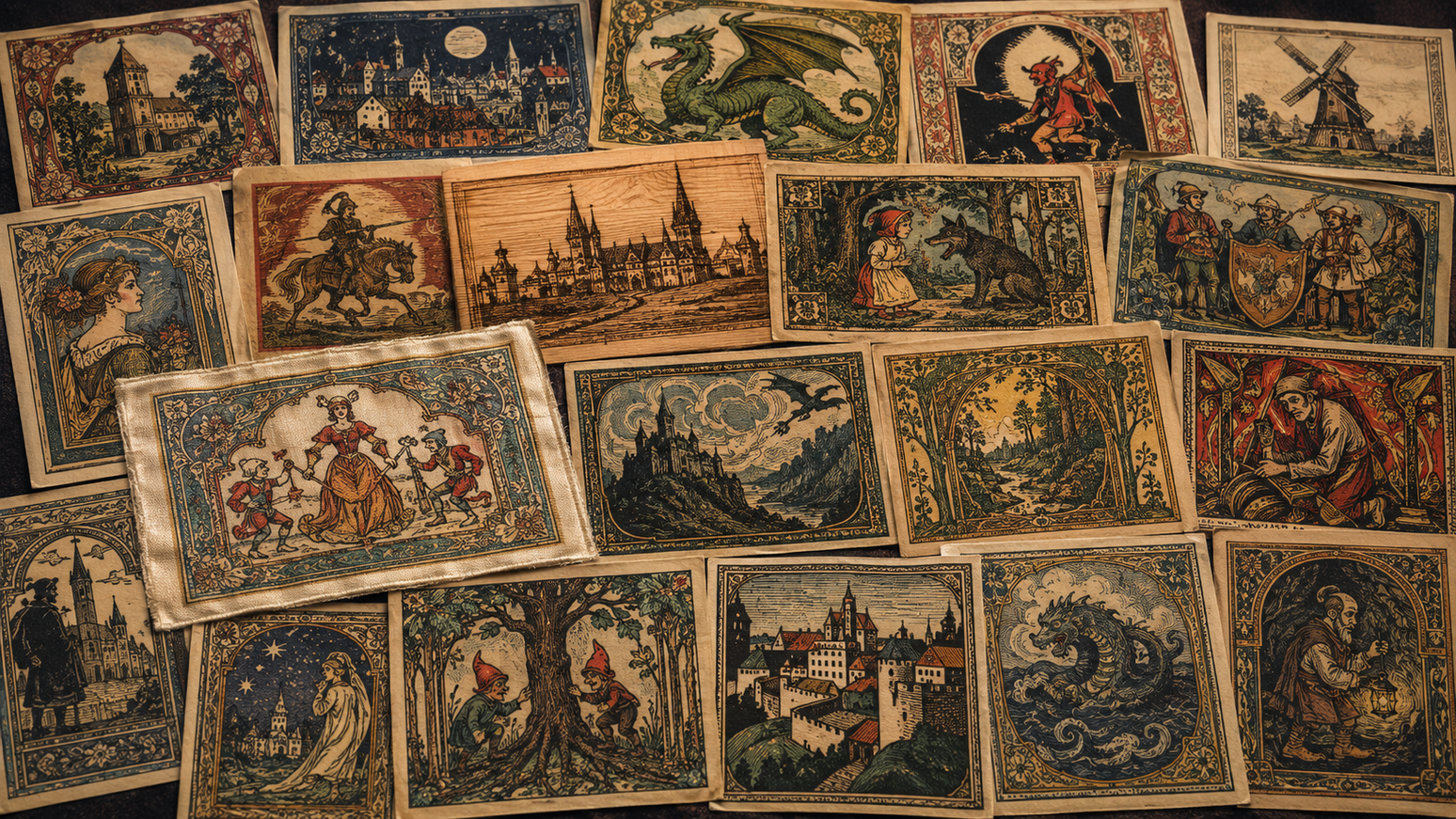
| Serienscheine | 1918–1922 | Pictorial "series notes" designed for collectors — folklore, fairy tales, satire, local landmarks |
| Inflation Notgeld | 1922–1923 | Million-, billion-, and trillion-mark emergency notes from the hyperinflation's peak |
| Wertbeständiges Notgeld | 1923–1924 | "Stable-value" notes denominated in gold marks, U.S. dollars, or even rye and wheat |
Why are Serienscheine the most collected Notgeld?
By 1920, town treasurers had noticed something odd: collectors were buying their emergency notes and never redeeming them. Every unredeemed note was free revenue. So municipalities began issuing notes designed never to circulate — vividly illustrated series depicting Grimm fairy tales, the Pied Piper of Hamelin, local legends, medieval skylines, and pointed political satire, often commissioned from serious graphic artists. These Serienscheine ("series notes") were sold to collectors in complete sets, sometimes with the redemption deadline already expired.
The result is paper money's version of a golden age of illustration: thousands of miniature artworks in expressionist, art nouveau, and folk styles that no central bank would ever have approved. A century later, they remain astonishingly affordable — most Serienscheine survive in uncirculated condition precisely because they were never meant to be spent.
Serienscheine were money that was never meant to be spent — which is exactly why they survive today as crisp, hundred-year-old works of art.
What happened to Notgeld during the 1923 hyperinflation?
In 1923, the mark went into free fall. Reparations pressure, the French occupation of the Ruhr, and unrestrained money printing pushed prices into absurdity — by November 1923, a loaf of bread cost roughly 428 billion marks. The Reichsbank's presses physically could not keep up, so the government authorized cities, districts, and large companies to print their own high-denomination notes. This inflation Notgeld is the rawest artifact of the collapse: overprinted denominations, hasty single-color designs, and face values climbing from millions to milliarden (billions) to billionen (trillions) in months. A single town like Duderstadt could issue a 1 trillion mark note — a denomination that would have been unthinkable eighteen months earlier.
The endgame produced the strangest chapter of all: wertbeständiges Notgeld, "stable-value" emergency money denominated in gold marks, U.S. dollars, or commodities like rye — a public admission that paper marks had ceased to be a unit of account. The introduction of the Rentenmark in November 1923 finally stabilized the currency, and Notgeld faded away, leaving behind an estimated tens of thousands of distinct issues from thousands of localities. The full universe has never been definitively counted; Arnold Keller's foundational catalog of the 1923 inflation issues alone runs some 1,200 pages, and Hans-Ludwig Grabowski's modern catalogs continue the work today.
Was Notgeld really printed on silk, leather, and wood?
Yes — and this is where Notgeld becomes unlike anything else in numismatics. Materials shortages and collector demand pushed issuers to print money on whatever held ink:
- Silk, linen, and velvet
- The city of Bielefeld, a textile center, issued its famous Stoffgeld ("fabric money") on silk and linen — including ornate commemorative pieces now prized as the aristocrats of Notgeld collecting.
- Leather
- Several towns issued small leather notes, a nod to local tanning industries.
- Wood and playing cards
- Thin wooden veneer notes and overprinted playing cards circulated where paper ran short.
- Porcelain
- Saxony's state porcelain works at Meissen produced red-brown Böttger stoneware and white porcelain emergency coinage — money you could shatter.
How do you start collecting Weimar Notgeld?
Notgeld may be the friendliest serious specialty in paper money. There is no gatekeeping price of admission: attractive uncirculated Serienscheine can be had for a few dollars each, which means a new collector can build a genuinely beautiful hundred-note collection for less than the cost of a single mid-grade U.S. type note. Sensible ways in:
Collect by theme. Fairy tales, dragons, windmills, ships, satire of profiteers and politicians — pick a thread and follow it across hundreds of towns. Collect by region. Choose an area your family came from and assemble its towns' issues. Collect by material. A type set spanning paper, linen, silk, leather, and wood makes the most visually arresting display in the hobby. Or collect the collapse itself. A denomination run from 25 pfennig to 1 trillion marks tells the entire Weimar story on one album page — the same arc our reference on Zimbabwe's 2008 Agro Cheques traces eight decades later.
Condition still matters: uncirculated is the norm for Serienscheine, so damaged examples are worth little, while genuinely circulated wartime and inflation issues are honest history. Store them properly from day one — see our guide to storing and preserving banknotes — and if you're new to world paper generally, start with the beginner's guide to world banknote collecting.
Frequently Asked Questions
What does Notgeld mean?
Notgeld is German for "emergency money" — locally issued currency printed by towns, banks, and businesses between roughly 1914 and 1923, when official money was scarce or worthless.
How many different Notgeld notes exist?
Tens of thousands of distinct issues from thousands of localities — the universe has never been definitively counted. Arnold Keller's catalog of the 1923 inflation issues alone runs roughly 1,200 pages.
What are Serienscheine?
"Series notes" issued from 1918 to 1922, designed and sold for collectors rather than circulation. They feature fairy tales, local legends, and artwork by serious illustrators, and most survive in uncirculated condition.
Was Notgeld legal money?
It occupied a tolerated gray zone. It wasn't Reichsbank currency, but authorities permitted it because local commerce depended on it — and in 1923 the government explicitly authorized towns and companies to issue high-denomination emergency notes.
What ended the Notgeld era?
The Rentenmark currency reform of November 1923 stabilized German money. With a trusted national currency restored, emergency issues were redeemed, banned, or simply abandoned to collectors.
Is Weimar Notgeld the same as Weimar hyperinflation banknotes?
No. Reichsbank inflation notes (like the 100 trillion mark national issues) were official central-bank currency. Notgeld is the parallel world of local and private emergency money — though in 1923 the two streams ran side by side, and many collectors pursue both.
Sources
Background draws on the University of Chicago Library's Notgeld Collection guide (1914–1923), the Smithsonian National Museum of American History's hyperinflation exhibit, the Library of Congress collection of German emergency money, 1914–1924, and the standard Keller and Grabowski catalog literature.
Start Your Notgeld Collection
Curated 1920s Germany Notgeld variety packs — dozens of authentic century-old notes per set, hand-assembled from our Sarasota inventory.
SHOP NOTGELD VARIETY PACKSExplore Popular Articles

Consecutive Serial Numbers: How to Buy Banknote Lots
Collector's Guide · Buying Guide · Updated October 7, 2026 Consecutive Serial Numbers, Explained: H...

Venezuela 200 Bolívares = 200 Million Old Bolívares
Collector's Guide · World Banknotes · Updated October 7, 2026 Venezuela's 200 Bolívares Note Equals...
Yugoslavia October Dinar 1993: All 10 Notes, Pick 128–137
Monetary History · September 30, 2026 · 8 min read Yugoslavia’s October Dinar, 1993: Six Zeros Off...

Venezuela 1,000,000 Bolívar Note (Pick 114), Explained
Collector’s Guide · September 29, 2026 · 7 min read Venezuela’s 1,000,000 Bolívar Note, Explained:...