
Hyperinflation Note vs. High-Denomination Note: The Difference Explained
Collector's Reference · May 19, 2026 · 10 min read
Hyperinflation Note vs. High-Denomination Note: What’s the Difference (And Why It Matters for Collectors)
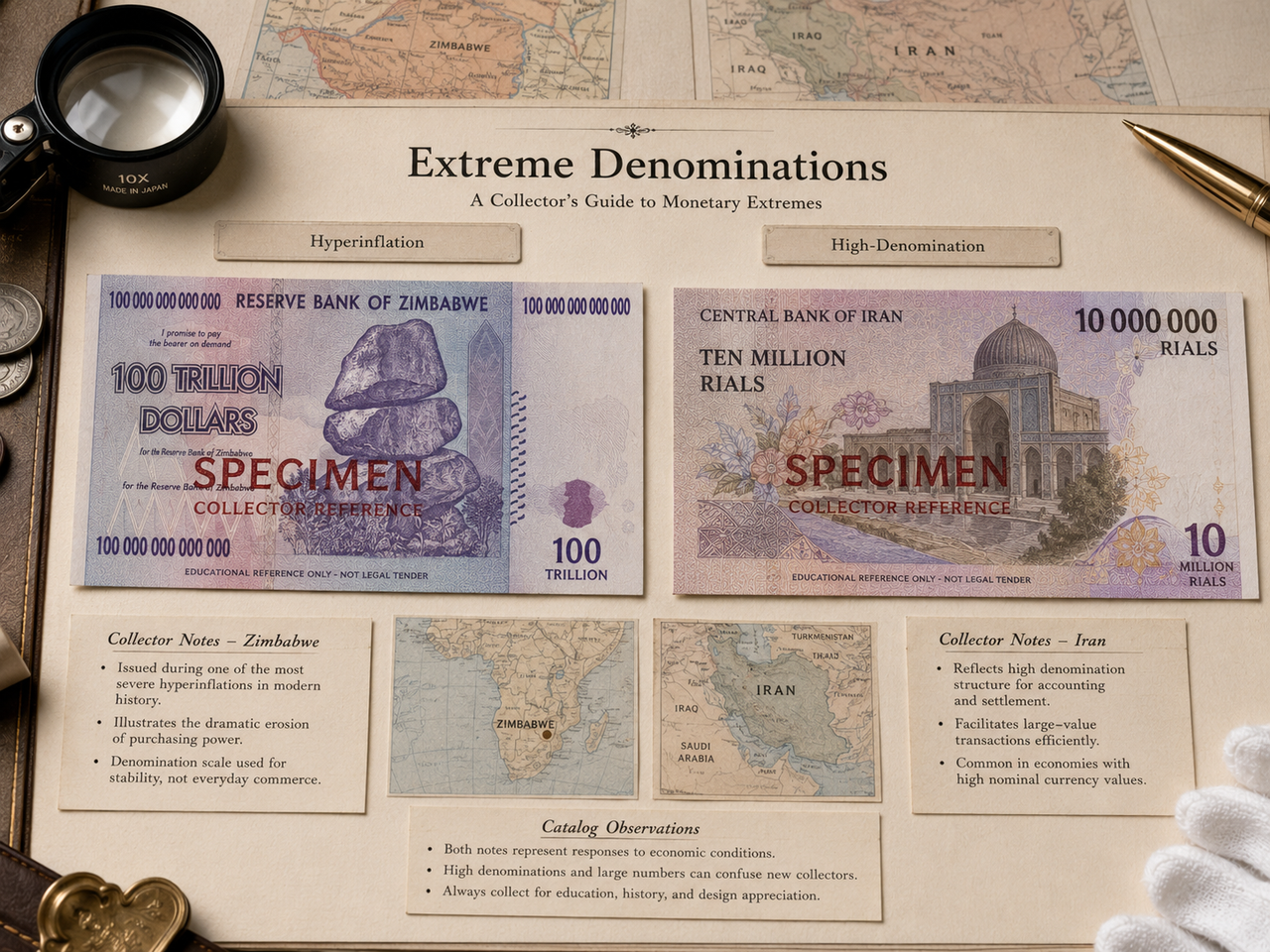
Every collector has asked it eventually: is the Iran 10 Million Rial a hyperinflation note? Is the Zimbabwe 100 Trillion just a really big banknote? The distinction matters — here’s why.
What is a hyperinflation note?
The technical definition comes from American economist Phillip Cagan, who in 1956 proposed the standard academic threshold: a country is in hyperinflation when its monthly inflation rate exceeds 50%. A banknote is considered a hyperinflation note if it was issued and circulated during such a period.
Hyperinflation is a rare and historically destructive economic event. It tends to be associated with specific kinds of crises — the collapse of an empire, the loss of a war, a political upheaval, or the breakdown of a central bank’s credibility. Because hyperinflation typically forces central banks to print ever-larger denominations to keep up with collapsing purchasing power, hyperinflation notes are almost always also high-denomination notes. But the inverse is not true.
Famous hyperinflation episodes that produced collectible notes include:
- Weimar Germany, 1922–1923 — Reichsmark and Notgeld emergency issues; peak monthly inflation around 29,500%
- Hungary, 1945–1946 — the pengő, with the highest hyperinflation ever recorded; peak daily inflation of roughly 207%
- Yugoslavia, 1992–1994 — the dinar; peak monthly inflation around 313 million percent
- Zimbabwe, 2007–2008 — the Zimbabwean dollar; peak monthly inflation estimated at 79.6 billion percent
- Venezuela, 2017–2021 — multiple bolivar series; sustained hyperinflation across roughly four years
Notes from these episodes form the core of what most collectors mean when they say “hyperinflation note.” The 100 Trillion Zimbabwe, the Hungarian 100 quintillion pengő, and the 500 Billion Yugoslav dinar are recognized worldwide as canonical examples.
What is a high-denomination note?
A high-denomination note is any banknote with a large face value — typically interpreted as carrying six or more zeros. The key difference: high-denomination notes are not defined by hyperinflation. They can be issued in any of several contexts:
- Sustained moderate inflation over a long period eventually pushes everyday transactions into the millions. The currency hasn’t collapsed in a hyperinflation event, but inflation has compounded enough that high-denomination notes become necessary for routine commerce. The modern Iranian Rial is a textbook example.
- Internal accounting or interbank use. Some countries have issued high-denomination notes intended for bank-to-bank settlement rather than public circulation. The U.S. once issued $10,000 and $100,000 notes for this purpose.
- Commemorative or ceremonial issues. Some central banks issue large-face-value notes as commemorative items, not as transactional currency.
An important nuance: a country can have high-denomination notes without being in hyperinflation, and a country can be in hyperinflation without the highest-denomination notes you might expect (if the hyperinflation episode is short or the central bank loses control of printing).
Hyperinflation vs. high-denomination: a side-by-side comparison
| Aspect | Hyperinflation Note | High-Denomination Note |
|---|---|---|
| Definition | Issued during monthly inflation > 50% | Large face value, any economic context |
| Economic context | Crisis, often political/wartime | Sustained inflation, banking, or commemorative |
| Circulation life | Often months or weeks before being demonetized | Years or decades |
| Catalog category | Often tied to a specific monetary regime change | Part of a regular issued series |
| Supply dynamics | Fixed once the episode ends | Variable — still being issued |
| Iconic examples | Zimbabwe 100T, Hungary 100 quintillion pengő, Yugoslavia 500B dinar | Iran 10M Rial, Vietnam 500,000 Dong, Indonesia 100,000 Rupiah |
Real-world examples: which category does each note belong to?
Some of the most commonly collected notes can be ambiguous. Here’s a quick reference for the canonical cases:
| Note | Year | Category | Why |
|---|---|---|---|
| Zimbabwe 100 Trillion Dollar | 2008 | Hyperinflation | Issued during 79.6 billion % monthly inflation |
| Yugoslavia 500 Billion Dinar | 1993 | Hyperinflation | Issued during 313M % monthly inflation |
| Hungary 100 Quintillion Pengő | 1946 | Hyperinflation | Highest hyperinflation ever recorded |
| Venezuela 100 Million Bolivar | 2021 | Hyperinflation | Issued during the 2017–2021 hyperinflation episode |
| Venezuela 500 Million Bolivar | 2023 | Hyperinflation | Post-hyperinflation tail of the same episode |
| Iran 10 Million Rial Cheque | 2026 | High-Denomination | Elevated but not hyperinflationary inflation |
| Vietnam 500,000 Dong | 2003 | High-Denomination | Issued under moderate sustained inflation |
| US $100,000 Gold Certificate | 1934 | High-Denomination | Interbank settlement; never publicly circulated |
A hyperinflation note tells you a country’s monetary system broke. A high-denomination note tells you it’s under stress. The distinction is the story.
Every documented hyperinflation episode, ranked by peak monthly rate, is catalogued in the complete hyperinflation ranking in our reference library.
Why the distinction matters for collectors
For a collector building a focused, coherent collection, knowing whether a given note belongs to the hyperinflation category or the high-denomination category affects several things:
- Thematic coherence. A “modern hyperinflation episodes” collection has a specific scope — you’re collecting artifacts of a defined economic phenomenon. Mixing in high-denomination notes that look like they belong dilutes the theme.
- Long-term supply dynamics. Hyperinflation notes have fixed supply because the episode ended. High-denomination notes may still be in active issuance — the Central Bank of Iran could print more 10 Million Rial cheques next year. This affects long-term scarcity expectations.
- Historical significance. Hyperinflation notes are tied to specific named historical events (the Zimbabwe inflation crisis of 2008, the Venezuelan crisis of 2017–2021). High-denomination notes are part of a continuous monetary regime. Both have value, but the historical anchoring is different.
- Catalog and reference treatment. Numismatic catalogs (Krause/Pick, NGC, PMG) generally treat hyperinflation issues as a distinct category and may give them dedicated sections, while high-denomination notes are filed as part of the regular series.
The grey zone: notes that sit between categories
Not every note falls cleanly on one side. Three notable grey-zone examples:
The 2021 Venezuelan Digitale series. Venezuela’s 2017–2021 hyperinflation officially ended around late 2021. Notes issued in the immediate aftermath — like the 500 Million Bolivar Digitale of 2023 — are sometimes catalogued as hyperinflation issues (because they were a direct response to the episode) and sometimes as post-hyperinflation high-denomination issues. Both framings have merit.
The 1923 Weimar Notgeld. Emergency money (Notgeld) issued by German municipalities during the 1923 hyperinflation isn’t technically state-issued currency, but functionally it operated as money during the crisis. Some catalogs treat it as hyperinflation currency; others treat it as a separate emergency-issue category.
The 2026 Iranian Rial cheques. Iran’s inflation has been persistently elevated for over a decade without crossing the formal hyperinflation threshold. The 2026 5 Million and 10 Million Rial cheques are technically high-denomination notes — but they exist because of sustained currency depreciation that, in less stable countries, would have produced full hyperinflation.
For the high-denomination side of that line, see the highest denomination banknote ever printed.
Frequently Asked Questions
What is the difference between a hyperinflation note and a high-denomination note?
A hyperinflation note was issued during a period of monthly inflation exceeding 50% — Cagan’s threshold for hyperinflation. A high-denomination note simply carries a large face value but may have been issued under stable monetary conditions. The Zimbabwe 100 Trillion is a hyperinflation note; the Iran 10 Million Rial Cheque is a high-denomination note.
What makes a banknote a hyperinflation note?
The standard academic definition, from economist Phillip Cagan, is monthly inflation exceeding 50% during the period when the note circulated. By this measure, the 1946 Hungarian pengő, the 2008 Zimbabwean dollar, and the 2018 Venezuelan Bolivar Soberano qualify.
Is the Iran 10 Million Rial a hyperinflation note?
No. While the Iranian Rial has lost significant value over time and inflation has been elevated, Iran has not officially entered hyperinflation by Cagan’s monthly-50% definition. The 10 Million Rial is a high-denomination note, not a hyperinflation note.
Why does the distinction matter for collectors?
Hyperinflation notes occupy a defined category in numismatic literature — they’re tied to specific historical economic crises and have generally outperformed pure high-denomination notes in long-term collector interest. Understanding which category a note belongs to helps collectors build coherent themed collections and evaluate long-term significance.
What is the highest-denomination banknote ever issued?
The 1946 Hungarian 100 quintillion pengő (100,000,000,000,000,000,000 — twenty zeros) holds the record. It was issued as a one-day adjustment note and was technically never circulated. The highest-denomination note actually used in transactions is the Zimbabwean 100 trillion dollar note from 2008.
Can a note be both hyperinflation and high-denomination?
Yes — most famous hyperinflation notes are also extremely high-denomination because hyperinflation forces central banks to print larger and larger face values. The Zimbabwe 100 Trillion is both. The terms describe different aspects of the note: hyperinflation describes the economic context of its issuance, while high-denomination describes its face value.
Sources & Further Reading
- Cagan, Phillip. The Monetary Dynamics of Hyperinflation (1956)
- Hanke, Steve and Krus, Nicholas. World Hyperinflations (2013)
- The 5 Worst Hyperinflations in History — A Collector’s Guide
- What is PMG Grading? — A Collector’s Guide
Browse the Collection
Hyperinflation & High-Denomination Notes from Around the World
Explore the Store →Explore Popular Articles

Consecutive Serial Numbers: How to Buy Banknote Lots
Collector's Guide · Buying Guide · Updated October 7, 2026 Consecutive Serial Numbers, Explained: H...

Venezuela 200 Bolívares = 200 Million Old Bolívares
Collector's Guide · World Banknotes · Updated October 7, 2026 Venezuela's 200 Bolívares Note Equals...

Yugoslavia October Dinar 1993: All 10 Notes, Pick 128–137
Monetary History · September 30, 2026 · 8 min read Yugoslavia’s October Dinar, 1993: Six Zeros Off...

Venezuela 1,000,000 Bolívar Note (Pick 114), Explained
Collector’s Guide · September 29, 2026 · 7 min read Venezuela’s 1,000,000 Bolívar Note, Explained:...