
Syria's New 500-Pound Note: 2026 Redenomination Guide
Collector's Reference · May 19, 2026 · 7 min read
Syria’s 2026 Pound Redenomination Explained: What the New 500 Pound Note Means
A 100-to-1 currency reset and the first-issue legal tender note that marks it — what collectors need to know about the most consequential Syrian monetary event in a generation.
What is the 2026 Syrian Pound redenomination?
A redenomination is a monetary reform in which a central bank declares that a new unit of currency replaces the old at a fixed conversion rate — in this case, one new Syrian Pound is equivalent to 100 old Pounds. The conversion is administrative, not economic: the total purchasing power of money in circulation doesn’t change. Only the labels do.
For consumers in Syria, the practical effect is that a loaf of bread that used to cost 5,000 Pounds now costs 50. A 50,000-Pound bill becomes a 500. The transition reduces the inconvenience of carrying and accounting for transactions denominated in tens of thousands, and over time it simplifies bookkeeping, pricing displays, and the design of new banknotes.
For collectors, the redenomination is a permanent historical marker. The predecessor notes — the Syrian Pound issues that circulated through the 2010s and early 2020s — become a closed series. Supply of those notes is now fixed, and they enter the secondary market as historical artifacts rather than active currency.
The 2026 500 Pound Note: specifications and significance
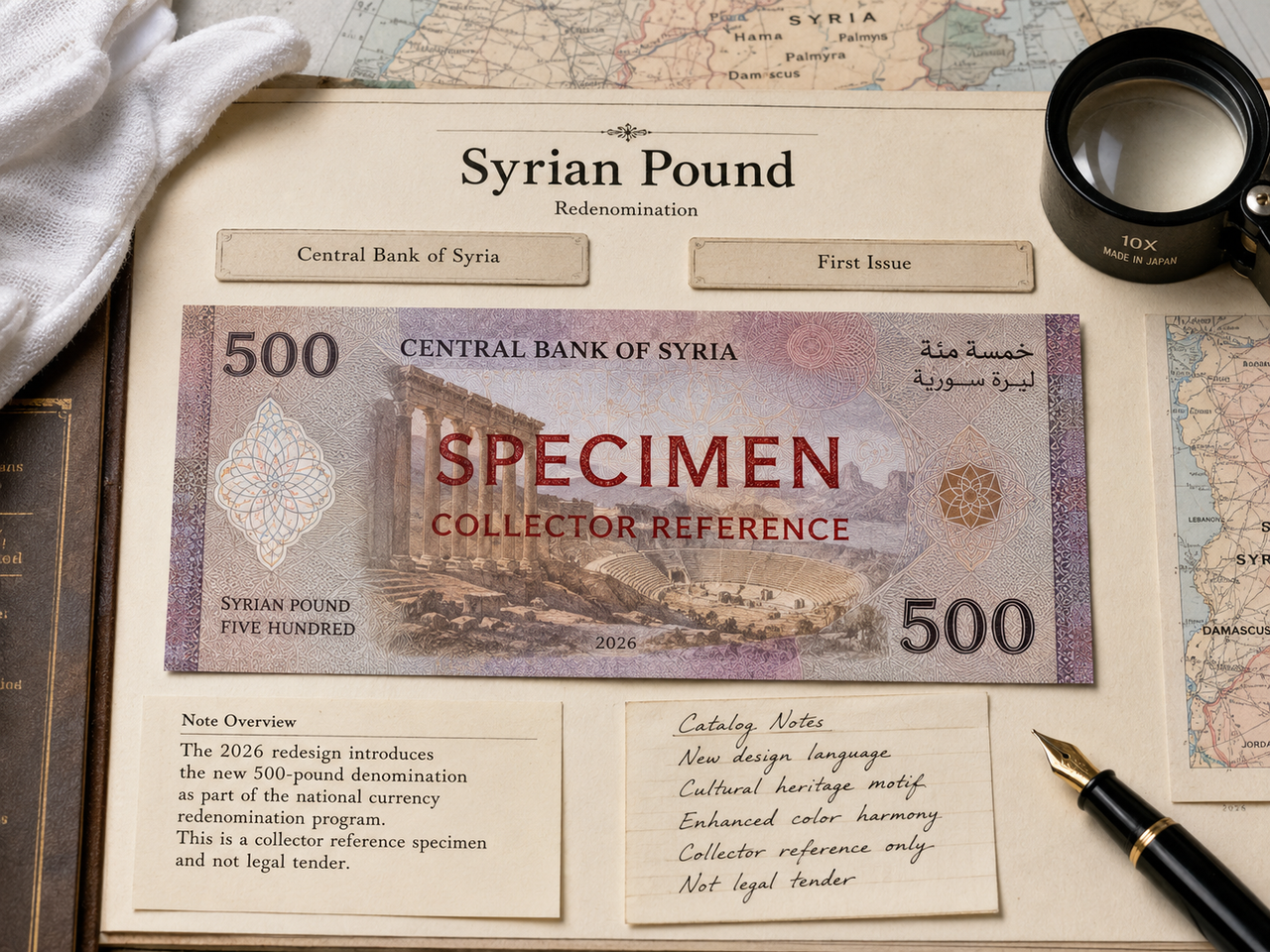
The new 500 Pound note is the first paper money issued under the redenominated Syrian Pound series. As the first-issued denomination of a new monetary regime, it carries unique historical weight regardless of its eventual circulation life.
| Specification | Detail |
|---|---|
| Denomination | 500 Syrian Pounds (new series) |
| Old-series equivalent | 50,000 Syrian Pounds |
| Issuing authority | Central Bank of Syria |
| Year of issue | 2026 |
| Conversion ratio | 100:1 (old to new) |
| Status | Legal tender, current series |
| Collectibility | First-issue, new monetary regime |
First-issue redenomination notes have a strong historical track record as collectible artifacts. They occupy a clearly bounded category in catalogs, they mark the start of a new Pick series, and they tend to outperform later issues of the same denomination in long-term numismatic interest.
How redenomination compares across countries
Syria’s 2026 redenomination is part of a broader pattern of currency resets that have taken place across multiple economies over the past several decades. Each was driven by sustained inflation that pushed routine transactions into inconveniently large denominations, and each produced a similar transition note that collectors now treasure.
| Country | Year | Ratio | Currency Transition |
|---|---|---|---|
| Turkey | 2005 | 1,000,000:1 | Lira → New Lira |
| Venezuela | 2008 | 1,000:1 | Bolivar → Bolivar Fuerte |
| Venezuela | 2018 | 100,000:1 | Bolivar Fuerte → Bolivar Soberano |
| Venezuela | 2021 | 1,000,000:1 | Soberano → Digitale |
| Zimbabwe | 2024 | N/A (new currency) | Zimbabwe Dollar → ZiG |
| Syria | 2026 | 100:1 | Old Pound → New Pound |
A useful frame: Turkey’s 1,000,000:1 reset in 2005 was one of the largest single redenomination events in modern history, and the first-issue New Turkish Lira notes are now among the most-collected modern Turkish issues. Venezuela’s three separate redenominations between 2008 and 2021 generated multiple highly collectible first-issue series. Syria’s 2026 reset places it firmly within this lineage.
Every collectible currency reset produces one note that catches the moment — the first-issued denomination of the new series. For Syria in 2026, that note is the 500 Pound.
Why first-issue redenomination notes are collectible
Three structural reasons collectors place a premium on first-issue redenomination notes:
- The predecessor series is permanently closed. Once a currency is redenominated, the old notes can no longer be issued. Whatever quantity existed at the date of demonetization is the final supply. That fixed-supply dynamic is foundational to long-term numismatic value.
- The new note begins a fresh Pick series. Standard cataloging conventions assign new Pick (P-) numbers to redenominated notes. The first-issued denomination of a new series carries the lowest catalog number of that series — a position of permanent historical primacy.
- The transition note is a historical artifact. Currency redenominations are tied to specific historical moments — usually a period of sustained inflation, sometimes a political transition. The first-issue note is a physical record of that turning point.
For a collector building a focused thematic collection — “modern redenominations of the early 21st century” or “currency reform first-issues” — the 2026 Syria 500 Pound is a logical inclusion alongside the Turkish New Lira, the Venezuelan Bolivar series, and the Zimbabwean ZiG.
What collectors should look for in a 2026 Syria 500 Pound
Two practical notes for collectors evaluating the 2026 issue:
Condition matters more than usual for new issues. Because the note is newly released, the market expects uncirculated examples to be the baseline. Pay attention to corner sharpness, paper crispness, and the absence of fold marks or counting flicks. A circulated example of a brand-new note is unusually penalized in the market.
Serial number prefix may matter long-term. Modern central banks typically open a new series with low-prefix serial numbers (often A/1 or similar). Notes with the earliest prefix tend to command modest premiums in mature secondary markets. It’s too early to know which prefixes will be most coveted for the 2026 Syria issue, but it’s worth noting your note’s prefix if you acquire one.
Frequently Asked Questions
What is the 2026 Syrian Pound redenomination?
The Central Bank of Syria carried out a 100-to-1 redenomination of the Syrian Pound in 2026, removing two zeros from circulating denominations. The new 500 Pound note is equivalent in purchasing power to the old 50,000 Pound note.
What does 100:1 redenomination mean?
Each new Pound equals 100 old Pounds. Citizens and banks exchange currency at that fixed ratio for a transition period. The total economic value of money in circulation does not change — only the face value labels do.
Why did Syria redenominate?
Syria’s currency had lost most of its purchasing power over a decade of conflict and economic disruption, leading to inconveniently large numbers on routine transactions. Redenomination simplifies pricing, accounting, and cash handling.
Are the old Syrian Pound notes still legal tender?
Old Pound notes typically remain legal tender during a transition period — usually six to twelve months — after which they must be exchanged at banks. Specific timelines vary by country and were detailed in the Central Bank of Syria’s announcement.
Why are first-issue redenomination notes collectible?
First-issue redenomination notes mark a permanent monetary event. The supply of demonetized predecessor notes becomes fixed, the new design enters numismatic catalogs as a new series, and collectors view the transition note as a historical artifact of the currency reset.
How does this redenomination compare to Zimbabwe’s ZiG launch?
Zimbabwe’s 2024 ZiG launch was a more comprehensive monetary reform — introducing an entirely new currency unit pegged to gold reserves rather than redenominating the existing dollar. Syria’s 2026 reform is a pure redenomination, keeping the Pound as the unit and adjusting only the scale.
Sources & Further Reading
- Central Bank of Syria — Official Site
- Krause/Pick — Standard Catalog of World Paper Money, Modern Issues
- The 5 Worst Hyperinflations in History — A Collector’s Guide
Explore Popular Articles

Venezuela 500 Bolívares = 500 Million Old Bolívares
Collector's Guide · World Banknotes · October 2026 Venezuela's 500 Bolívares Note Equals 500 Millio...

Iran's Four-Zero Redenomination: A Timeline
Collector's Guide · World Banknotes · October 2026 Iran Is Removing Four Zeros From the Rial: The T...

Consecutive Serial Numbers: How to Buy Banknote Lots
Collector's Guide · Buying Guide · Updated October 7, 2026 Consecutive Serial Numbers, Explained: H...

Venezuela 200 Bolívares = 200 Million Old Bolívares
Collector's Guide · World Banknotes · Updated October 7, 2026 Venezuela's 200 Bolívares Note Equals...