
Money Through America's 250 Years: 1776 to 2026
Numismatic Reference · June 2026 · 9 min read
Money Through 250 Years: What Americans Carried at Every Milestone (1776–2026)
For 250 years, the quickest way to understand America has been to look at what was in its pockets. From hand-signed Continental bills that funded a revolution to the redesigned coins jingling in your change in 2026, the nation’s money is a running diary of who Americans were at each turn. Here is what they carried at every 50-year milestone — and how a collector can hold a real piece of each one.
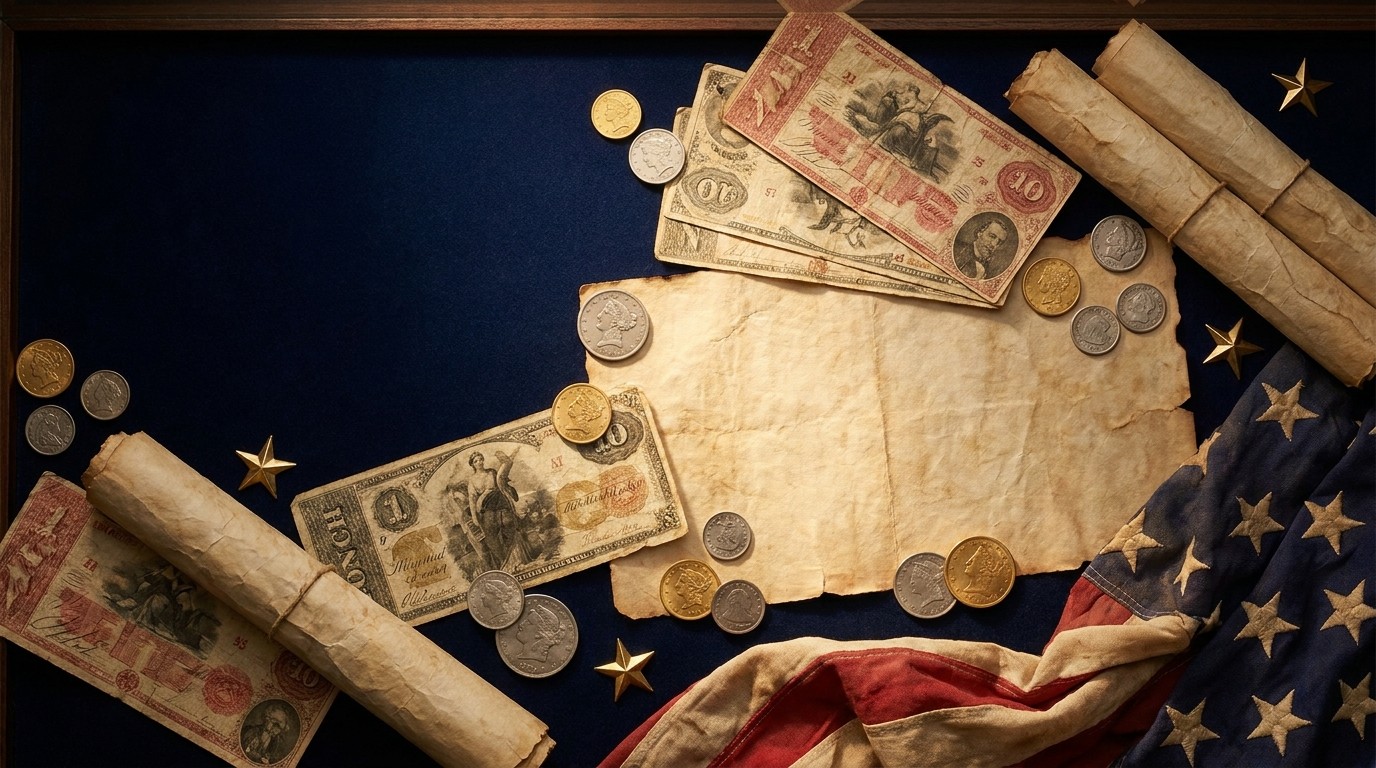
Two and a half centuries of American money, from the founding to the Semiquincentennial.
The short answerAcross 250 years, American money evolved from Continental currency and Spanish silver dollars (1776), to the gold-and-silver coins and bank notes of the 1800s, the large-size silver certificates of the early 1900s, the Bicentennial coins of 1976, and the Semiquincentennial redesign of 2026. Each era left behind paper and metal that collectors can still own — a tangible timeline of the country’s first quarter-millennium.
1776: Continental currency and Spanish silver dollars
At the founding there was no Federal Reserve, no national mint, and no dollar bill as we know it. The money of the Revolution was Continental currency — paper bills of credit issued by the Continental Congress beginning in 1775 to pay for the war. Denominated in dollars but backed only by the hope of victory, they were printed in enormous quantities and depreciated so badly they gave us the phrase “not worth a Continental.” Circulating right alongside them was the real workhorse of colonial commerce: the Spanish silver dollar, or “piece of eight,” often physically cut into wedges to make change — the literal origin of “two bits” for a quarter. There was even a 1776 Continental dollar, a large pewter or silver pattern coin bearing Benjamin Franklin’s mottoes “Mind Your Business” and a chain of thirteen linked colonies.
What you can own: a genuine Continental or colonial note is about as close as paper gets to the Revolution itself — currency that may once have paid a Continental soldier.
1826: the age of the silver half dollar
Fifty years in, the young republic still issued no federal paper money — and wouldn’t for decades. Everyday money meant coins from the U.S. Mint (founded 1792) plus a patchwork of notes from state-chartered banks and the Second Bank of the United States. The silver coin Americans actually used was the Capped Bust half dollar, the high-value workhorse of the era, joined by hefty copper large cents you could feel in your palm and those ever-present Spanish silver dollars, which stayed legal tender until 1857. Paper money was a gamble: a note from a distant or shaky bank might trade well below face value, and counterfeits were everywhere.
What you can own: a Capped Bust half dollar or a large copper cent from the 1820s is affordable, genuinely old, and a direct handshake with the America of its day.
1876: greenbacks, National Bank Notes, and the Centennial
By the 100th anniversary, the Civil War had transformed American money forever. To fund the Union, the Treasury issued the first federal paper dollars — United States Notes, nicknamed “greenbacks” for their green-inked backs — and then created the National Bank Note, a uniform federal currency issued by thousands of local “national” banks, each bill proudly carrying its hometown bank’s name and charter number. Coins had vanished into hoards during the war, so the government even printed Fractional Currency: small paper notes worth as little as three cents. As the country threw itself a 100th-birthday party at the great Philadelphia Centennial Exposition of 1876, Seated Liberty silver and a short-lived twenty-cent piece filled the tills. American money had become, for the first time, recognizably national.
What you can own: a large-size National Bank Note names a specific American town and year — a hometown time capsule you can hold in one hand.
1926: silver certificates and the Sesquicentennial
At 150 years, Americans carried “large-size” notes — bills about a third bigger than today’s, nicknamed “horse blankets.” The most common was the Series 1923 $1 silver certificate, a handsome note once redeemable for a silver dollar and bearing a stately portrait of Washington. Federal Reserve Notes (introduced in 1914) and gold certificates rounded out the wallet, while pocket change held some of the most beloved coins ever struck: the Buffalo nickel, Mercury dime, Standing Liberty quarter, Walking Liberty half dollar, and Peace dollar. For the 150th birthday, the Mint issued a 1926 Sesquicentennial commemorative half dollar — unusual for portraying two presidents, George Washington and the then-living Calvin Coolidge, making it the only U.S. coin ever to depict a sitting president. Just two years later, in 1928, paper money shrank to the small size we still use.
What you can own: a crisp Series 1923 $1 silver certificate is one of the most attainable pieces of classic American paper — large, ornate, and unmistakably of its era.
1976: the Bicentennial coins and the return of the $2 bill
The 200th anniversary gave many of us the first money we remember as historic: the 1776–1976 dual-dated coins. The Mint redesigned three circulating coins for the occasion — a quarter showing a colonial drummer boy, a half dollar featuring Independence Hall, and a dollar with the Liberty Bell superimposed over the moon, a fitting emblem for a nation that had reached for both. The Treasury also reintroduced the $2 bill in 1976, refreshed with John Trumbull’s painting of the signing of the Declaration of Independence on the reverse. Hundreds of millions were made, so most are common today — but they are the keepsakes an entire generation set aside, and fifty years on they’re still affectionately collected.
What you can own: Bicentennial quarters, halves, and dollars are inexpensive and easy to find — a perfect first “anniversary” coin — and a 1976 $2 bill is a pocket-sized piece of the party.
2026: the Semiquincentennial redesign
Which brings us to now. To mark 250 years — the Semiquincentennial — the U.S. Mint has carried out its broadest circulating coin redesign since 1976, with every coin from the cent to the half dollar stamped with the dual date 1776–2026. The dime gained an all-new Liberty portrait and an eagle reverse; the quarter rotates through five reverses tracing American self-government from the Mayflower Compact to the Gettysburg Address; the nickel keeps Jefferson and adds the anniversary date; and the cent and half dollar appear only in collector sets. A premium “Best of the Mint” series even reissues historic designs in 24-karat gold with a Liberty Bell “250” privy mark. Like the Bicentennial coins before them, these are struck for one year only. For the full breakdown, see our complete guide to 2026’s redesigned money.
What you can own: a complete set of the 2026 coins, set aside fresh and uncirculated, is the newest chapter of this 250-year story — and the easiest one to start today.
250 years of American money, at a glance
| Milestone | What filled American pockets | What a collector can own |
|---|---|---|
| 1776 | Continental currency, Spanish silver dollars | A Continental or colonial note |
| 1826 | Capped Bust silver, large cents, bank notes | A Capped Bust half dollar |
| 1876 | Greenbacks, National Bank Notes, fractional currency | A hometown National Bank Note |
| 1926 | Large-size silver certificates, classic silver coins | A Series 1923 $1 silver certificate |
| 1976 | Bicentennial coins, the reintroduced $2 bill | A 1776–1976 quarter or a 1976 $2 |
| 2026 | Semiquincentennial coins, dual-dated 1776–2026 | A complete 2026 coin set |
“Money is the one history book everyone carries. For 250 years, America has been writing it one coin and one note at a time.”
How to hold a piece of each era
The beauty of collecting American money is that the timeline is still within reach. You do not need a vault or a fortune: a single representative piece from each milestone — a colonial note, a Capped Bust coin, a National Bank Note, a 1923 silver certificate, a Bicentennial quarter, and a 2026 set — turns a shelf into a 250-year story you can pick up and hold. Each one carries the fingerprints of its moment: the desperation and daring of 1776, the local pride stamped into an 1876 bank note, the quiet elegance of a 1920s silver certificate.
That is what makes the Semiquincentennial such a natural time to begin. The country is pausing to look back 250 years, and the most personal way to join in is to own a real piece of the road that got us here — not a reproduction, but the genuine paper and metal that Americans once spent, saved, and carried. The 2026 coins are the newest entry in a very long ledger; the older chapters are still out there, waiting to be collected.
Related reading
· America 250: The Complete Guide to 2026’s Redesigned Money
· Hyperinflation Banknotes: Money Stories From Around the World
Frequently asked questions
What money did Americans use in 1776?
Mostly Continental currency — paper bills of credit issued by the Continental Congress to fund the Revolution — together with Spanish silver dollars (“pieces of eight”) and a variety of colonial and state notes. There was no national dollar bill or federal mint yet; the U.S. Mint wasn’t founded until 1792.
What does the “1776–2026” dual date mean?
It is an anniversary signature: 1776 for the year of independence and 2026 for the 250th anniversary, joined by a decorative swash on the coins. It deliberately echoes the 1776–1976 dual date that ran on the Bicentennial quarter, half dollar, and dollar fifty years earlier.
What changed about U.S. money in 1976 for the Bicentennial?
The Mint issued three dual-dated 1776–1976 coins — a quarter with a colonial drummer, a half dollar with Independence Hall, and a dollar showing the Liberty Bell over the moon — and the Treasury reintroduced the $2 bill with John Trumbull’s signing of the Declaration of Independence on the back.
Is there special paper money for America’s 250th anniversary?
No. The 2026 Semiquincentennial program is coins only; U.S. banknotes are not being redesigned for the anniversary. Collectors who want anniversary-era paper pair the new coins with genuine historic U.S. currency from earlier chapters of the nation’s story.
How can I own currency from each era of American history?
Assemble one representative piece per milestone: a colonial or Continental note, a Capped Bust coin from the early 1800s, a large-size National Bank Note, a Series 1923 silver certificate, a 1976 Bicentennial coin, and a 2026 set. Many of these are surprisingly affordable, so a complete 250-year timeline is within reach for most collectors.
What is the biggest change to American money in 2026?
The broadest circulating coin redesign since 1976: an all-new Liberty dime, five rotating quarter reverses, a dual-dated cent through half dollar, and a 24-karat “Best of the Mint” gold series — every piece marked 1776–2026 and struck for one year only.
Sources
· U.S. Mint — Semiquincentennial Coin Program
· Early American Currency — overview
· Silver Certificate (United States) — overview
· United States Bicentennial Coinage — overview
America Turns 250 Once
Own a real piece of the history that got us here. Authentic, graded U.S. currency — 25% off with code 1776 through July 4 (Independence Day).
Shop Historic U.S. CurrencyExplore Popular Articles

Consecutive Serial Numbers: How to Buy Banknote Lots
Collector's Guide · Buying Guide · Updated October 7, 2026 Consecutive Serial Numbers, Explained: H...

Venezuela 200 Bolívares = 200 Million Old Bolívares
Collector's Guide · World Banknotes · Updated October 7, 2026 Venezuela's 200 Bolívares Note Equals...

Yugoslavia October Dinar 1993: All 10 Notes, Pick 128–137
Monetary History · September 30, 2026 · 8 min read Yugoslavia’s October Dinar, 1993: Six Zeros Off...
Venezuela 1,000,000 Bolívar Note (Pick 114), Explained
Collector’s Guide · September 29, 2026 · 7 min read Venezuela’s 1,000,000 Bolívar Note, Explained:...