
Raw vs. Graded Banknotes: When Is PMG Grading Worth the Premium?
★ Featured in FeedSpot’s Top 20 Paper Money Blogs
Collector’s Guide · July 2026 · 11 min read
Raw vs. Graded Banknotes: When Is PMG Grading Worth the Premium?
A graded note costs more than the same note raw — sometimes much more. Here is exactly what that premium buys, when it’s worth paying, and when your money is better spent on the notes themselves.
Quick Answer
A PMG-graded (“slabbed”) banknote is worth the premium over a raw note in four situations: the note is valuable enough that authentication matters, it belongs to a frequently counterfeited series, condition drives most of its price, or you may eventually resell it. For inexpensive notes, grading fees exceed the benefit — buy raw UNC from a dealer who guarantees authenticity. The grade number measures condition on a 70-point scale; the EPQ designation certifies original, unrestored paper; the Star (★) marks exceptional eye appeal.
What does “raw” vs. “graded” actually mean?
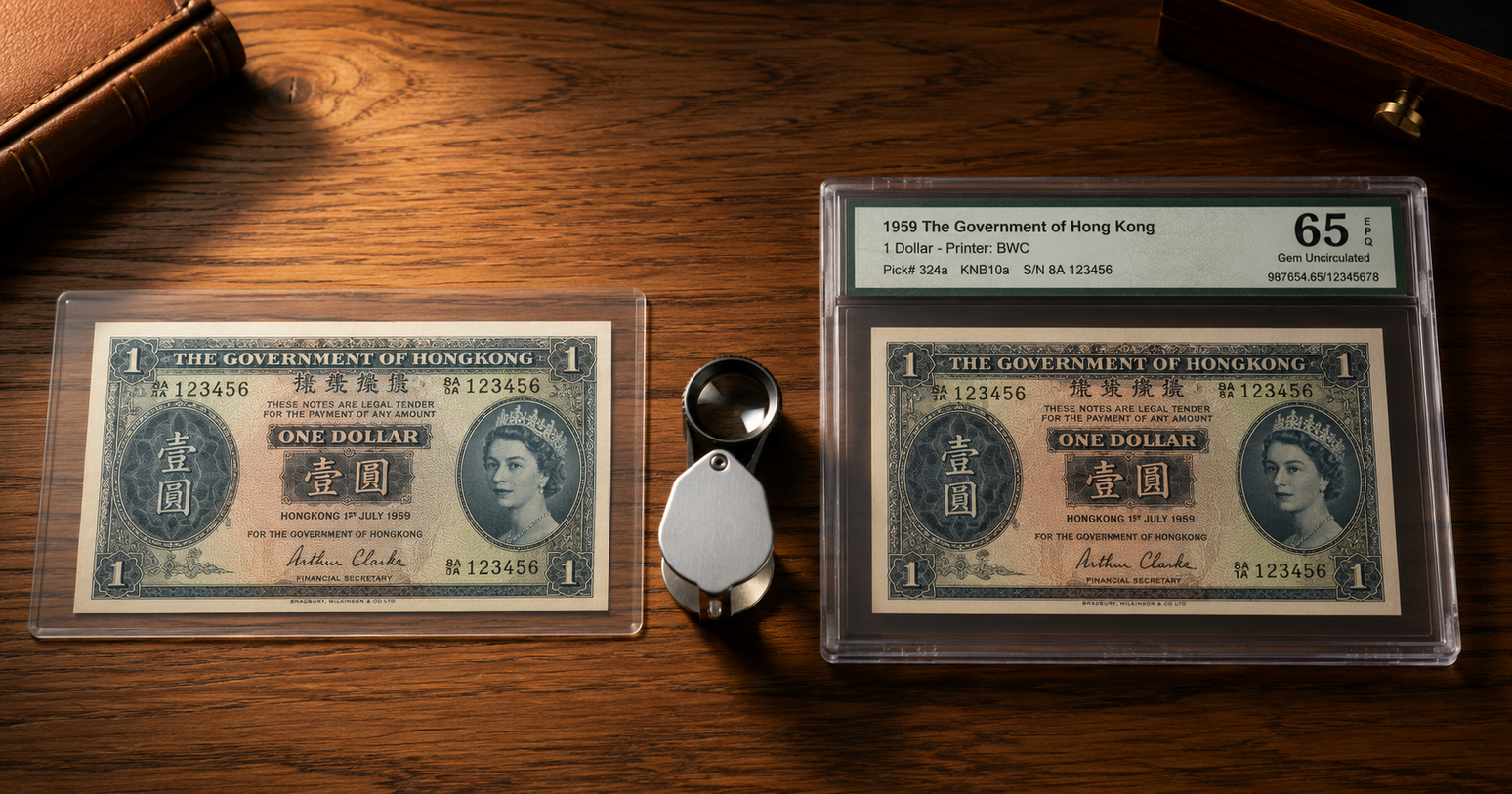
A raw note is exactly what it sounds like: the banknote itself, in a sleeve, condition described by whoever is selling it. A graded note has been examined by Paper Money Guaranty — the world’s largest third-party grader, founded in 2005 within the Certified Collectibles Group — authenticated, assigned a numeric grade, and sealed in a tamper-evident holder. When Heritage or Stack’s Bowers sells a six-figure rarity, it almost always crosses the block in a PMG or PCGS holder. We covered the full certification system — submission process, label anatomy, holder technology — in our complete guide, What Is PMG Grading? This guide answers the narrower question collectors actually wrestle with at checkout: when is the slab worth the premium?
A detail we’re fond of: PMG is headquartered in Sarasota, Florida — the same city as our own family shop. The notes on our graded wall don’t travel far to get their grades, and that proximity is part of why graded material is a Planet Banknote specialty.
How does the PMG 70-point grading scale work?
You can’t judge whether a grade is worth paying for without knowing what the number says. The scale runs from 1 to 70; every number is a judgment about circulation wear, handling, centering, and paper integrity. The tiers that matter most in practice:
| GRADE | PMG NAME | WHAT IT MEANS |
|---|---|---|
| 68–70 | Superb Gem Uncirculated | Near-perfect to perfect: exceptional centering, no visible handling. Population-report territory. |
| 67 | Superb Gem Uncirculated | The sweet spot where quality outpaces price for many modern notes. |
| 65–66 | Gem Uncirculated | Fully uncirculated with above-average margins and registration. |
| 63–64 | Choice Uncirculated | No circulation wear, but centering or minor handling holds it back. |
| 60–62 | Uncirculated | Never circulated, but with noticeable flaws — a corner bump, poor centering. |
| 50–58 | About Uncirculated | A single light fold or touch of handling separates it from UNC. |
| 20–45 | Very Fine – Choice Extremely Fine | Honest circulation: folds and wear, but body and color intact. Where most affordable classics live. |
| 1–15 | Good – Choice Fine | Heavy wear. Collectible mainly for rarity, not condition. |
Two notes with the same Pick number and one grade point between them can sell for very different prices — and the gap widens dramatically above 65, where each point up the scale means a smaller surviving population.
What does EPQ mean on a PMG label?
EPQ stands for Exceptional Paper Quality, and it may be the most misunderstood designation in the hobby. EPQ is not a higher grade — it’s a statement about originality. It certifies that the paper is exactly as the printing press left it: no washing, no pressing, no repairs, no chemical brightening, none of the “improvements” that have quietly plagued paper money for a century. A PMG 65 EPQ and a PMG 65 without EPQ carry the same number, but the market treats them very differently, because a missing EPQ on an uncirculated note is a flag that something was done to it. For modern notes, serious collectors generally consider EPQ non-negotiable.
What does the PMG Star (★) designation mean?
The Star is PMG’s mark for exceptional eye appeal — a note whose visual quality stands out even within its grade: exceptional ink saturation, perfect registration, striking embossing. It’s awarded sparingly, which is exactly why Star notes command premiums. Think of the number as the measurement and the Star as the compliment.
The number is the measurement. EPQ is the honesty certificate. The Star is the compliment.
Raw vs. graded: when is a graded note worth the premium?
A graded note costs more than the same note raw. What the premium buys:
Authentication. PMG’s graders reject counterfeits and alterations before assigning any number — for notes that are widely faked (high-value Zimbabwe trillions among them), this alone justifies the holder. Condition certainty. “UNC” in a private seller’s listing is an opinion; “PMG 66 EPQ” is a documented, guaranteed one. Liquidity. Graded notes sell faster and travel across borders more credibly because the buyer doesn’t have to trust the seller’s eye. Preservation. The inert, tamper-evident holder is archival storage in itself.
When is raw fine? For inexpensive notes where grading fees would exceed the note’s value, for reference collections, and for buyers who enjoy handling their notes. A sensible collection usually holds both: raw notes for breadth, graded notes for the pieces that anchor it. If you’re building from scratch, our guide to the 10 most iconic hyperinflation banknotes is a good map of which notes tend to be worth holding in graded form — the Zimbabwe 100 Trillion being the canonical example.
What is a custom PMG label?
PMG produces special-edition labels for select dealers and series — and Planet Banknote is one of them. Our Planet Banknote PMG Label notes carry our name on the certification label inside the holder, a pairing you won’t find anywhere else. The grade and guarantee are pure PMG; the label records where the note came from. For collectors who care about provenance, it’s a small detail that does a lot of work.
Frequently asked questions
Is a PMG 70 really perfect?
Perfect under 5x magnification, with perfect centering — the strictest standard PMG applies. True 70s are rare enough that most “top pop” modern notes sit at 68 or 69.
Does PMG grade polymer banknotes?
Yes — polymer notes are graded on the same 70-point scale, and EPQ applies to polymer originality just as it does to paper.
What’s the difference between PMG and PCGS Banknote?
Both are reputable third-party graders using 70-point scales. PMG is the volume leader in world paper money; PCGS Banknote is the paper-money arm of the PCGS coin brand. We stock both, and cross-market price differences are usually about population, not quality.
Can a graded note lose its grade?
Not while sealed. The grade applies to the note inside the intact holder; PMG guarantees it. Crack the holder open and the note is raw again.
What is a population report?
PMG’s public census of every note it has graded, by catalog number and grade. It’s how you learn that your 67 EPQ is one of a handful — or one of thousands.
Sources
PMG grading scale and designation definitions (pmgnotes.com) · PMG World Note Population Report · Certified Collectibles Group · Planet Banknote graded inventory records, Sarasota, FL.
Browse PMG- and PCGS-certified notes — including exclusive Planet Banknote PMG Label pieces — on our graded wall.
Shop Graded Banknotes
Explore Popular Articles

Venezuela 500 Bolívares = 500 Million Old Bolívares
Collector's Guide · World Banknotes · October 2026 Venezuela's 500 Bolívares Note Equals 500 Millio...

Iran's Four-Zero Redenomination: A Timeline
Collector's Guide · World Banknotes · October 2026 Iran Is Removing Four Zeros From the Rial: The T...

Consecutive Serial Numbers: How to Buy Banknote Lots
Collector's Guide · Buying Guide · Updated October 7, 2026 Consecutive Serial Numbers, Explained: H...

Venezuela 200 Bolívares = 200 Million Old Bolívares
Collector's Guide · World Banknotes · Updated October 7, 2026 Venezuela's 200 Bolívares Note Equals...