
How to Start a World Banknote Collection for Under $100 (2026 Blueprint)
★ Featured in FeedSpot’s Top 20 Paper Money Blogs
Collector’s Guide · July 2026 · 10 min read
How to Start a World Banknote Collection for Under $100 (2026 Guide)
One hundred dollars buys a trillion-dollar banknote — authenticated, uncirculated, and sleeved — with change to spare. Here is exactly how to spend a first $100, how to judge condition, and the mistakes that waste a starter budget.
Quick Answer
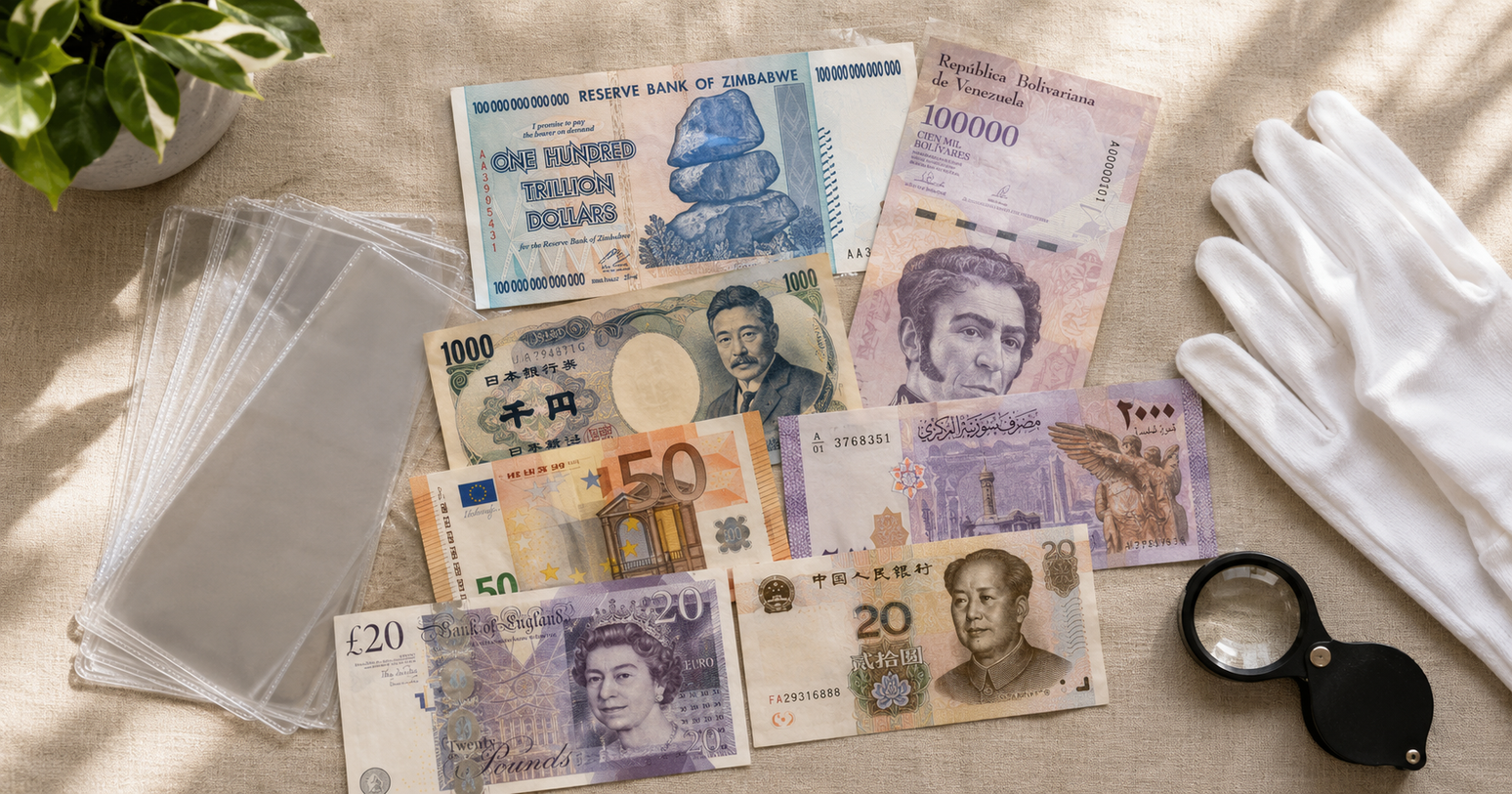
You can start a genuine world banknote collection for under $100 by anchoring it with one iconic hyperinflation-era note in crisp uncirculated (UNC) condition — a Zimbabwe trillion-series note, a Yugoslav hyperinflation note, or a 1946-era Hungarian pengő each qualify — or by combining two or three modern-crisis notes, using buy-one-get-one listings to double the count. Buy UNC from a dealer who guarantees authenticity in writing, store every note in an archival sleeve, and learn the Pick number system to identify exactly what you own.
Why banknotes are the most affordable way into serious collecting
Paper money is the great open secret of the collectibles world. In coins, $100 buys one decent piece of common silver — a nice Morgan dollar, and the budget is gone. In banknotes, the same bill buys an authenticated, never-circulated example of the highest-denomination currency ever printed by a central bank, with money left over for the archival sleeve. The reason is attention, not quality: hyperinflation governments printed staggering quantities in their final months, and paper money attracts a fraction of the collector demand coins do. The history-per-dollar ratio is unmatched anywhere in collecting.
What does $100 actually buy?
Real numbers from our own shelves, all crisp UNC unless noted, all shipped sleeved with a Certificate of Authenticity:
| NOTE | THE STORY IT TELLS | CURRENT PRICE |
|---|---|---|
| Zimbabwe 50 Trillion Dollars, 2008 (P-90) | The peak of the most famous modern hyperinflation — one step below the record-holding 100 Trillion | $79 |
| Zimbabwe 100 Billion Special Agro Cheque, 2008 (P-64) | Emergency “cheque money” issued when the printing presses couldn’t keep up with the zeros | $99 |
| Yugoslavia hyperinflation-era notes | The second-worst hyperinflation ever recorded, as a country dissolved | from $89 |
| Hungary pengő-era notes, 1946 | The worst hyperinflation in human history — prices doubled every 15 hours | from $99 |
| Venezuela 50 Million Bolívares, 2021 | A hyperinflation that happened in the smartphone era, documented in real time | $29 |
| Syria 500 Pounds, 2026 first issue | The note that marks Syria’s 100-to-1 redenomination — modern monetary history as it happens | $62 — currently BOGO, so a second note ships free |
Three proven ways to spend the first $100:
The anchor. One Zimbabwe 50 Trillion at $79 — the single most recognizable note class in the hobby, and the piece every visitor will ask about. The modern-crisis trio. The Venezuela 50 Million ($29) plus the Syria 500 BOGO pair ($62 for two notes): three genuine notes from two ongoing monetary stories, $91 all in. The doubled budget. Build the whole order from the BOGO wall, where every listing ships a second note free — the fastest way to turn $100 into a six-note starter set. Each note class above has its own reference guide on this blog, including the Yugoslavia 500 Billion Dinara, the 1946 Hungarian B-Pengő, and Syria’s 2026 redenomination.
A hundred dollars in coins buys one nice silver dollar. A hundred dollars in banknotes buys fifty trillion — authenticated, uncirculated, and sleeved.
What does UNC mean, and does condition really matter?
UNC — uncirculated — means the note has never been folded, never passed hand to hand, and shows no wear: crisp paper, sharp corners, original embossing. Condition matters enormously in paper money, more than most beginners expect. A note that spent a year in wallets can be worth a fraction of the same note in UNC. The good news for a starter budget: because hyperinflation notes were printed in vast quantities and demonetized quickly, UNC examples remain accessible — you can start at the top of the condition scale, which is impossible in almost any other collecting field. When a listing says “AU” (about uncirculated) or “VF” (very fine), it is describing progressively more handling; for a first collection, insist on UNC.
What is a Pick number?
Every collectible banknote has a catalog reference from the Standard Catalog of World Paper Money, universally called the Pick number after the catalog’s founder, Albert Pick. “Zimbabwe P-91” identifies the 2008 100 Trillion Dollar note precisely, in any language, on any website. Learn to check the Pick number before buying: it’s how you confirm a listing is the exact note, date, and variety you think it is, and it’s the vocabulary every serious dealer and collector shares.
How do you store banknotes properly?
Three rules cover ninety percent of it. First, every note goes in an archival currency sleeve — rigid or soft, but always PVC-free, because PVC plastics leach and permanently damage paper over years. Second, keep notes flat and away from direct sunlight; ultraviolet light fades inks that can never be restored. Third, handle notes by the edges, ideally over a clean surface. A binder of sleeved pages on a closet shelf is a perfectly good home for a starter collection — museum conditions are not required, just consistency.
Where should a beginner buy banknotes?
Buy from established dealers who guarantee authenticity in writing and issue documentation with each order — a Certificate of Authenticity is standard practice at reputable shops. Auction marketplaces can offer tempting prices but shift the authentication burden onto you, which is a poor trade for a beginner who hasn’t yet handled enough genuine notes to spot a fake — and with high-value notes that have known counterfeit problems, the Zimbabwe trillion series chief among them, an unauthenticated bargain is often no bargain at all. Our 100 Trillion reference guide covers authentication in detail.
The three mistakes that waste a $100 budget fastest
1. Chasing the cheapest listing. An unauthenticated "deal" on a frequently faked note is the most expensive purchase in the hobby — the discount is usually the authentication you didn’t get. 2. Skipping storage. A dollar sleeve protects an eighty-dollar note; buy supplies with your first order, not your fifth. 3. Scattering the budget. Ten random grab-bag notes with no theme teach you less and impress no one; pick a story — one country, one era, one monetary event — and build it. We’ve written up the full list — authentication traps, focus drift, catalog errors, and seven more — in 10 Common Banknote Collecting Mistakes, and if you’re brand new to the hobby, our Beginner’s Guide to World Banknote Collecting covers the fundamentals this budget blueprint builds on.
Frequently asked questions
Is banknote collecting expensive?
It’s among the least expensive serious collecting hobbies. A first note with real historical weight starts under $100 in authenticated UNC condition, and buy-one-get-one listings stretch a starter budget further than almost any other collectible category allows.
Are hyperinflation banknotes real money?
They were — genuine legal tender issued by central banks, later demonetized. They’re collected today as historical artifacts of those monetary events, not as usable or exchangeable currency.
What’s the single best first banknote to buy?
The Zimbabwe trillion series is the classic first note: instantly recognizable, historically significant, and available in authenticated UNC under $100. If the budget stretches, the 100 Trillion (P-91) is the icon of the series — the highest denomination ever printed.
Should a beginner buy graded notes?
Not necessarily at first. Raw UNC from a dealer who guarantees authenticity is the right starting point; graded holders make sense as the collection grows into higher-value anchor pieces — our raw vs. graded guide covers when the slab earns its premium.
How do I know a banknote is genuine?
Buy from dealers who guarantee authenticity in writing, check security features against reference guides, and prefer third-party-graded examples for frequently counterfeited notes.
Do banknotes need special insurance or care?
A starter collection needs only archival sleeves, a binder, and a spot away from sunlight and humidity. Insurance conversations start when a collection reaches the value of the deductible — a good problem for later.
Sources
Standard Catalog of World Paper Money (Pick), General & Modern Issues · PMG World Note Census · Hanke-Krus Hyperinflation Table · Planet Banknote current inventory and pricing, Sarasota, FL (July 2026).
Every note above ships from our family shop sleeved, authenticated, and with a Certificate of Authenticity — and the BOGO wall doubles a starter budget.
Shop BOGO DealsExplore Popular Articles

Venezuela 500 Bolívares = 500 Million Old Bolívares
Collector's Guide · World Banknotes · October 2026 Venezuela's 500 Bolívares Note Equals 500 Millio...

Iran's Four-Zero Redenomination: A Timeline
Collector's Guide · World Banknotes · October 2026 Iran Is Removing Four Zeros From the Rial: The T...

Consecutive Serial Numbers: How to Buy Banknote Lots
Collector's Guide · Buying Guide · Updated October 7, 2026 Consecutive Serial Numbers, Explained: H...

Venezuela 200 Bolívares = 200 Million Old Bolívares
Collector's Guide · World Banknotes · Updated October 7, 2026 Venezuela's 200 Bolívares Note Equals...