
Why Queen Elizabeth II Banknotes Are Disappearing
Collector's Reference · July 2026 · 9 min read
Why Queen Elizabeth II Banknotes Are Disappearing — and Why Collectors Are Paying Attention
Her portrait appeared on more currency than any person in history. Since 2022, that entire body of money has been in slow, permanent retreat — country by country, denomination by denomination. Here is what is actually being withdrawn, what is being replaced, and what it means for the notes in collections today.
Quick answer: Queen Elizabeth II appeared on the banknotes of more than 30 issuing authorities across the Commonwealth during her seventy-year reign — a record no other figure has approached. Since her death in September 2022, no new QEII notes have been printed anywhere. The United Kingdom began issuing King Charles III notes in June 2024, Australia replaced her on the $5 note with an Indigenous design, and other issuers are following as notes wear out. QEII notes remain legal tender in most countries, but the supply only shrinks from here — which is why collectors treat her portrait series as a closed book.
How many countries put Queen Elizabeth II on their banknotes?
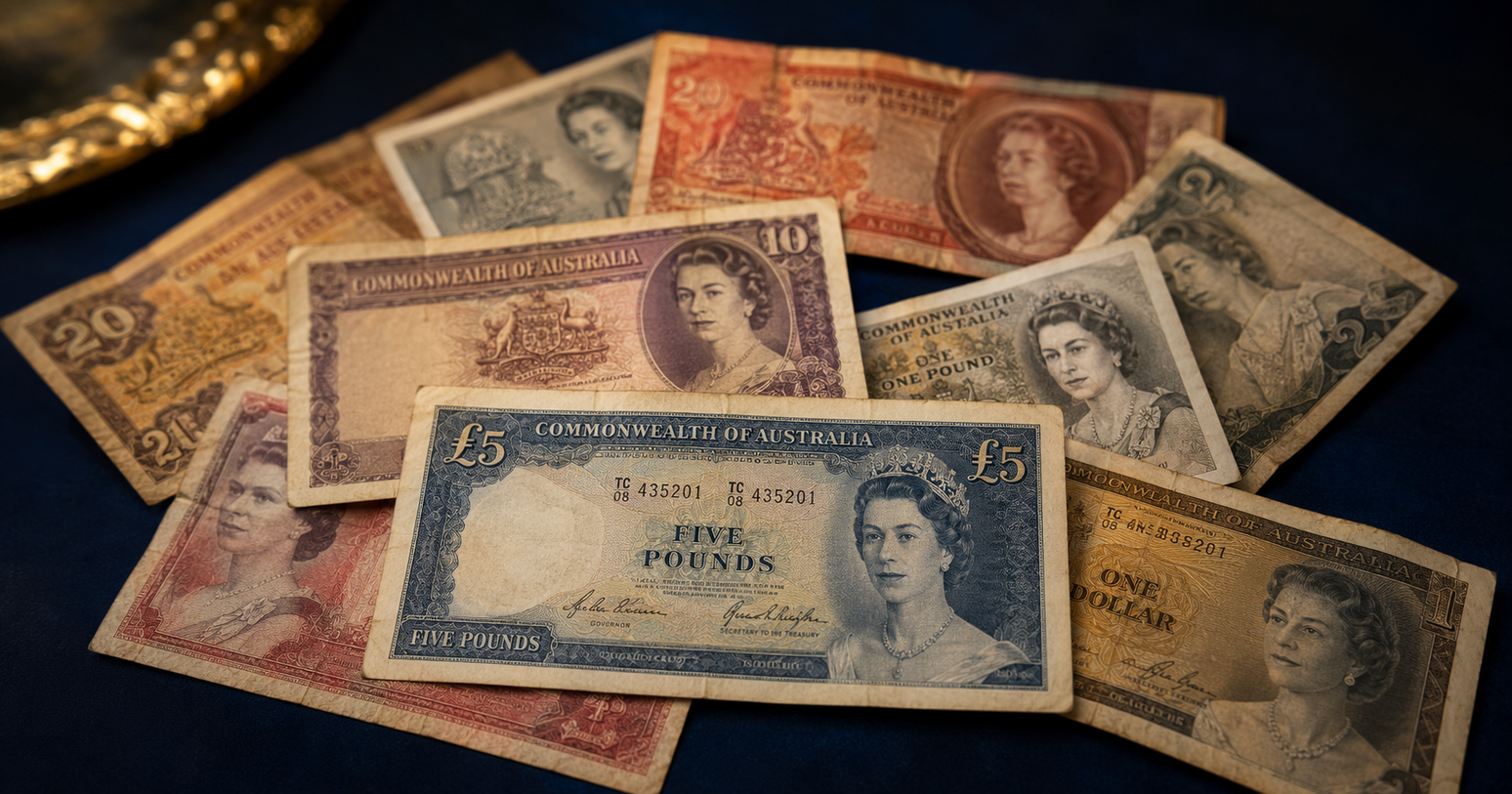
More than thirty issuing authorities used her portrait at some point between 1952 and 2022 — the United Kingdom, Canada, Australia, New Zealand, the Eastern Caribbean states, Fiji, Belize, Bermuda, the Cayman Islands, Hong Kong, and many more. Because her reign spanned seven decades, her currency portraits also form a unique timeline: collectors can hold the same monarch at 26 on a 1950s note and at 90 on a 2010s issue. No other person's face documents its own aging across world currency this way, and no future monarch is likely to reign long enough to repeat it.
What has actually been replaced since 2022?
| Issuer | Status of QEII notes |
|---|---|
| United Kingdom | King Charles III notes entered circulation June 2024. QEII notes remain legal tender and co-circulate, but worn notes are withdrawn and replaced with the new portrait. |
| Australia | The $5 — the only note carrying her portrait — is being replaced with a design honoring First Nations Australians rather than the new King. Her portrait leaves Australian paper money entirely. |
| Canada | The $20 carried her portrait; a King Charles III redesign is in the pipeline, with QEII $20s circulating until replaced. |
| Eastern Caribbean, Belize, Cayman Islands, Fiji & others | Transitioning on their own schedules; several had already moved away from the portrait before 2022. Existing QEII notes circulate until worn out. |
The mechanism matters more than any single announcement: central banks rarely demonetize over a portrait. They simply stop printing the old design and let attrition do the work. Every worn QEII note that reaches a bank gets destroyed and replaced by a note she is not on. There is no dramatic deadline — just a supply that has been shrinking every business day since 2022 and will never grow again.
Central banks don't demonetize a portrait. They let it wear out — one note at a time, forever.
Which Queen Elizabeth II notes do collectors focus on?
The portrait timeline. Assembling one note from each era of her reign — the young Queen of the 1950s–60s, the mature portraits of the 1970s–90s, the late-reign issues — is the classic QEII collection, and it can be built across many countries and budgets.
Small-territory issues. Notes from smaller issuers — Belize, Bermuda, the Eastern Caribbean, Fiji — were printed in far lower quantities than UK or Canadian notes, and high-grade survivors are genuinely scarce. These are the sleepers of the series.
Final-issue notes. The last QEII designs printed before the transition — the notes that closed the book — carry an obvious historical hook that only strengthens as the portrait vanishes from daily use.
Graded gems. Because most QEII notes circulated hard, uncirculated examples certified by PMG or PCGS occupy a different tier from the folded notes in drawers worldwide. If you are weighing whether certification makes sense for a particular note, our guide on raw versus graded banknotes lays out the decision cleanly.
Are Queen Elizabeth II notes still legal tender?
In most issuing countries, yes — the UK, Canada, and others kept QEII notes fully spendable alongside the new designs. That creates a strange window collectors should understand: notes that are simultaneously ordinary money and a finite historical artifact. Crisp examples pulled aside today cost face value plus a modest premium; the same notes a generation from now will exist only in collections. Anyone who has hunted 1990s notes in gem condition knows how this movie ends — the common note of today is the condition rarity of tomorrow, a dynamic we cover in our fancy serial numbers guide as well: the time to check serials and set aside gems is while the notes still pass through hands.
Frequently asked questions
Did any country put King Charles III on its notes immediately?
The United Kingdom moved fastest, with Bank of England notes bearing King Charles III entering circulation on June 5, 2024. Most other issuers are replacing designs gradually as stocks and printing schedules allow.
Are old QEII notes worthless now?
No — the opposite on both counts. They generally remain legal tender in their home countries, and as collectibles their supply is permanently capped, with condition and scarcity determining collector interest.
Which QEII portrait is on the most notes?
The mature portraits used from the 1970s onward appear on the largest volume of surviving notes, since modern print runs dwarf mid-century ones. The young-Queen portraits of the 1950s and 1960s are the scarcer end of the timeline.
Is Australia removing the monarchy from its currency?
From the $5 banknote, yes — the Reserve Bank of Australia chose a design honoring First Nations Australians rather than a portrait of King Charles III. The monarch remains on Australian coins.
What is the best way to start a QEII collection?
Pick an axis: one note per decade of the reign, one note per country, or one denomination followed across portrait changes. Prioritize the best condition you can afford — the notes are a closed series, and condition is the one variable still in your control.
Sources
Bank of England — King Charles III banknote issuance, June 2024 (bankofengland.co.uk)
Reserve Bank of Australia — $5 banknote redesign announcement (rba.gov.au)
Bank of Canada — currency design and portrait policy (bankofcanada.ca)
A closed series
Planet Banknote keeps a dedicated Queen Elizabeth II collection — notes from across the Commonwealth and across the decades of her reign, including PMG-certified examples, every one authenticated with a COA.
Explore Popular Articles

How to Read a PMG Banknote Label, Line by Line
Collector's Guide · Grading · October 2026 How to Read a PMG Banknote Label, Line by Line A PMG lab...

How to Frame a Banknote Without Damaging It
Collector's Guide · Storage and Display · October 2026 How to Frame a Banknote Without Damaging It...

Banknote Gifts for Collectors: 2026 Holiday Guide
Collector's Guide · Gift Guide · October 2026 Banknote Gifts for Collectors: The 2026 Holiday Guide...

Teaching Inflation With Real Banknotes: A Classroom Guide
Collector's Guide · Education · October 2026 How to Teach Inflation With Real Banknotes A percentag...