
How to Spot a Fake Zimbabwe 100 Trillion Dollar Note
Buyer's Guide · July 2026 · 10 min read
How to Spot a Fake Zimbabwe 100 Trillion Dollar Note
The most widely copied authentication checklist for this note tells you to hold it to the light and find a watermark. The genuine note does not have one and never did. Here is what the P-91 actually carries, why so much published advice is wrong, and how to check a note in about ninety seconds.
Quick Answer
The genuine 2008 Zimbabwe 100 Trillion Dollar note (Pick P-91) measures 148 mm by 74 mm, is predominantly blue with a peach accent, and carries no watermark and no security thread — sanctions prevented the Reserve Bank of Zimbabwe from obtaining that security paper. Its real security feature is a patterned stripe carrying a Zimbabwe Bird silhouette printed in optically variable ink, which shifts colour as you tilt the note. Any checklist telling you to find a watermark or a windowed thread will cause you to reject authentic notes.
Why so much authentication advice about this note is wrong
The P-91 is one of the most searched banknotes in the world, which means it attracts an enormous volume of thin, recycled content. A checklist gets written by somebody who has never handled the note, describing the security features a banknote of that era would normally have. It gets copied. It gets rewritten by a language model. Within a few years it is everywhere, and it says to check a watermark of the Balancing Rocks and a windowed thread reading RBZ.
That describes a note that was never printed. In 2008 the Reserve Bank of Zimbabwe was operating under sanctions and had lost access to its European banknote supplier, including the specialist security paper that watermarks and embedded threads require. The trillion-series notes were produced without them. This is documented contemporaneously in reporting from the period and recorded in Owen Linzmayer's The Banknote Book, the standard catalogue reference for the series.
The practical consequence is the opposite of what the bad checklists intend. A collector who receives a genuine note, holds it to a lamp, finds nothing, and concludes it is counterfeit has been misled into distrusting the real thing.
The absence of a watermark is not a red flag on this note. It is a historical fact about how it was made.
What the genuine P-91 actually looks like
| Attribute | Genuine note |
|---|---|
| Dimensions | 148 mm wide by 74 mm high |
| Dominant colour | Blue, with a peach accent |
| Front design | Chiremba Balancing Rocks (Domboremari) near Epworth, at centre |
| Reverse design | Victoria Falls at left, Cape buffalo at right |
| Security feature | Patterned stripe with Zimbabwe Bird silhouette in optically variable ink |
| Watermark | None |
| Security thread | None |
| Issuer | Reserve Bank of Zimbabwe, dated 2008 |
| Introduced | 16 January 2009, alongside the 10, 20 and 50 trillion notes |
The ninety-second check
Work through these in order. The first two catch the overwhelming majority of fakes, because the people producing them are printing decorative novelties on ordinary stock, not attempting a serious forgery.
- Tilt the note and watch the stripe. The genuine security stripe carries a Zimbabwe Bird silhouette in optically variable ink, and the colour shifts as the viewing angle changes. Flat, printed, non-shifting imitation of that stripe is the single most common failure. Do this under a normal lamp, not a phone torch held straight on.
- Measure it. 148 mm by 74 mm. A ruler settles this in five seconds. Novelty reproductions are frequently trimmed to the wrong size, and souvenir sheets are almost always off.
- Feel the printing. Genuine intaglio printing on the front has perceptible texture. Run a fingernail lightly across the denomination and the lettering. A wholly flat surface indicates offset or digital printing.
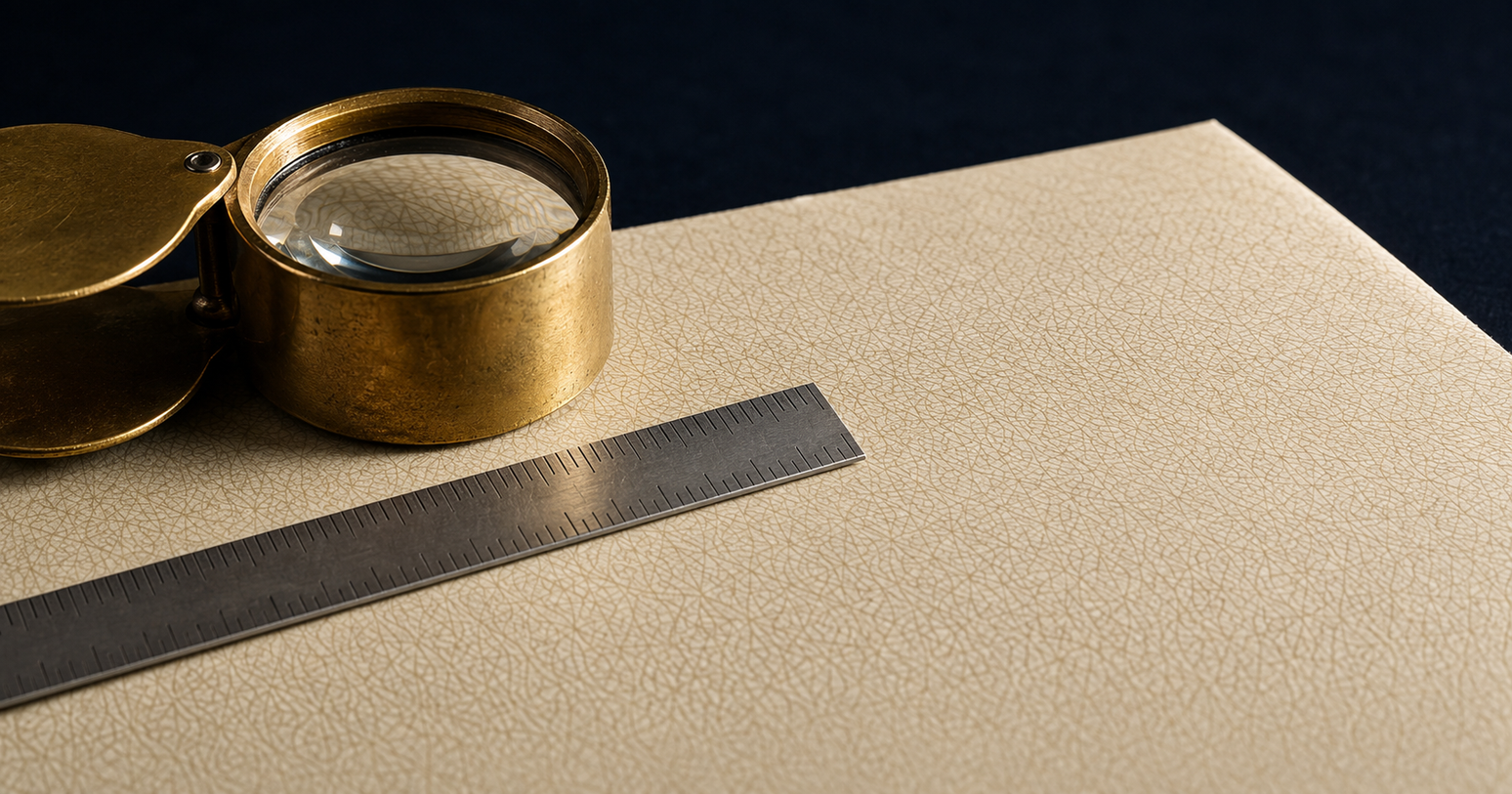
- Look at the paper under magnification. A ten-power loupe will show whether the design is drawn in continuous printed line or assembled from a dot rosette. A visible CMYK dot pattern across the artwork means it came off an inkjet or a commercial press, not a banknote works.
- Read the serial number. It should be crisp, consistently spaced, and identical in both positions where the design prints it twice. Numbers that look laser-printed, sit at a slightly different angle to the design, or vary in tone across the digits are a serious warning.
- Check the wording and spelling. Reserve Bank of Zimbabwe, the 2008 date, and the denomination should all be present and correctly spelled. Souvenir and joke notes routinely alter or omit the issuer line, and some carry explicit novelty text in small type.
- Do not test for a watermark or a thread. There is nothing to find. Finding "nothing" here tells you nothing either way.
What kinds of fakes are actually circulating?
They fall into three groups, and it helps to know which one you are looking at.
Novelty and souvenir reproductions. By far the most common. Sold openly as gifts, party favours, and prop money, often in bulk. Many are printed on thin stock at the wrong dimensions with no attempt at the optically variable stripe. Problems arise when these are resold second-hand by people who do not know what they have.
Deliberate counterfeits aimed at collectors. Less common but more careful. These try to reproduce the stripe and get the size closer. Magnification and feel usually still separate them, because reproducing genuine intaglio texture is expensive and reproducing a true optically variable ink shift is harder still.
Misdescribed genuine notes. Not counterfeit at all, but a real problem: notes from elsewhere in the trillion series, or lower denominations of the same family, listed or photographed as if they were the 100 trillion. Always confirm the denomination on the actual note in the actual photograph.
How to avoid the problem entirely
Authentication skill is worth having, but the reliable protection is structural rather than forensic.
Buy the photographed note. A seller who photographs the specific note you will receive, serial number visible, has removed most of the risk before you spend anything. Stock photography on a note this heavily counterfeited is a reason to ask questions.
Prefer consecutive runs where budget allows. Forgers work in ones and twos. An unbroken sequence pulled from an original pack is difficult to fake and easy to verify by reading the serials in order. It is one of the quiet advantages of buying a run rather than several singles from different sources.
Consider third-party certification for higher-value examples. A note in a PMG or PCGS holder has been examined by graders who see this issue constantly, and the holder preserves the attribution permanently. Our guide to raw versus graded notes covers when that is worth the premium.
A short history of why the note is so heavily copied
The Reserve Bank of Zimbabwe introduced the 100 trillion dollar note on 16 January 2009, together with the 10, 20 and 50 trillion denominations. Its working life was extraordinarily short. The Zimbabwean dollar was suspended on 12 April 2009, less than three months later, and the currency was formally demonetized in 2015.
What followed was unusual. A note that had almost no circulating career became one of the most recognised banknotes on earth, the standard visual shorthand for hyperinflation, and an object that people who collect nothing else still want to own. Demand of that shape, attached to a design that is instantly recognisable and was printed without conventional security paper, is precisely the condition under which imitations flourish. For more on the surviving supply and how counterfeits distort it, see how many 100 Trillion notes are actually left.
Frequently asked questions
Does the Zimbabwe 100 Trillion note have a watermark?
No. Sanctions in force at the time cut the Reserve Bank of Zimbabwe off from its usual supplier of security paper, and the trillion-series notes were produced without watermarks. Guides that instruct you to look for one are describing a note that does not exist.
Does it have a security thread?
No. Embedded threads require the same specialist paper that was unavailable. The note's security feature is the patterned stripe with the Zimbabwe Bird silhouette printed in optically variable ink.
What size is a real Zimbabwe 100 Trillion note?
148 millimetres wide by 74 millimetres high. Measuring is one of the fastest and most reliable single checks available, because reproductions are frequently trimmed inaccurately.
What colour is the genuine note?
Predominantly blue with a peach accent. Descriptions calling the note gold or yellow-dominant are describing something else, and that error appears in several widely copied online listings.
Can a note still be genuine if it has no AA prefix?
Prefix should always be checked against a catalogue reference for the specific issue rather than assumed. If a prefix looks unfamiliar to you, treat it as a question to resolve with the seller and a catalogue, not as proof of anything on its own.
Is a UV light useful for checking this note?
It is of limited value here, precisely because the note was made without the paper-based features UV inspection usually targets. Tilt inspection of the optically variable stripe, measurement, and magnification are more informative.
What should I do if I think I bought a fake?
Photograph the note front and back in good light, including the stripe at an angle, and raise it with the seller and the platform you bought through. Reputable dealers will resolve it. If you want an independent opinion, submission to a third-party grading service will settle authenticity definitively.
Sources
Owen Linzmayer, The Banknote Book, "Zimbabwe", CDN Publishing, 2025 — design, dimensions and security features of the trillion series
Reserve Bank of Zimbabwe — banknote introduction notices, January 2009, and demonetisation statement, 2015
BBC News — contemporaneous reporting on the introduction of the trillion-series notes, 16 January 2009
The Guardian — reporting on Zimbabwe's loss of banknote-supply access under sanctions, 23 July 2008
National Museum of American History, Smithsonian Institution — catalogue record for the 2008 100 trillion dollar note
Paper Money Guaranty (pmgnotes.com) and PCGS Banknote (pcgs.com) — third-party authentication standards
Every Note Examined Before It Ships
Planet Banknote photographs the exact note you receive, checks it by hand, and ships it with a Certificate of Authenticity. Our 100 Trillion examples come from original packs, and consecutive runs are pulled in serial order.
Explore Popular Articles
How to Read a PMG Banknote Label, Line by Line
Collector's Guide · Grading · October 2026 How to Read a PMG Banknote Label, Line by Line A PMG lab...

How to Frame a Banknote Without Damaging It
Collector's Guide · Storage and Display · October 2026 How to Frame a Banknote Without Damaging It...

Banknote Gifts for Collectors: 2026 Holiday Guide
Collector's Guide · Gift Guide · October 2026 Banknote Gifts for Collectors: The 2026 Holiday Guide...

Teaching Inflation With Real Banknotes: A Classroom Guide
Collector's Guide · Education · October 2026 How to Teach Inflation With Real Banknotes A percentag...