
Zimbabwe 2008 to 2026: From 100 Trillion to ZiG
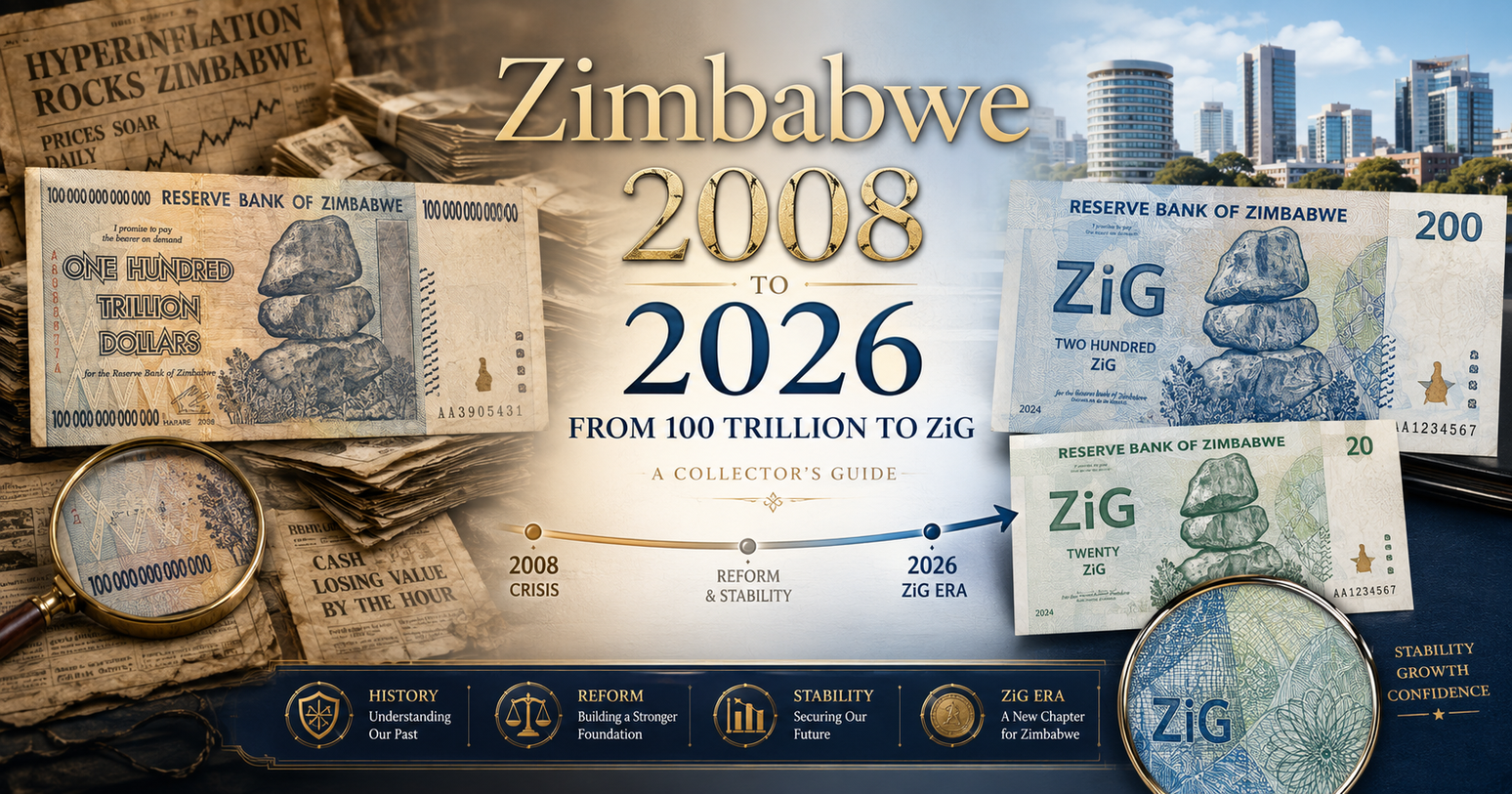
Numismatic Reference · Zimbabwe · August 2026
From 100 Trillion Dollars to 3.2 Percent: Zimbabwe’s Currency Story, 2008 to 2026
The country that printed the world’s most famous hyperinflation banknote just posted one of the lower inflation rates in Africa. Here is how Zimbabwe got from the 100 trillion dollar note to the gold-backed ZiG — and why both ends of that story now sit in collectors’ albums.
Quick answer: Zimbabwe’s annual inflation, measured in its ZiG currency, fell to 3.2 percent in July 2026 — eighteen years after the hyperinflation that produced the 2008 100 trillion dollar note (Pick 91), the highest denomination ever issued for circulation in dollar terms. The old Zimbabwe dollar was formally retired in 2015; the gold-backed ZiG launched in April 2024, and a redesigned second series of ZiG banknotes entered circulation on April 7, 2026. The 100 trillion is a closed, finite series. The ZiG is a live, evolving one. Collectors increasingly hold both as bookends of the same story.
What happened to Zimbabwe’s 100 trillion dollar note?
In 2008, Zimbabwe’s inflation ran so far beyond ordinary measurement that economists could only estimate it — the most widely cited academic estimate puts the November 2008 peak in the sextillions of percent per year. The Reserve Bank of Zimbabwe answered with the trillion series: 10, 20, 50, and finally 100 trillion dollars, all dated 2008. The 100 trillion (Pick 91) circulated only briefly before the country abandoned its own currency in early 2009 and moved to a multi-currency system built around the US dollar.
The Zimbabwe dollar was formally retired in 2015, which fixed the supply of every note in the trillion series permanently. No more will ever be printed. That finality — combined with the sheer spectacle of fourteen zeros — is why the 100 trillion became the single most recognized world banknote of the past two decades, covered by the BBC, the Guardian, and every major numismatic reference since.
The 100 trillion is a finished book. The ZiG is a book still being written. A collection that holds both tells the whole story.
What is the ZiG, and why does 3.2 percent inflation matter?
The Zimbabwe Gold currency — ZiG — launched in April 2024, backed by the Reserve Bank’s gold and foreign reserve holdings. It is Zimbabwe’s sixth attempt at a national currency since 2008, and by the numbers it is the most stable one yet. According to the Zimbabwe National Statistics Agency, annual ZiG inflation fell to 3.2 percent in July 2026, down from 4.7 percent in June, with month-on-month inflation at just 0.1 percent. The Reserve Bank projects single-digit inflation through 2026.
Confidence showed up in the banknotes themselves. On February 27, 2026, the RBZ unveiled a redesigned second series, and on April 7, 2026 the first three denominations — ZiG10, ZiG20, and ZiG50 — entered circulation through banks and ATMs in Harare, Bulawayo, and other cities. ZiG100 and ZiG200 notes are planned to follow when conditions allow. For collectors, a brand-new note family from the world’s most storied monetary experiment is a first-issue moment — and first issues only happen once. Our complete guide to the 2026 ZiG banknotes covers the new series note by note.
Zimbabwe currency timeline: 2008 to 2026
| Year | Event | Collector significance |
|---|---|---|
| 2008 | Hyperinflation peaks; trillion series printed (10T–100T) | Pick 90 and Pick 91 — the flagship hyperinflation notes |
| 2009 | Zimbabwe dollar abandoned; US dollar era begins | Trillion series circulation window closes after months |
| 2015 | Zimbabwe dollar formally retired | Supply of all 2008 notes permanently fixed |
| 2016–2019 | Bond notes, then a new Zimbabwe dollar (ZWL) | Short-lived series; collected as transition issues |
| 2024 | Gold-backed ZiG launches in April | First series ZiG notes (P-110 onward) |
| 2026 | Second-series ZiG10/20/50 circulate April 7; July inflation 3.2% | A live first-issue moment; ZiG100/200 still to come |
Why collectors hold both ends of the story
Numismatics is at its best when a note explains its own moment. The 100 trillion explains 2008 in a single object: fourteen zeros, the Chiremba balancing rocks on the face, and no watermark or security thread — because sanctions had cut the Reserve Bank off from its European security-paper supplier. (That last detail matters for authentication; our guide to spotting a fake 100 trillion explains why the watermark test everyone repeats is actually wrong.)
The new ZiG notes explain 2026 the same way: a gold-backed currency, redesigned security features, and a central bank deliberately printing higher denominations only as trust builds. Graded early examples — PMG-certified ZiG10s and ZiG20s from the first printings — are already moving into collections alongside slabbed 100 trillions, and the pairing is becoming its own collecting theme: the before and the after, from the same central bank, eighteen years apart.
Frequently asked questions
Is the Zimbabwe 100 trillion dollar note still legal tender?
No. The Zimbabwe dollar it belongs to was formally retired in 2015. It is collected today purely as a historical artifact — which is precisely why its supply can never grow.
What is Zimbabwe’s inflation rate in 2026?
Annual inflation measured in ZiG was 3.2 percent in July 2026, per the Zimbabwe National Statistics Agency — down from 4.7 percent in June. The US dollar also continues to circulate under the multi-currency system.
What are the new Zimbabwe banknotes in 2026?
A redesigned second series of ZiG notes, unveiled February 27, 2026. The ZiG10, ZiG20, and ZiG50 entered circulation April 7, 2026; ZiG100 and ZiG200 are planned for later.
Does the 100 trillion note have a watermark?
No — and this is the most common authentication mistake. The 2008 trillion series was printed without watermarks or embedded threads. The genuine security feature is the color-shifting stripe with the Zimbabwe Bird silhouette.
How many 100 trillion notes were printed?
The Reserve Bank of Zimbabwe has never published an official print figure. What is certain is that printing ended in 2009 and the note was retired with the currency in 2015, so the surviving supply only shrinks.
Sources
- Zimbabwe National Statistics Agency (ZimStat), July 2026 inflation release, via Xinhua, July 28, 2026
- Reserve Bank of Zimbabwe, second-series ZiG banknote gazette and April 2026 circulation notices
- Standard Catalog of World Paper Money (Pick numbers P-90, P-91, P-110 onward)
- Hanke, S. & Kwok, A., “On the Measurement of Zimbabwe’s Hyperinflation,” Cato Journal
The complete trillion series — singles, consecutive sets, and PMG-graded examples — is on the shelf now, every note hand-examined and shipped with a COA.
Shop the Trillion SeriesExplore Popular Articles

How to Store Banknotes: Sleeves, Holders & Handling
Collector's Guide · Care and Storage · Updated September 2026 How to Store Banknotes: Sleeves, Hold...

Banknote Grading Scale Explained: VF, XF, AU, UNC Meaning
Grading Guide · Numismatic Reference · Updated September 2026 Banknote Grading Scale Explained: Wha...

Zimbabwe 50 Trillion Dollar Note Value & Guide (P-90) 2026
Collector's Guide · Zimbabwe · Updated September 2026 Zimbabwe 50 Trillion Dollar Note (P-90): Valu...

How Much Is a Zimbabwe 100 Trillion Dollar Note Worth in 2026?
Collector's Guide · Yugoslavia · Hyperinflation Notes The Yugoslavia 500 Billion Dinara Note (1993)...