
Famous Banknote Errors & Misprints Worth Real Money | 2026 Guide
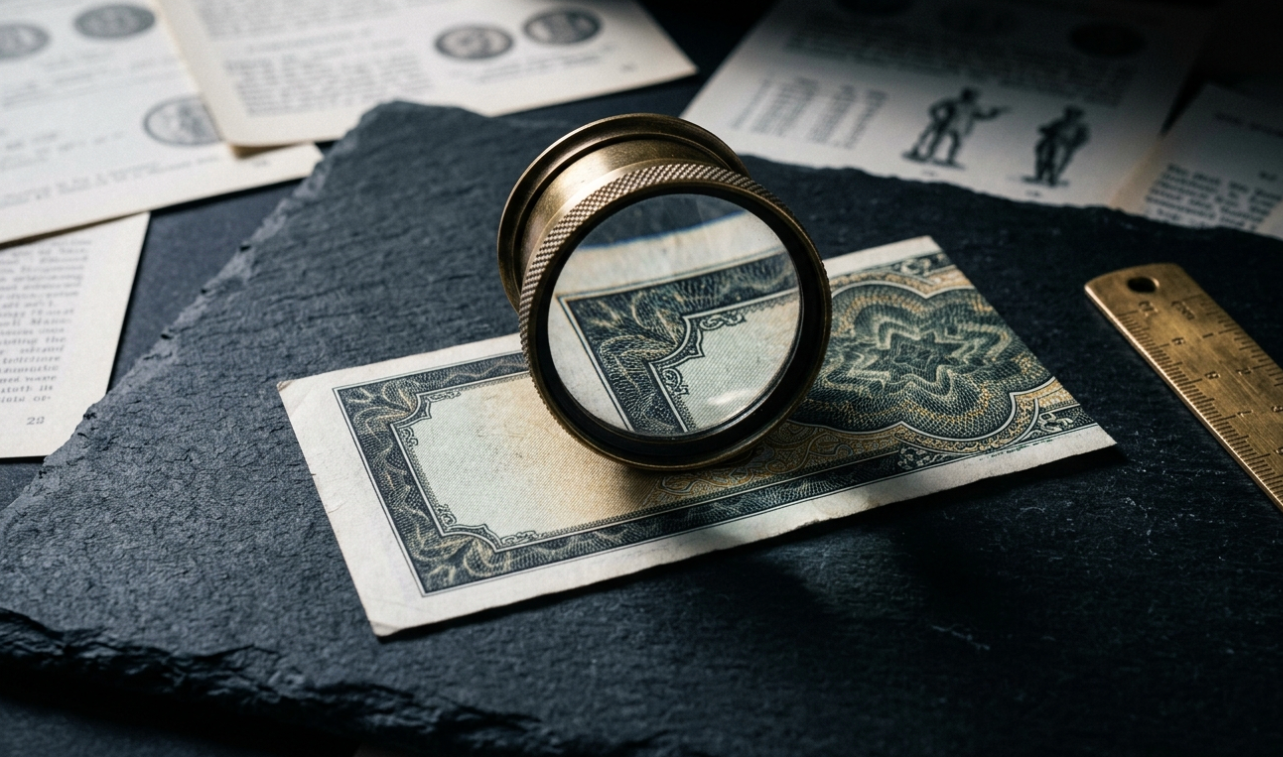
Famous Banknote Errors, Varieties & Misprints That Are Actually Worth Real Money
Ten Error Categories Every Collector Should Know — With Real Auction Prices, Identification Guides, and the Stories Behind the Most Valuable Misprints in History
The most famous misprinted banknote in American history sold for $396,000 in January 2021. It was a 1996 $20 Federal Reserve Note with a Del Monte banana sticker stuck to the paper before the final overprint went down — the sticker was permanently embedded in the printing process, charter sealed and serialized as part of the note itself. A single banana sticker, in the right circumstances, multiplied the face value of a $20 bill by nearly 20,000 times.
That story captures something essential about banknote errors. The Bureau of Engraving and Printing manufactures roughly 7 billion notes per year with extraordinary quality control. When mistakes survive, they survive against staggering odds — and collectors will pay extraordinary premiums for the ones that do. This guide walks through the ten most important error categories every collector should know, with real auction prices, identification techniques, and the stories that turned ordinary mistakes into trophy-tier collectibles.
How Banknote Errors Actually Happen
Modern U.S. currency is printed in three main stages: the back of the sheet is printed first and allowed to dry, then most of the front design is added, and finally the seals and serial numbers are overprinted. Each stage uses different printing equipment, different inks, and different alignment tolerances. Errors can occur at any stage — and because each error type leaves a distinctive signature, error collectors have developed precise terminology to describe and catalog them.
The single most important distinction is between errors and varieties. An error is an unintentional production mistake on a specific note or batch (a missing print, a shifted overprint, an ink smear). A variety is a documented difference between intended versions (an extra leaf added to a design die, a redesigned signature plate, a new seal style). Both are collectible, but they trade in different sub-markets and follow different pricing dynamics.
#1 — Inverted Overprints
An inverted overprint occurs when the sheet is rotated 180 degrees between printing stages, causing the seals and serial numbers to appear upside-down relative to the rest of the design. These errors are dramatic, immediately visible, and historically among the most popular collectible errors.
The legendary 1974 $1 Federal Reserve Note inverted overprints are perhaps the most famous American error series. Multiple sheets of these notes escaped detection at the Bureau of Engraving and Printing and entered circulation, with the green Treasury seal and serial numbers printed upside-down on the front. Quality examples regularly trade in the hundreds to low thousands of dollars depending on grade.
What to look for: The Treasury seal and serial numbers appear rotated 180 degrees relative to the portrait. The portrait, denomination text, and back design are oriented normally. PMG and PCGS Banknote both certify these errors with the appropriate notation on the holder label.
#2 — Missing Print Errors
A missing print error occurs when a note fails to receive ink at one of the three printing stages. The result can be dramatic: a Federal Reserve Note with no back design, or with the front design printed over a blank back, or with the overprint missing entirely.
One striking modern example is a 1977A $1 Federal Reserve Note (New York) that received only the front and overprint stages — the back was completely blank. The note was certified PMG 50 About Uncirculated and offered through Heritage Auctions. World banknotes can also exhibit this error: a 2001 Cuba 20 Pesos note with a completely blank back was certified PMG 66 Gem Uncirculated EPQ and realized $252 at a 2022 Heritage sale — modest by error standards but a substantial multiple of the note’s normal value.
What to look for: One side of the note is partially or completely blank, or specific elements (seal, serial number, treasury signature) are missing while the rest of the design is normal. Not to be confused with notes that have faded with age — missing print errors show no design where the design should be, with the paper itself looking fresh.
#3 — Multiple Impression Errors
The opposite of a missing print: a multiple impression error occurs when a note unexpectedly receives an extra print at one of the production stages. The result can be visually spectacular — a single note that contains elements from multiple print runs layered on top of each other.
One documented example is a 1985 $10 Federal Reserve Note (Richmond) where the front of the note shows the expected Alexander Hamilton portrait but also includes the Treasury Building and other elements from the back design layered on top. The result is a single side of paper showing front and back content simultaneously — a print that looks impossible at first glance.
What to look for: Visible ghost imagery, doubled designs, or design elements appearing on the wrong side of the note. Multiple impression errors are immediately obvious to any careful observer because the result is something that simply shouldn’t be possible on a normally produced note.
#4 — Mismatched and Duplicate Serial Numbers
Every U.S. banknote carries two serial numbers, one in the upper right and one in the lower left. They’re supposed to match. When they don’t, you have a mismatched serial number error — one of the rarest and most valuable error types because both serial numbers are printed in the same overprint stage.
A particularly intriguing modern example surfaced when the BEP’s Large Examining and Printing Equipment (LEPE) systems generated a $5 Federal Reserve Note with both mismatched and missing serial number digits. Bidding reached $5,500 at auction in 2022 before the bidding closed. The error was traced to a setup issue with the new LEPE production equipment that was approved for $5 production in 2019.
An even more unusual variant is the duplicate serial number error, where two different notes carry identical serial numbers. The famous “Project 2013B” tracking effort has documented millions of $1 notes from the 2013 series printed in pairs with matching serial numbers due to an internal Bureau of Engraving and Printing miscommunication. As of April 2023, only 37 matched pairs had been verified by Project 2013B. A confirmed pair sold for $25,000 in October 2022; an earlier pair reportedly sold for $150,000.
What to look for: Compare the two serial numbers on the front of any note carefully. They should be identical. If they differ, you may have a mismatched serial error. For duplicate serial errors, you would need two separate notes with the same serial number — or to consult the Project 2013B database to see if your serial number has a known match.
#5 — Double Denomination Errors (The Holy Grail)
The double denomination error is the most spectacular currency error type ever documented. It occurs when a note has one denomination printed on the front and a different denomination printed on the back — the result of a sheet being printed at one denomination, then somehow ending up in a print run for a different denomination at the next stage.
The most famous example is a $50/$100 Brown Back / Black Charge National Bank Note from 1882. Only two examples of this specific error are known to exist. One, issued by a bank in New Mexico Territory in 1882, resides in the American Numismatic Association Museum. The other, issued by Kansas City’s Aetna Bank, was the first to be offered at public auction since 1945 when it sold for $62,500 plus buyer’s fee in 2017. It changed hands again in 2023 for $70,500. The note shows a $50 denomination on the face and a $100 denomination on the back — an impossible production result that nonetheless escaped Bureau quality control 140+ years ago.
What to look for: The denomination text and numerals on the front of the note should match the denomination text and numerals on the back. If they don’t, you have either a double denomination error (extraordinarily rare) or a counterfeit (vastly more common). Authentication by PMG or PCGS Banknote is essential before celebrating — nearly all suspected double denomination errors turn out to be alterations or fakes.
#6 — Obstruction and Foreign Object Errors
This is the category that produced the legendary Del Monte note. An obstruction error occurs when a foreign object — a piece of paper, tape, sticker, or other material — ends up between the printing plate and the sheet at one of the production stages. The object blocks ink from reaching that part of the sheet, leaving an unprinted void in its shape.
The Del Monte note — a 1996 $20 Federal Reserve Note — takes this category to its extreme. A genuine Del Monte banana sticker (with the brand name and trademark visible) was caught between the printing plate and the sheet during the third printing stage, where the green Treasury seal and serial numbers are added. The sticker absorbed the green ink that should have hit the paper. When the sheet moved on, the sticker remained adhered to the note, became a permanent part of it, and was eventually cut and circulated as currency. The note sold for $396,000 in January 2021, making it the most valuable error note in U.S. history at the time of sale.
What to look for: An unprinted void in the shape of an object on one or more printing stages, often with the object itself still adhered to the paper or with traces of adhesive remaining. Authentication is critical — counterfeit Del Monte-style errors are common attempts at fraud, and only a handful of legitimate foreign-object errors have ever been certified.
#7 — Miscuts and Off-Center Printing
Miscut errors occur when a printed sheet is cut along the wrong axis, producing notes that include parts of adjacent notes from the same sheet, oversized margins on one side and missing design on the other, or notes that include selvage (the unprinted border of the sheet).
One striking example from world banknotes is a 2004 Zimbabwe 500 Dollar (Pick #11b) with such an extreme miscut that pieces of three different banknotes appear in a single example. The cut was so misaligned that what should have been a single note instead shows portions of the note above and the note below as well. Errors of this severity are visually arresting and command significant premiums over standard examples.
What to look for: Major margin imbalances, design elements running off the edge of the note in unexpected places, parts of adjacent notes visible at the edges, or unprinted selvage areas at the borders. The more extreme the miscut, the more valuable the error.
#8 — Ink Smears, Over-Inking, and Color Shifts
This category covers a range of errors caused by ink-related problems during printing. Over-inking occurs when too much ink is applied to a printing plate, producing blurred or smudged design details. Ink smears occur when wet ink transfers to unintended parts of the note. Color shifts can occur when one ink color is replaced or contaminated by another.
These errors are generally less valuable than the more dramatic categories above — common ink smear errors typically trade in the $50–$300 range depending on severity and grade. However, dramatic over-inking on high-denomination notes ($50 or $100 Federal Reserve Notes) can command stronger premiums, and certain documented color-shift errors on world banknotes have realized substantial prices.
What to look for: Visibly blurred or smeared design elements, ink in places ink shouldn’t be (like across borders or onto the back through bleed-through), or color elements that don’t match the standard reference for that note type.
#9 — National Bank Note Errors (A Specialty Within a Specialty)
National Bank Notes — the bank-specific currency issued by federally chartered banks from 1863 to 1935 — have their own dedicated error category that’s become a specialty within the larger Nationals collecting universe. These errors are particularly fascinating because they often involve the bank-specific overprinting that made each Nationals issue unique.
Documented National Bank Note error types include:
- Misspelled town names. The city of Bartlett, Texas had its name printed as “Barlett” on a shipment of 1929 $10 and $20 notes. Most were caught and cancelled at the time, but two examples are known today to the paper money collecting community.
- Wrong charter numbers. An Ashland, Virginia First National Bank 1929 $5 was printed with charter numbers in red that actually belonged to a different Ohio bank. The mismatched overprint was caught only after the notes had been distributed.
- Inverted digits in charter numbers. A Malta, Ohio Malta National Bank 1902 $10 features an inverted “5” in the charter number printed vertically next to the McKinley portrait. This note realized $7,475 at a 2009 auction and was offered as part of the famous Tulsa Collection of National Bank Note Errors.
- Missing charter numbers. A Chase National Bank of New York 1882 $5 Date Back was printed with the charter number 2370 entirely missing from where it should appear above and to the right of the word “CHASE” on the front of the note.
For a complete guide to collecting U.S. National Bank Notes, including how charter numbers work and what makes specific banks rare, see our companion guide to U.S. National Bank Notes.
#10 — World Banknote Errors and Spelling Varieties
Banknote errors are not unique to American currency. Every major central bank has occasionally produced errors that escape quality control, and some of the most fascinating examples come from world issues. A few notable cases:
The Australia 2018 $50 “Responsibility” Misspelling. The Reserve Bank of Australia issued a polymer 2018 $50 note (Pick #65a) with the word “responsibility” misspelled in microprint. The error went undetected for months before being caught by an alert public, with millions of misprinted notes already in circulation. Although the error is microprint-scale and not visible to the naked eye, the notes are now actively collected as a documented variety.
Zimbabwe Color Errors. A 2008 Zimbabwe 100,000 Dollar note (P-75) was printed without one of its offset ink colors, producing a striking color-mismatched example. Combined with Zimbabwe’s broader hyperinflation collecting popularity (covered in our 100 Trillion guide), color errors from this era have become a niche specialty.
Polymer Errors. The transition to polymer banknotes (covered in our existing polymer technology guide) has introduced new error types unique to the substrate — clear-window misalignments, foil application errors, and substrate defects. These are emerging as a modern specialty as more central banks adopt polymer.
Varieties: The Cousin of Errors
Beyond unintentional errors, many banknotes have documented varieties — deliberate differences between issues that create distinct collecting opportunities. Common variety categories include:
- Signature varieties. The same note design issued with different combinations of Treasury or central bank officials’ signatures. Some signature combinations are common; others are extreme rarities.
- Plate varieties. Notes printed from re-engraved or replacement plates that show subtle but consistent differences from the original.
- Star notes. U.S. Federal Reserve Notes and other issues use a star symbol in the serial number to mark replacement notes — printed to replace damaged sheets in production. Star notes from low-print runs are highly collectible.
- Series varieties. The same denomination issued across different series years, with varying design details, security features, and signature combinations.
- Overprint varieties. Notes overstamped or overprinted for specific purposes (Hawaii overprints, North Africa yellow seals from World War II, etc.).
The Authentication Imperative
If you remember nothing else from this guide, remember this: error notes attract counterfeiters and alterers more than any other category of paper money. The premiums commanded by genuine errors are so substantial that fabricating fake errors — through chemical processing, careful trimming, deliberate ink alteration, or complete fabrication — has become a meaningful fraud industry.
For this reason, professional certification by PMG or PCGS Banknote is non-negotiable for any error note worth more than a few hundred dollars. Both services have specialized error-note authentication processes, and both will note the specific error type on the holder label. Importantly, neither service charges an additional fee for error certification — the error notation is included with standard grading services. Submission forms include a Variety/Pedigree column where the submitter can describe the error for verification.
Buying a raw “error note” from an unverified source is the single most common way collectors lose money in this category. Buying certified errors from established dealers is the standard professional path. For a complete guide to PMG grading and what the holder label tells you, see What Is PMG Grading? The Complete Collector’s Guide.
- Edges that don’t look properly cut by Bureau equipment
- Ink chemistry that doesn’t match the era of the note
- Paper that shows chemical wash or treatment marks
- “Errors” suspiciously clean given their dramatic appearance
- Sellers unwilling to submit the note for certification before sale
How to Build an Error Note Collection
For collectors interested in pursuing this category, here is a practical roadmap:
- Start with affordable category examples. Common ink smears, modest miscuts, and standard inverted overprints can typically be acquired in the $100–$500 range graded. This builds familiarity with the category without significant capital exposure.
- Buy certified, not raw. The fraud risk in raw error notes is severe. PMG or PCGS Banknote certified examples eliminate the risk entirely.
- Specialize by category. Error notes span dozens of distinct types. Picking one or two categories (e.g., inverted overprints, missing prints, miscuts) and going deep is more rewarding than a scattershot approach.
- Build educational reference material. The PMG “Error Note Chronicles” series is a free, comprehensive online resource. Combined with major auction archives (Heritage Auctions, Stack’s Bowers, Lyn Knight), it provides the foundation for serious error-note connoisseurship.
- Watch your pocket change. Common error types occasionally appear in circulation, particularly mismatched serial numbers and minor miscuts. Cashiers, bartenders, and bank tellers are statistically the most likely people to encounter them.
- Store properly. Whether raw or certified, error notes deserve the same archival storage as your premium inventory. See our complete preservation guide for details.
Frequently Asked Questions
The famous “Del Monte Note” — a 1996 $20 Federal Reserve Note with a Del Monte banana sticker permanently embedded in the printing process — sold for $396,000 in January 2021, making it the most valuable single error note publicly recorded in modern American currency collecting.
Set the note aside immediately and do not spend it. Store it flat in an archival sleeve to prevent further wear. Photograph both sides. Compare the note to known error categories (the PMG “Error Note Chronicles” series is the best free reference). For any potential error worth investigating seriously, submission to PMG or PCGS Banknote for certification is the recommended next step — both services authenticate and grade error notes with no extra fee for the error designation.
Yes. Error notes are legitimate U.S. currency that simply slipped through Bureau quality control. They retain face value as legal tender, but their collectible value is typically many times higher — spending an error note destroys substantial collector value.
Authentication by PMG or PCGS Banknote is the only reliable answer. Both services have dedicated error-note expertise and equipment to detect post-production alterations. Common red flags for fake errors include suspiciously clean condition, edges that don’t match Bureau cutting tolerances, ink chemistry that doesn’t match the era, and sellers who refuse to submit the note for certification before sale. The premium commanded by genuine errors creates strong financial incentive for fraud, so caution is essential.
A star note is a deliberate replacement note used by the Bureau of Engraving and Printing to substitute for sheets damaged during production — it’s not an error, just a replacement note marked with a star symbol in the serial number. An error note is a note that escaped Bureau quality control with an unintended production defect. Both are collected, but they trade in different markets and follow different pricing dynamics. Star notes from low-print runs can be valuable, but they’re fundamentally a variety, not an error.
Auction history for major error categories shows generally firm prices, with trophy-tier examples (Del Monte, double denomination Nationals, key matched-pair Project 2013B notes) seeing strong upward movement over the past decade. As with any collectible, individual outcomes vary by category, condition, and market timing. We don’t make specific predictions about future values, but the long-term trend in well-documented error categories has been favorable.
The Bottom Line
Error notes are among the most fascinating — and most volatile — categories in modern currency collecting. The combination of dramatic visual interest, documented production stories, and authentication complexity makes them simultaneously rewarding to collect and risky to acquire without proper diligence. Done right, they offer some of the most distinctive trophy pieces available in numismatics; done wrong, they offer some of the most expensive lessons.
Planet Banknote occasionally acquires verified error and variety notes — we recommend checking our New Arrivals page for current availability. For collectors interested in error notes specifically, we’re happy to help with sourcing, authentication referrals, and category-specific guidance directly.
Explore Popular Articles

How to Start a World Banknote Collection for Under $100 (2026 Blueprint)
★ Featured in FeedSpot’s Top 20 Paper Money Blogs Collector’s Guide · July 2026 · 10 min read How t...
Raw vs. Graded Banknotes: When Is PMG Grading Worth the Premium?
★ Featured in FeedSpot’s Top 20 Paper Money Blogs Collector’s Guide · July 2026 · 11 min read Raw v...

Vietnamese Đồng: Collector's Guide to the Polymer Notes
Collector’s Reference · July 2026 · 9 min read The Vietnamese Đồng: A Collector’s Guide to the Worl...
2026's Record U.S. Banknote Auction Prices Explained
Market Reference · July 2026 · 8 min read Rare U.S. Banknotes Are on a Tear in 2026: Inside the Rec...