
3.4% Inflation vs. Real Hyperinflation: The Scale
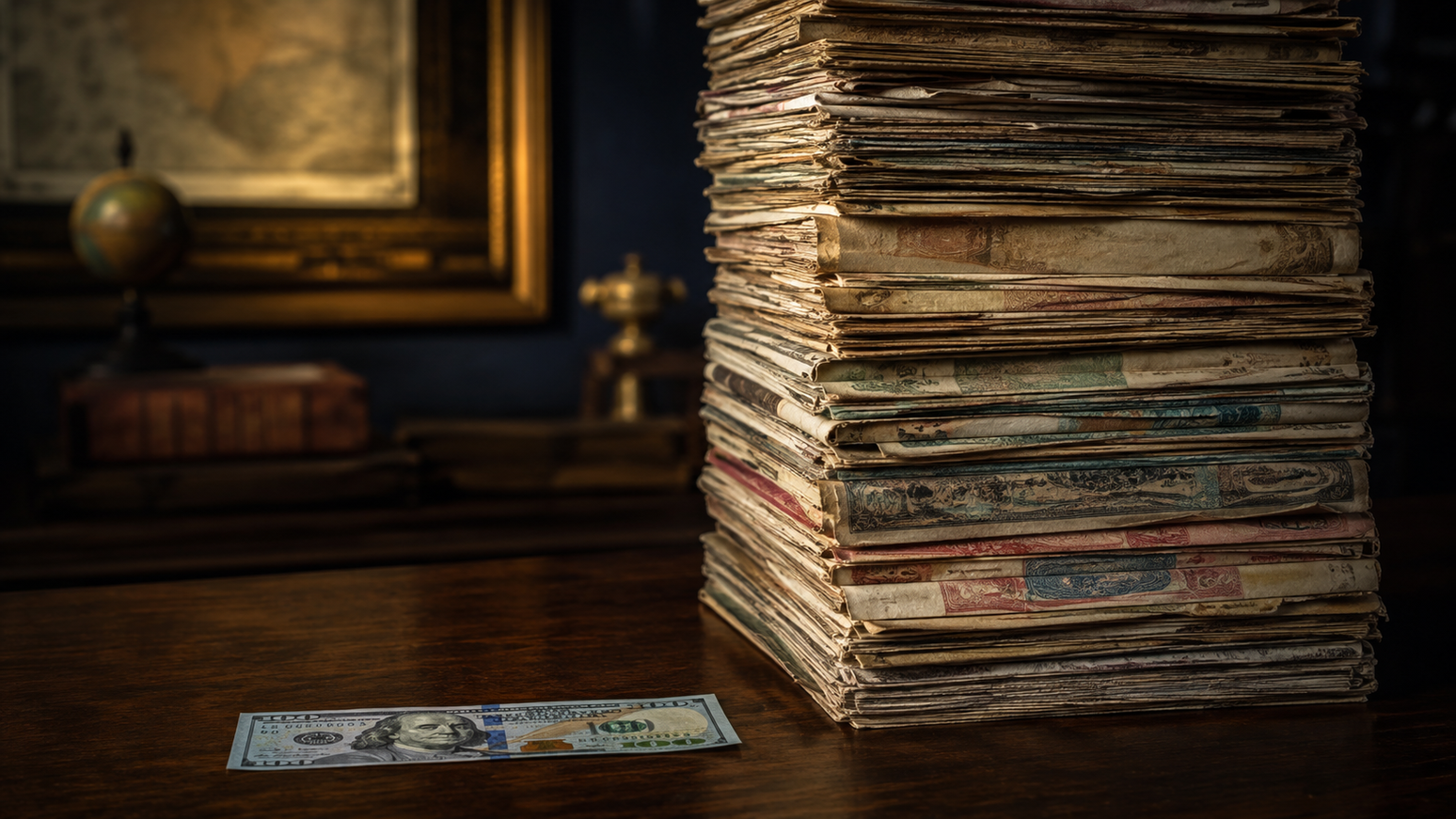
Collector's Guide · Hyperinflation · August 2026
What Does 3.4% Inflation Look Like Next to Real Hyperinflation?
The August 2026 CPI print came in at 3.4% — enough to make headlines. The banknotes in a hyperinflation collection come from economies where that was a good hour. Here's the honest scale of the difference.
Quick answer: At 3.4% annual inflation, prices take roughly 20 years and 9 months to double. During Hungary's 1946 hyperinflation — the worst ever recorded — prices doubled about every 15 hours. Zimbabwe in late 2008 doubled every 24.7 hours. The gap between ordinary inflation and hyperinflation isn't a matter of degree; it's a difference of roughly five orders of magnitude, and it's exactly why the banknotes those episodes left behind are collected today.
How long does it take prices to double at 3.4% inflation?
About 20.7 years. The math is simple: divide the natural log of 2 by the log of the inflation rate, or use the collector-friendly shortcut, the Rule of 72 (72 ÷ 3.4 ≈ 21 years). A child born on the day of the August 2026 CPI release would be applying to college before U.S. prices doubled at this pace.
Hyperinflation is formally defined — by economist Phillip Cagan's 1956 standard, still the one professionals use — as inflation exceeding 50% per month. At exactly 50% per month, prices double every 51 days. Every episode below blew far past that threshold.
How do history's worst hyperinflations compare?
| Episode | Peak rate | Prices doubled every | Highest denomination printed |
|---|---|---|---|
| United States, Aug 2026 | 3.4% per year | ~20.7 years | $100 |
| Weimar Germany, 1923 | ~29,500% per month (Oct 1923) | ~3.7 days | 100 trillion mark |
| Argentina, 1989–1991 | ~3,079% per year (1989) | weeks, at the worst stretch | 500,000 australes |
| Yugoslavia, Jan 1994 | ~313,000,000% per month | ~34 hours | 500 billion dinara |
| Zimbabwe, Nov 2008 | 89.7 sextillion % per month (est.) | ~24.7 hours | $100 trillion |
| Hungary, Jul 1946 | 41.9 quadrillion % per month | ~15 hours | 100 quintillion pengő |
Peak-rate figures follow the standard academic estimates (Cagan; Hanke & Krus, "World Hyperinflations," 2012). Zimbabwe's final months outran official statistics — the last official annual figure, July 2008, was already 231,000,000%.
What does hyperinflation actually feel like day to day?
Statistics compress the strangeness. The texture is in the details. In Berlin in November 1923, a loaf of bread cost around 200 billion marks, and workers were paid twice a day so their morning wages could be spent before losing value by evening. In Budapest in the summer of 1946, shops repriced goods multiple times per day, and the government invented an entirely separate indexed unit — the adópengő — just to keep tax collection meaningful. In Harare in 2008, the central bank added denominations so quickly that the $100 trillion note entered circulation in January 2009, barely six months after the $100 billion note it made obsolete.
A $100 trillion note is not a joke currency. It's the physical record of an economy forced to count in numbers no economy should ever need.
This is what makes these notes collectible rather than merely curious. Each one is a primary-source document: the paper, the ink, the ever-lengthening row of zeros trace the timeline of a monetary collapse more vividly than any chart. Zimbabwe's 2008 AA-prefix $100 trillion (Pick 91) has become the icon of the category precisely because it's the largest denomination of the most recent great hyperinflation — recent enough that crisp, uncirculated examples still exist in quantity, historic enough that they never will again. The note was demonetized in 2015; the Reserve Bank's official exchange rate at redemption valued it at 40 U.S. cents.
Why do collectors care about the difference between 3.4% and 41.9 quadrillion percent?
Because scarcity in this category is made by endings. Ordinary inflation produces no artifacts — the $100 bill of 2026 looks like the $100 bill of 2013. Hyperinflation produces artifacts constantly and then stops producing them forever, because the episode always ends the same way: the currency is replaced. Hungary introduced the forint in August 1946 at a conversion rate of 400 octillion pengő to one. Argentina retired the austral in 1992 at 10,000 to one new peso. Zimbabwe simply abandoned its dollar in 2009. Every one of those endings froze a finite supply of notes, and every year since, attrition has thinned it.
The comparison also keeps the category honest. A 3.4% print is a normal year in a functioning economy — annoying at the grocery store, invisible on a banknote. The notes on this page mark the rare moments when money itself failed. Collecting them isn't a bet on doom; it's owning the evidence of episodes the world worked hard to end, from countries whose later, stabilized currencies are the other half of the story.
Frequently asked questions
Is 3.4% inflation considered high?
It's above the Federal Reserve's 2% target but historically ordinary — U.S. inflation averaged roughly 3% across the 20th century. It is about fifteen million times too low to meet the formal definition of hyperinflation.
What officially counts as hyperinflation?
The standard definition, from Phillip Cagan's 1956 study, is inflation exceeding 50% per month — equivalent to about 12,875% per year. Roughly five dozen episodes in recorded history have crossed that line.
What is the worst hyperinflation ever recorded?
Hungary, July 1946, when monthly inflation reached an estimated 41.9 quadrillion percent and prices doubled roughly every 15 hours. Zimbabwe's November 2008 peak is the second worst.
Was the Zimbabwe $100 trillion note ever actually used?
Briefly. It circulated from January 2009 until Zimbabweans abandoned the currency for U.S. dollars and South African rand weeks later. At release it was worth around US$30 on the street and falling by the day.
How can I tell a genuine 100 trillion dollar note from a replica?
Genuine 2008-series notes carry the AA (or rarer AB) serial prefix, a silver security strip reading "RBZ," a Chiremba balancing-rocks watermark, and raised intaglio printing. Souvenir replicas typically fail the watermark and strip tests immediately. Buying from an established U.S. dealer, or buying PMG/PCGS-graded examples, removes the guesswork.
Are hyperinflation banknotes expensive to collect?
It remains one of the most affordable entry points in world paper money. Circulated Weimar, Yugoslav, and Argentine notes cost a few dollars; crisp uncirculated Zimbabwe 100 trillions and full country sets sit comfortably in double and low triple digits, with certified high grades above that.
Sources
- Hanke, S. & Krus, N., World Hyperinflations, Cato Institute Working Paper (2012)
- Cagan, P., "The Monetary Dynamics of Hyperinflation," in Studies in the Quantity Theory of Money (1956)
- U.S. Bureau of Labor Statistics, Consumer Price Index news release, August 12, 2026
- Reserve Bank of Zimbabwe demonetization notices (2015)
Own the scale of it
From the Zimbabwe 100 trillion to Argentine australes by the brick, every note is verified, ships free via U.S. Priority, and arrives with a COA.
Browse Hyperinflation Notes & Sets
Explore Popular Articles

Consecutive Serial Numbers: How to Buy Banknote Lots
Collector's Guide · Buying Guide · Updated October 7, 2026 Consecutive Serial Numbers, Explained: H...

Venezuela 200 Bolívares = 200 Million Old Bolívares
Collector's Guide · World Banknotes · Updated October 7, 2026 Venezuela's 200 Bolívares Note Equals...

Yugoslavia October Dinar 1993: All 10 Notes, Pick 128–137
Monetary History · September 30, 2026 · 8 min read Yugoslavia’s October Dinar, 1993: Six Zeros Off...

Venezuela 1,000,000 Bolívar Note (Pick 114), Explained
Collector’s Guide · September 29, 2026 · 7 min read Venezuela’s 1,000,000 Bolívar Note, Explained:...