
1946 Hungary 100,000 B.-Pengő (Pick 133): The Complete Collector's Guide

Collector's Guide · November 25, 2026 · 6 min read
1946 Hungary 100,000 B.-Pengő (Pick 133): The Complete Collector's Guide
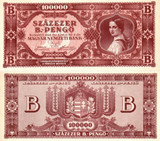
A farmer girl's portrait on a note worth 100 quadrillion pengő. How to read Pick 133, when it was issued, and how to judge one before you buy.
How much is 100,000 b.-pengő in pengő?
100 quadrillion pengő, a 1 followed by 17 zeros. The face prints only five of them. The other twelve hide in the unit: the b. stands for billió, the Hungarian word for a million million.
| Step | Figure |
|---|---|
| Number on the note | 100,000 (SZÁZEZER, "one hundred thousand") |
| Unit | 1 b.-pengő = 1012 pengő |
| Value in pengő | 100,000,000,000,000,000 (1017) |
| American name | 100 quadrillion |
| Hungarian long-scale name | száz billiárd (100 billiárd) |
The American and Hungarian names differ because the two languages count big numbers on different scales. Our post Billion or Milliard? explains the split, and the Learn page on milpengő vs b.-pengő compares Hungary's two 1946 units.
What are the specifications of the 1946 100,000 b.-pengő?
| Catalog number | Pick 133 (Adamo MBK2 P36) |
|---|---|
| Issuer | Magyar Nemzeti Bank (Hungarian National Bank) |
| Face text | SZÁZEZER B.-PENGŐ ("one hundred thousand b.-pengő") |
| Value | 100,000,000,000,000,000 pengő (1017) |
| Issued | July 2, 1946 |
| Demonetized | July 31, 1946 |
| Size | 178 × 80 mm |
| Front | Valéria Rudas, a farmer girl from the village of Bény, in Palóc folk dress |
| Back | Hungarian coat of arms framed by folk motifs |
| Designer | Endre Horváth (front and back) |
| Specimen | Known with MINTA ("sample") overprint |
Who is the woman on the 100,000 b.-pengő note?
Valéria Rudas, a farmer girl from the village of Bény, shown in traditional Palóc dress. The Palóc are a Hungarian ethnographic group from the hills of the north, known for richly embroidered costume. Unlike Lajos Kossuth on the 1,000,000 b.-pengő, she was not a national hero. She was an ordinary young woman whose face ended up on some of the largest numbers ever printed on money.
Endre Horváth designed both sides. The back carries the Hungarian coat of arms framed by folk motifs, which keeps the rural theme of the front.
Why does the 100,000 b.-pengő look like the 100,000 pengő?
Because it is the same design. In 1946 Hungary needed a new denomination every few days, so the Hungarian National Bank reused artwork from earlier notes and changed the unit. Pick 133 reuses the designs of the 100,000 pengő (Pick 121, which comes in blue and brown versions) and the 100,000 milpengő (Pick 127).
| Note | Pick | Value in pengő |
|---|---|---|
| 100,000 pengő | 121 | 105 (100 thousand) |
| 100,000 milpengő | 127 | 1011 (100 billion) |
| 100,000 b.-pengő | 133 | 1017 (100 quadrillion) |
All three say "one hundred thousand" on the face. Each is worth a million times the note before it. Side by side, they tell the story of Hungary's inflation without a single word of explanation, and they make a natural three-note set.
When was the 100,000 b.-pengő issued?
On July 2, 1946, one day after the 10,000 b.-pengő and two days before the 1,000,000 b.-pengő. It stayed legal tender for 29 days. In that month prices rose by about 41.9 quadrillion percent and doubled roughly every 15 hours, the fastest inflation ever recorded. Hungary issued larger notes on July 4, 8 and 11, ending with the 100,000,000 b.-pengő (Pick 136), the highest denomination ever circulated.
On August 1, 1946, the forint replaced the pengő at 400 octillion pengő (4 × 1029) to one forint. The background to that month, including the adópengő that ran alongside the b.-pengő, is in Hungary 1946: the worst hyperinflation in history and the adópengő vs the b.-pengő.
At the forint rate, a single forint was worth four trillion of these notes.
What is a 1946 Hungary 100,000 b.-pengő note worth?
As money, nothing since July 31, 1946. As a collectible, the price follows condition. Worn, folded copies survive in quantity. Notes that still have crisp paper, sharp corners and bright color are much harder to find, and 80 years on, a fully uncirculated copy is a real find.
When you shop for one, you will usually see three condition labels:
| Label | What it means | What to check |
|---|---|---|
| Circulated (VF, XF) | Used as money, with folds and softer paper | Tears, pinholes, stains |
| About Uncirculated (AU, aUNC) | Looks new, with a trace of handling such as a light fold or corner bend | Where the fold is and whether it breaks the paper |
| Uncirculated (UNC) | No handling at all | Corners, centering, and paper that has not been pressed flat |
A PMG holder takes the guesswork out of that last column. If the label carries EPQ (Exceptional Paper Quality), PMG found no sign that the paper was washed, pressed or otherwise treated. Our post on raw vs graded banknotes covers when a graded note is worth the step up.
How does Pick 133 fit with the other b.-pengő notes?
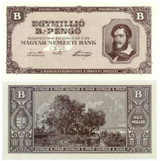
It is the second of five issued b.-pengő notes, each ten times the last: 10,000 (Pick 132), 100,000 (Pick 133), 1,000,000 (Pick 134), 10,000,000 (Pick 135) and 100,000,000 (Pick 136). A sixth, the 1,000,000,000 b.-pengő (Pick 137), was printed but never issued. Pick 133 and Pick 134 make a natural pair: two days apart, ten times apart, and with two very different faces: a farmer girl and a national hero. For the next note up, read our 1,000,000 b.-pengő (Pick 134) guide.
Frequently Asked Questions
How many zeros are in 100,000 b.-pengő?
Seventeen. The face shows five zeros, and the b.-pengő unit adds twelve: 100,000,000,000,000,000 pengő.
Who is on the 1946 Hungary 100,000 b.-pengő?
Valéria Rudas, a farmer girl from the village of Bény, in traditional Palóc dress. The note was designed by Endre Horváth.
When was the 100,000 b.-pengő issued?
July 2, 1946. It was demonetized on July 31, 1946, after 29 days in circulation.
Is the 100,000 b.-pengő the same design as the 100,000 pengő?
Yes. Pick 133 reuses the designs of the 100,000 pengő (Pick 121) and the 100,000 milpengő (Pick 127). Only the unit changed, and each step was worth a million times more.
Can you still exchange a 1946 b.-pengő note?
No. The pengő was replaced by the forint on August 1, 1946. Our Learn page on the pengő to forint changeover has the details. Today the note is a collectible only.
What is the difference between AU and UNC?
An uncirculated (UNC) note shows no handling at all. An About Uncirculated (AU) note looks new but has a trace of handling, usually a light fold or a corner bend.
Sources & Further Reading
- Numista: Hungary 100,000 B.-Pengő, 1946 (N# 208487) (size, portrait, designer, design reuse, MINTA specimen)
- Wikipedia: Hungarian pengő (units, 1946 inflation, forint rate)
- PMG (Paper Money Guaranty) (grading scale and EPQ)
- Planet Banknote Learn: Hungarian Pengő Series Catalog (issue dates)
- Planet Banknote Learn: Milpengő vs B.-Pengő
100 quadrillion pengő, in hand
Hungary 1946, 100,000 B.-Pengő (Pick 133), About Uncirculated (AUNC)
See the note →Through December 15, 2026, this note ships free with any order of $500 or more after code DEFLATION, and a PMG-graded Pick 134 ships free at $750 or more (one free note per order).
Explore Popular Articles
1946 Hungary 100,000 B.-Pengő (Pick 133): The Complete Collector's Guide
Collector's Guide · November 25, 2026 · 6 min read 1946 Hungary 100,000 B.-Pengő (Pick 133): The Co...
1946 Hungary 1,000,000 B.-Pengő (Pick 134): The Complete Collector's Guide
Collector's Guide · November 24, 2026 · 7 min read 1946 Hungary 1,000,000 B.-Pengő (Pick 134): The...
The Stories Behind Four Famous Banknotes (2026)
Collector's Guide · World Banknotes · November 2026 The Stories Behind Four Famous Banknotes Zimbab...

Can You Exchange Old Zimbabwe Dollars or Bolívars?
Numismatic Reference · November 16, 2026 · 6 min read Can You Still Exchange Old Zimbabwe Dollars o...