
1946 Hungary 1,000,000 B.-Pengő (Pick 134): The Complete Collector's Guide
Collector's Guide · November 24, 2026 · 7 min read
1946 Hungary 1,000,000 B.-Pengő (Pick 134): The Complete Collector's Guide
Six zeros on the face, eighteen in the value. How to read the quintillion-pengő note, when it was issued, whose portrait it carries, and what PMG grades mean for it.
How much is 1,000,000 b.-pengő in pengő?
One quintillion pengő, a 1 followed by 18 zeros. The face only shows six of them, because by the summer of 1946 Hungary was printing its notes in larger units. The b. stands for billió, the Hungarian word for a million million. Multiply the number on the note by the unit and you get the full value.
| Unit | Value in pengő | American name |
|---|---|---|
| 1 pengő | 1 | one |
| 1 milpengő | 106 | one million |
| 1 b.-pengő | 1012 | one trillion |
| 1,000,000 b.-pengő (Pick 134) | 1018 | one quintillion |
Hungarian counts on the long scale, so a Budapest shopkeeper in 1946 would have called 1018 one trillió pengő. In American English it is one quintillion. If the two scales trip you up, our guide to how many zeros are in a trillion lays out every rung, and the Learn page on milpengő vs b.-pengő covers the two units side by side.
What are the specifications of the 1946 1,000,000 b.-pengő?
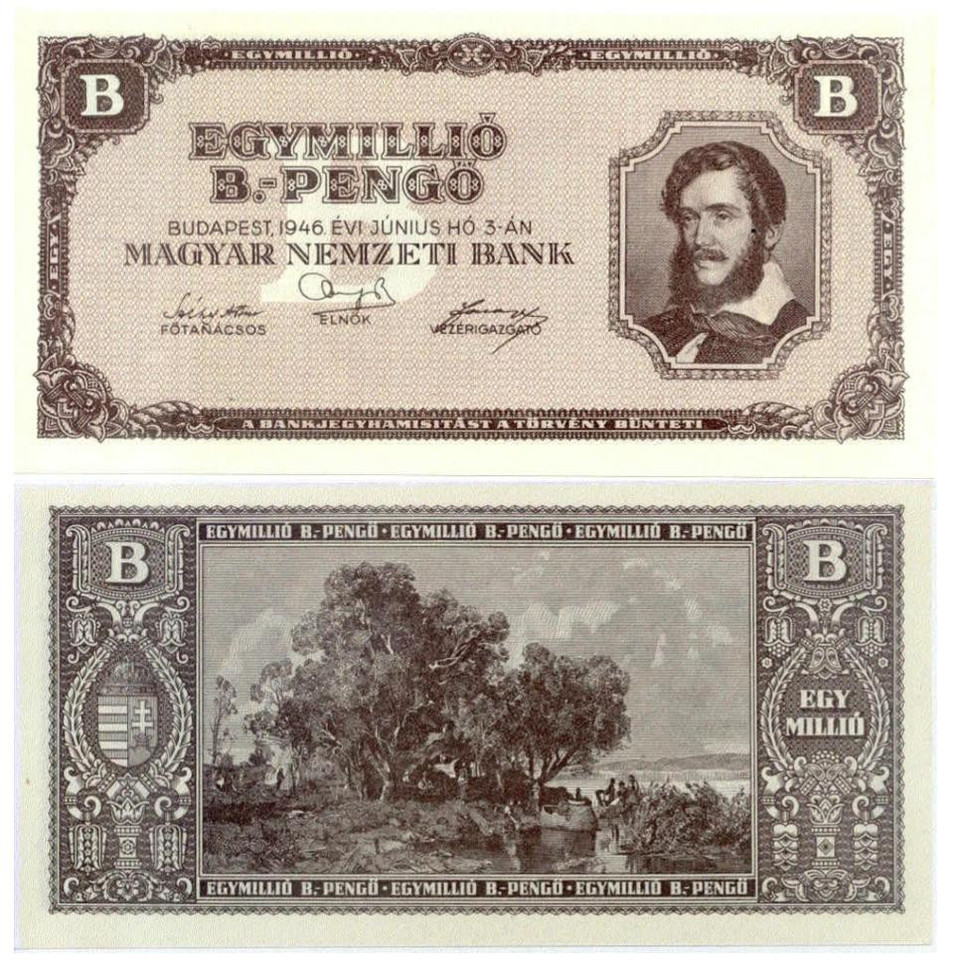
| Catalog number | Pick 134 (Adamo MBK2 P37) |
|---|---|
| Issuer | Magyar Nemzeti Bank (Hungarian National Bank) |
| Face text | EGYMILLIÓ B.-PENGŐ ("one million b.-pengő") |
| Value | 1,000,000,000,000,000,000 pengő (1018) |
| Issued | July 4, 1946 |
| Demonetized | July 31, 1946 |
| Size | 165 × 83 mm |
| Front | Portrait of Lajos Kossuth, designed by Ferenc Helbing |
| Back | "At the shore of Lake Balaton," a painting by Géza Mészöly |
| Specimen | Known with MINTA ("sample") overprint |
When was the 1,000,000 b.-pengő issued, and how long did it last?
It entered circulation on July 4, 1946, and was withdrawn on July 31. That is a working life of 27 days, and it was not even the shortest-lived note of that July. The b.-pengő series came out in five steps over eleven days, each worth ten times the last:
| Note (1946) | Pick | In pengő | Issued |
|---|---|---|---|
| 10,000 b.-pengő | 132 | 1016 | July 1 |
| 100,000 b.-pengő | 133 | 1017 | July 2 |
| 1,000,000 b.-pengő | 134 | 1018 | July 4 |
| 10,000,000 b.-pengő | 135 | 1019 | July 8 |
| 100,000,000 b.-pengő | 136 | 1020 | July 11 |
| 1,000,000,000 b.-pengő | 137 | 1021 | Printed, never issued |
The pace came from the worst inflation ever recorded. Prices in July 1946 rose by about 41.9 quadrillion percent in a single month and doubled roughly every 15 hours. Within a week of Pick 134's release, the 100 million b.-pengő (Pick 136) was out, and it remains the highest denomination ever put into circulation. On August 1, 1946, Hungary introduced the forint at 400 octillion pengő (4 × 1029) to one forint. For the full story of that summer, read Hungary 1946: the worst hyperinflation in history.
At the forint rate, it would have taken 400 billion of these notes to make a single forint.
Whose portrait is on the 1,000,000 b.-pengő note?
Lajos Kossuth, the leading figure of Hungary's 1848 to 1849 revolution and one of the country's most honored national heroes. The front was designed by Ferenc Helbing. The back reproduces "At the shore of Lake Balaton," a landscape by the 19th-century Hungarian painter Géza Mészöly.
The design was not new. With a new denomination needed every few days, the Hungarian National Bank reused artwork from earlier notes and changed the unit. Pick 134 reuses the designs of the 1,000,000 pengő (Pick 122) and the 1,000,000 milpengő (Pick 128). Put the three side by side and each one says "one million" on its face, yet each is worth a million times the one before it.
| Note | Pick | Value in pengő |
|---|---|---|
| 1,000,000 pengő | 122 | 106 (one million) |
| 1,000,000 milpengő | 128 | 1012 (one trillion) |
| 1,000,000 b.-pengő | 134 | 1018 (one quintillion) |
That makes Pick 134 a natural anchor for a small Hungarian set: three notes, the same word on each, and twelve zeros of history between the first and the last.
What is a 1946 Hungary 1,000,000 b.-pengő note worth?
As money, nothing since July 31, 1946. As a collectible, the price comes down almost entirely to condition. These notes survive in quantity, and worn, circulated copies turn up often. What collectors look for is a crisp uncirculated note, and the strongest demand is for uncirculated notes graded by PMG with the EPQ designation, because original paper is the hardest thing to prove on a note that is 80 years old.
Two notes can both look "uncirculated" in a photo and still be very different. A raw note can have a soft corner, a faint handling bend or paper that has been pressed flat. A PMG holder settles those questions for the next owner. If you are deciding between the two, our post on raw vs graded banknotes walks through when grading is worth it.
What do PMG grades mean on a Pick 134?
Our graded Pick 134s run from PMG 63 to 66 EPQ. Here is what each of those labels tells you:
| PMG label | Grade name | What it tells you |
|---|---|---|
| 63 | Choice Uncirculated | Never circulated, with minor flaws such as centering or light handling |
| 63 EPQ | Choice Uncirculated | Same grade, and PMG found the paper original and unprocessed |
| 64 | Choice Uncirculated | A step up in eye appeal, still short of Gem |
| 64 EPQ | Choice Uncirculated | Original paper at the top of the Choice range |
| 65 EPQ | Gem Uncirculated | Well centered, strong eye appeal, original paper |
| 66 EPQ | Gem Uncirculated | A Gem with better centering and eye appeal than a 65 |
EPQ stands for Exceptional Paper Quality. It means PMG saw no sign that the note has been washed, pressed or otherwise treated. On an 80-year-old note, that is the designation that matters most. For the rest of the label, including the serial number and the certification number you can look up online, see how to read a PMG banknote label.
Frequently Asked Questions
How many zeros are in 1,000,000 b.-pengő?
Eighteen. The face shows six zeros, and the b.-pengő unit adds twelve more: 1,000,000,000,000,000,000 pengő.
Is the 1,000,000 b.-pengő the highest denomination banknote ever?
No. Hungary issued two larger notes that same July: the 10,000,000 b.-pengő (Pick 135) and the 100,000,000 b.-pengő (Pick 136, 1020 pengő), which is the highest denomination ever circulated. A 1,000,000,000 b.-pengő (Pick 137) was printed but never issued.
What does b.-pengő mean?
Billió-pengő. In Hungarian a billió is a million million, so one b.-pengő was 1012 pengő.
Can you still exchange a 1946 b.-pengő note?
No. The note was demonetized on July 31, 1946, and the forint replaced the pengő on August 1, 1946. Today it is a collectible only. Our Learn page on the pengő to forint changeover has the conversion details.
Who is on the 1946 Hungary 1,000,000 b.-pengő?
Lajos Kossuth, leader of the 1848 to 1849 Hungarian revolution. The back shows Géza Mészöly's painting "At the shore of Lake Balaton."
What does EPQ mean on a PMG holder?
Exceptional Paper Quality. PMG adds it when the paper is original, with no evidence of washing, pressing or other processing.
Is there a specimen of the 1,000,000 b.-pengő?
Yes. Specimens overprinted MINTA, Hungarian for "sample," are catalogued, but they are far scarcer than issued notes.
Sources & Further Reading
- Numista: Hungary 1,000,000 B.-Pengő, 1946 (N# 208489) (size, designers, design reuse, MINTA specimen)
- Wikipedia: Hungarian pengő (units, 1946 inflation, forint rate)
- PMG (Paper Money Guaranty) (grading scale and EPQ)
- Planet Banknote Learn: Hungarian Pengő Series Catalog (issue dates)
- Planet Banknote Learn: The Hungarian 100 Quintillion Pengő
One quintillion pengő, in hand
Hungary 1946, 1,000,000 B.-Pengő (Pick 134), uncirculated: buy one, get a second one free
See the note →Prefer it graded? We also carry PMG-graded copies from 63 to 66 EPQ. Through December 15, 2026, a PMG 65 EPQ Pick 134 ships free with any order of $750 or more after code DEFLATION (one free note per order).
Explore Popular Articles
1946 Hungary 1,000,000 B.-Pengő (Pick 134): The Complete Collector's Guide
Collector's Guide · November 24, 2026 · 7 min read 1946 Hungary 1,000,000 B.-Pengő (Pick 134): The...
The Stories Behind Four Famous Banknotes (2026)
Collector's Guide · World Banknotes · November 2026 The Stories Behind Four Famous Banknotes Zimbab...

Can You Exchange Old Zimbabwe Dollars or Bolívars?
Numismatic Reference · November 16, 2026 · 6 min read Can You Still Exchange Old Zimbabwe Dollars o...

What Are Old Venezuelan Bolívar Notes Worth? (2026)
Collector's Guide · November 16, 2026 · 7 min read What Are Old Venezuelan Bolívar Notes Worth? A 2...