


-
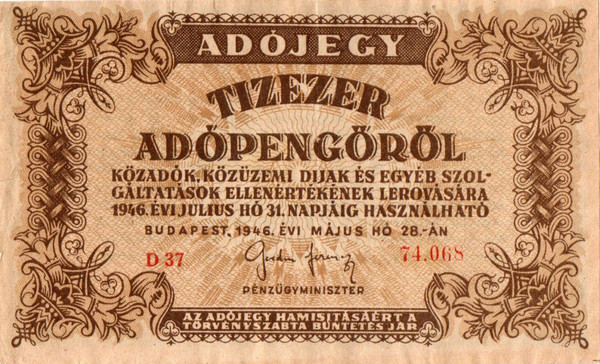

1946 Hungary 10,000 Adópengő Tax Voucher P-143 XF — 20 Septillion Pengő Equivalent
$59.00The 1946 Hungary 10,000 Adópengő tax voucher is an important monetary artifact from the final weeks of Hungary’s catastrophic postwar hyperinflation. Adópengő translates as “tax pengő.” I -


1946 Hungary 1,000,000 Adópengő P-140a XF — 2 Octillion Pengő Equivalent
$137.00The 1946 Hungary 1,000,000 Adópengő note is a remarkable surviving artifact from the most severe recorded hyperinflation in monetary history. Hungary introduced the Adópengő, meaning “tax... -
Only 2 left


1946 Hungary 100,000 Adópengő Tax Voucher P-144 UNC — 200 Septillion Pengő Equivalent
$99.00This 1946 Hungary 100,000 Adópengő tax voucher documents the extraordinary final phase of Hungary’s postwar hyperinflation. The Adópengő was initially established as an indexed tax and accounting uni -

 - 29%- 29%
Hungary 1,000,000,000,000,000,000 Pengo 1946 P-134 UNC (1 Quintillion) B-Pengo 1946
$239.00$339.00Hungary 1 Quintillion B-Pengo 1946 P-134, Uncirculated (Unc) Description: Step into a unique chapter of world history with the Hungary 1 Quintillion B-Pengo banknote from 1946, cataloged as P-134...
Description
This 1946 Hungary 100,000,000 Adópengő tax note, cataloged as Pick 142, is offered in Extra Fine (XF) condition. The Hungarian denomination “Százmillió Adópengő” translates as one hundred million tax pengő. Issued during the final days of Hungary’s historic post–World War II hyperinflation, this enormous-denomination note represents the highest regularly issued value in the adójegy tax-voucher series.
The note is formally identified as an adójegy, or tax voucher. Its printed inscription states that it could be used through July 31, 1946, for the payment of public taxes. The adópengő had originally been introduced on January 1, 1946, as an indexed accounting unit intended to preserve the government’s ability to assess taxes and manage financial obligations while the ordinary pengő rapidly depreciated.
Unlike the B.-pengő, which represented a fixed multiple of one trillion ordinary pengő, the adópengő had a changing conversion rate. Its value was periodically adjusted against the collapsing pengő. On July 31, 1946, the final index valued one adópengő at approximately two sextillion ordinary pengő. At that rate, this 100,000,000 adópengő note represented approximately 200 octillion ordinary pengő, written numerically as 200,000,000,000,000,000,000,000,000,000 pengő.
The extraordinary conversion illustrates the speed and severity of Hungary’s monetary collapse. The country emerged from World War II with devastated infrastructure, greatly reduced industrial and agricultural production, shortages of essential goods, occupation expenses, rebuilding costs, and an impaired tax system. Government expenditures were increasingly financed through currency creation, while the available supply of goods remained severely restricted. As confidence in the pengő disappeared, prices accelerated until Hungary experienced the most extreme recorded hyperinflation in monetary history.
The adópengő began as a government and banking accounting device, but physical tax vouchers were later issued to the public. During the final stage of the crisis, these notes took on a broader monetary role as the ordinary pengő became practically unusable. Both systems ended with the introduction of the Hungarian forint on August 1, 1946. Under the stabilization reform, one forint was established as the equivalent of 400 octillion ordinary pengő, making this 100 million adópengő tax voucher equal to approximately one-half forint at the final conversion rate.
The note features an ornate security-style border, bold denomination lettering, official tax-payment language, and the formal appearance of a government fiscal document. These characteristics reflect its unusual position between a tax instrument, indexed accounting unit, and emergency form of circulating money.
As the highest regularly issued denomination of the adójegy series, this Pick 142 Százmillió Adópengő is a significant artifact of Hungary’s 1946 currency crisis. Its immense final pengő equivalent, specialized fiscal purpose, brief period of validity, and connection to the introduction of the forint make it especially appealing to collectors of Hungarian banknotes, hyperinflation currency, emergency money, and twentieth-century economic history.