
The Texas Trophy
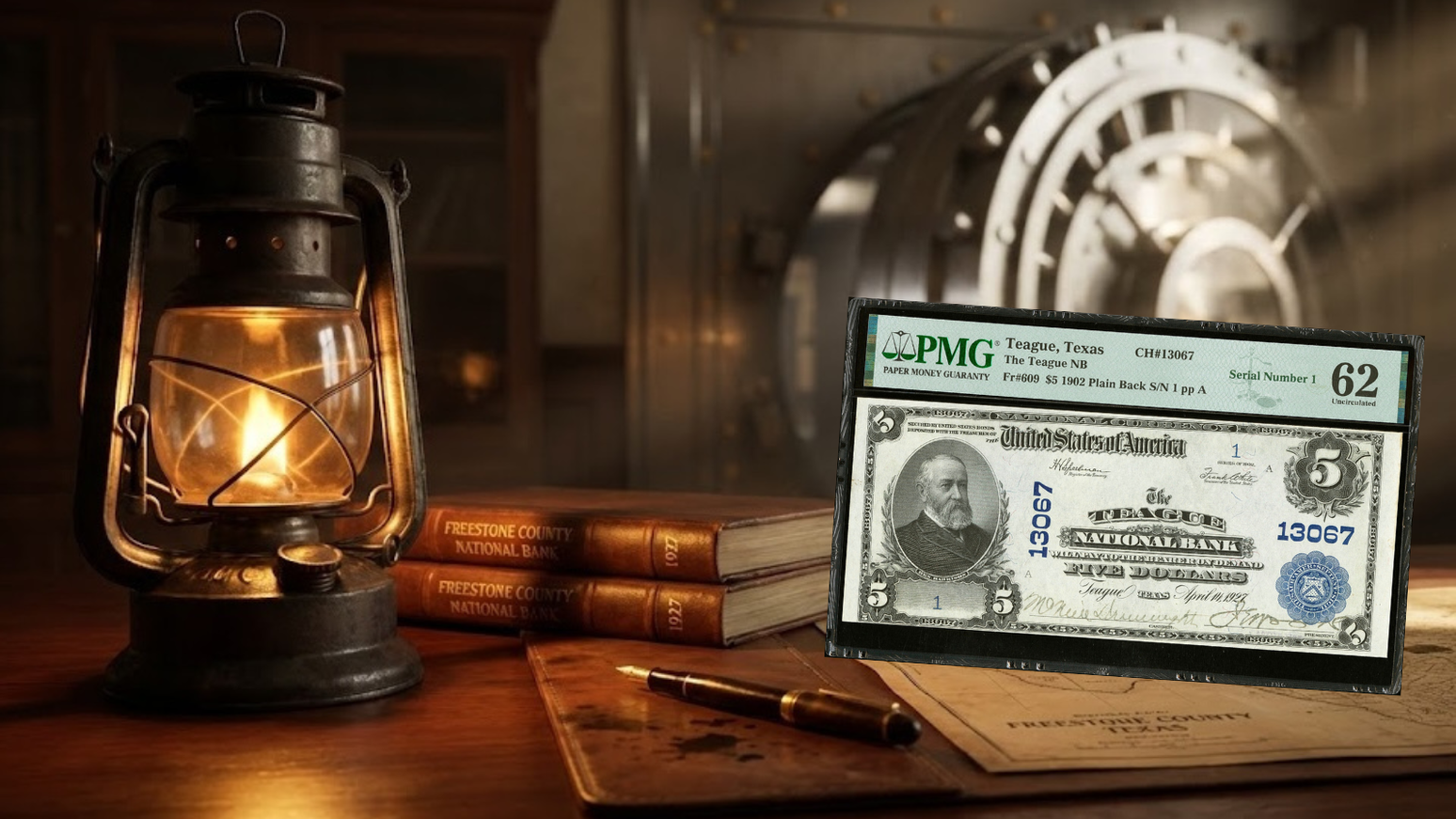
The Numismatic Genesis of Freestone County
A Comprehensive Analysis of the Serial Number 1 Teague National Bank Five-Dollar Note
The emergence of the Teague National Bank, operating under Federal Charter 13067, represents a critical intersection of late-era National Banking history and the rapid industrialization of Central Texas during the 1920s. Among the surviving relics of this institution, few items command as much reverence as the Series 1902 $5 Plain Back note bearing Serial Number 1.
This specific instrument, certified by PMG as Uncirculated 62, serves as a primary document for understanding the financial aspirations of a community built upon the iron rails of the Trinity and Brazos Valley Railway. As the only large-size Serial Number 1 example reported for this charter, the note is not merely a piece of currency but a "Texas Trophy" that encapsulates the twilight of the large-size note era.
The Historical Foundations of Teague and Freestone County
The town of Teague, located in Freestone County, Texas, was not a product of gradual frontier expansion but rather a deliberate creation of the railroad industry at the dawn of the twentieth century. Prior to the arrival of the locomotive, the area was a quiet settlement known as Brewer, which had seen modest growth since the post-Civil War era. The transformation of this hamlet into a bustling rail hub was catalyzed by the vision of Benjamin Franklin Yoakum, a railroad magnate who sought to connect the burgeoning markets of North Texas with the Gulf Coast.
The Influence of the Trinity and Brazos Valley Railway
The incorporation of Teague in 1906 was a direct result of the Trinity and Brazos Valley Railway (T&BV) construction. The town took its name from Betty Teague, the niece of B.F. Yoakum, signaling the deep symbiotic relationship between the community and the corporate interests that birthed it. Known affectionately as the "Boll Weevil" line—a nod to the pervasive pest that threatened the region's primary cash crop, cotton—the T&BV positioned Teague as a major destination point between Houston and Fort Worth.
By 1910, the population of Teague had reached 3,288, reflecting the rapid influx of workers and merchants drawn by the railroad’s presence. This growth continued steadily through the 1920s, with the census reporting 3,509 residents by 1930. The presence of six daily trains underscored the town's importance as a logistical node, necessitating a sophisticated banking infrastructure to manage the payroll of rail employees and the capital generated by the cotton trade.
| Period | Key Event | Economic Impact |
|---|---|---|
| Pre-1900 | Settlement of Brewer | Modest agricultural growth in Freestone County |
| 1902 | T&BV Railway Chartered | Initial rail connections established between Hillsboro and Mexia |
| 1906 | Teague Incorporated | Town named after Betty Teague; First National Bank (Charter 8195) founded |
| 1907 | Expansion to Houston | Teague becomes a major division point and railroad hub |
| 1927 | Nationalization | Teague State Bank converts to Teague National Bank (Charter 13067) |
| 1930 | Reorganization | B-RI Railroad Company formed; Teague National Bank building remodeled |
| 1945 | Consolidation | J.E. Woods unifies Charter 13067 and Charter 8195 into a single institution |
The economic vitality of the region during this period was inherently volatile, tied as it was to both the railroad's profitability and the harvest yields of Freestone County farmers. This volatility required local financial institutions to be robust. While the First National Bank of Teague (Charter 8195) had served the community since 1906, the demand for additional banking services led to the eventual establishment of the Teague National Bank in 1927.
The Evolution of the Teague National Bank (Charter 13067)
The Teague National Bank did not begin its life as a new entity but rather as a strategic conversion of the Teague State Bank. This transition, occurring in May 1927, was a significant move for the local directors, reflecting a desire to align with the national currency system and the prestige afforded by a federal charter. The timing was particularly notable, as it occurred during the height of the 1920s economic boom, yet only two years before the catastrophic stock market crash of 1929.
Organizational Structure and Leadership
The conversion process was overseen by a board of seasoned local leaders. In January 1927, the stockholders of the Teague State Bank elected a slate of directors that would soon lead the newly nationalized institution. Roy Simmons served as the Chairman of the Board, while T.B. Poindexter was elected President. Perhaps the most influential figure in the bank’s history, however, was Joseph Edgar "Jodie" Woods, who initially served as the active Vice President before ascending to the presidency in February 1929.
The institutional continuity provided by these men allowed the Teague National Bank to survive the initial shocks of the Great Depression. J.E. Woods, in particular, would go on to become a titan of Texas banking, eventually serving as a director of the Federal Reserve Bank of Dallas and purchasing controlling interests in several regional banks, including the consolidation of Teague's two national banks in 1945.
| Official Name | Role (at Chartering) | Signature Presence | Historical Significance |
|---|---|---|---|
| T.B. Poindexter | President (1927–1928) | Early Issues | Resigned to focus on interests in Wortham, TX |
| J.E. Woods | Vice President / President | President on SN 1 | Former President of Texas Bankers Association |
| McNeill Drumwright | Cashier (1927–1935) | Cashier on SN 1 | Continuous officer through the end of the note era |
| Roy Simmons | Chairman | N/A | Prominent regional businessman and board patriarch |
| Dr. W.P. Harrison | Vice President | N/A | Medical doctor and long-term director |
The conversion to a national charter involved rigorous federal oversight. The Teague National Bank was authorized with a capital of $60,000 and a surplus that was increased from $12,000 to $20,000 during the transition. This capital allowed the bank to purchase United States bonds, which were then deposited with the Treasurer of the United States to secure the issuance of National Bank Notes. The charter was officially granted on May 2, 1927, making Charter 13067 one of the later charters issued during the large-size note era.
Numismatic Analysis of the Series 1902 $5 Plain Back Note
The $5 note in question belongs to the Series 1902 Plain Back variety, which represents the third and final design phase of the 1902 series. To understand the significance of this specific note, one must analyze both its technical production and the artistic elements that define it as a masterpiece of American engraving. The "Plain Back" designation refers to the removal of the 1902–1908 charter dates from the reverse of the note, a change that was implemented starting in 1915.
| Variety Type | Issue Period | Distinctive Features | Survivor Frequency |
|---|---|---|---|
| Red Seal | 1902–1908 | Red Treasury seal and serials; 1902–1908 dates on back | 5% of reported notes |
| Date Back | 1908–1915 | Blue seal; 1902–1908 dates on back; Aldrich-Vreeland era | 15% of reported notes |
| Plain Back | 1915–1929 | Blue seal; dates removed from reverse; simplified design | 80% of reported notes |
The Significance of the Double Serial Number 1
In the world of numismatics, the serial number of a note is a primary indicator of its historical priority and rarity. The Teague National Bank $5 note is distinguished by its "Double Serial Number 1" status. This means that the note bears the bank serial number "1" as well as the treasury serial number "1," identifying it as the very first $5 note from the very first sheet printed for Charter 13067.
Typically, Serial Number 1 notes were set aside by bank officers or local dignitaries as souvenirs of the bank's opening. In the case of Teague National, it is highly likely that J.E. Woods or McNeill Drumwright ensured this note was preserved as a historical record of their new national charter.
| Position | Bank Serial Number | Treasury Serial Number | Plate Position |
|---|---|---|---|
| Top Note | 1 | (Duplicate) | A |
| Second Note | 1 | (Duplicate) | B |
| Third Note | 1 | (Duplicate) | C |
| Bottom Note | 1 | (Duplicate) | D |
Market Valuation and Collectibility in the 21st Century
For the modern collector and historian, the $5 Serial Number 1 note is more than a numismatic specimen; it is a portal into the year 1927. The value of such an item is driven by its rarity, its town-specific history, and the prestige of the Serial Number 1. Planet Banknote identifies this piece as an anchor for any specialized cabinet focusing on Lone Star State Nationals.
- Rarity: Only one large-size Serial Number 1 reported for the charter.
- Condition: PMG Uncirculated 62 provides exceptional eye appeal with bright inks and strong signatures.
- Late Charter Appeal: The narrow window of issuance (1927–1929) makes survivors from this bank far more scarce than older, longer-lived charters.
- Historical Figures: The presence of J.E. Woods' signature adds "pedigree" value to the note for Texas history specialists.
In comparison to other iconic Serial Number 1 notes, the Teague example holds its own as a premier regional rarity. While notes from major financial hubs like Newark or Philadelphia may be more common in the aggregate, the survival of a Serial Number 1 from a small railroad town in Freestone County is a testament to the enduring appeal of local history.
Conclusion: The Convergence of History and Value
The $5 1902 Plain Back note from the Teague National Bank stands at the pinnacle of Texas numismatic items. Its value is derived not only from its technical rarity and pristine condition but from the rich historical tapestry into which it is woven. It is a tangible link to the "Boll Weevil" railway, the cotton fields of Freestone County, and the visionary leadership of J.E. Woods. As the town of Teague continues to preserve its heritage through its museums and historic architecture, this note serves as the ultimate documentary evidence of the town's entry into the national financial stage. The "Double Serial Number 1" is, in every sense, the beginning of that story—a genesis captured in ink and paper that continues to fascinate nearly a century later.
Explore Popular Articles

The Iraqi Dinar: 5000 Years of History
The Iraqi Dinar: A Collector’s Guide to the Banknotes of Mesopotamia History, Designs, Security Fea...

Collectors Guide to Zimbabwe AA 100 Trillion Dollar Banknote
The Complete Collector’s Guide to the Zimbabwe 100 Trillion Dollar Note History, Authentication, Gr...

Defeating Counterfeits with Tech
The Future of Authentication Defeating Counterfeits with Tech in the 2026 Monetary Landscape The gl...