
The End of a Corrupt Narco-Regime in Venezuela: The Venezuelan Pivot (2026)
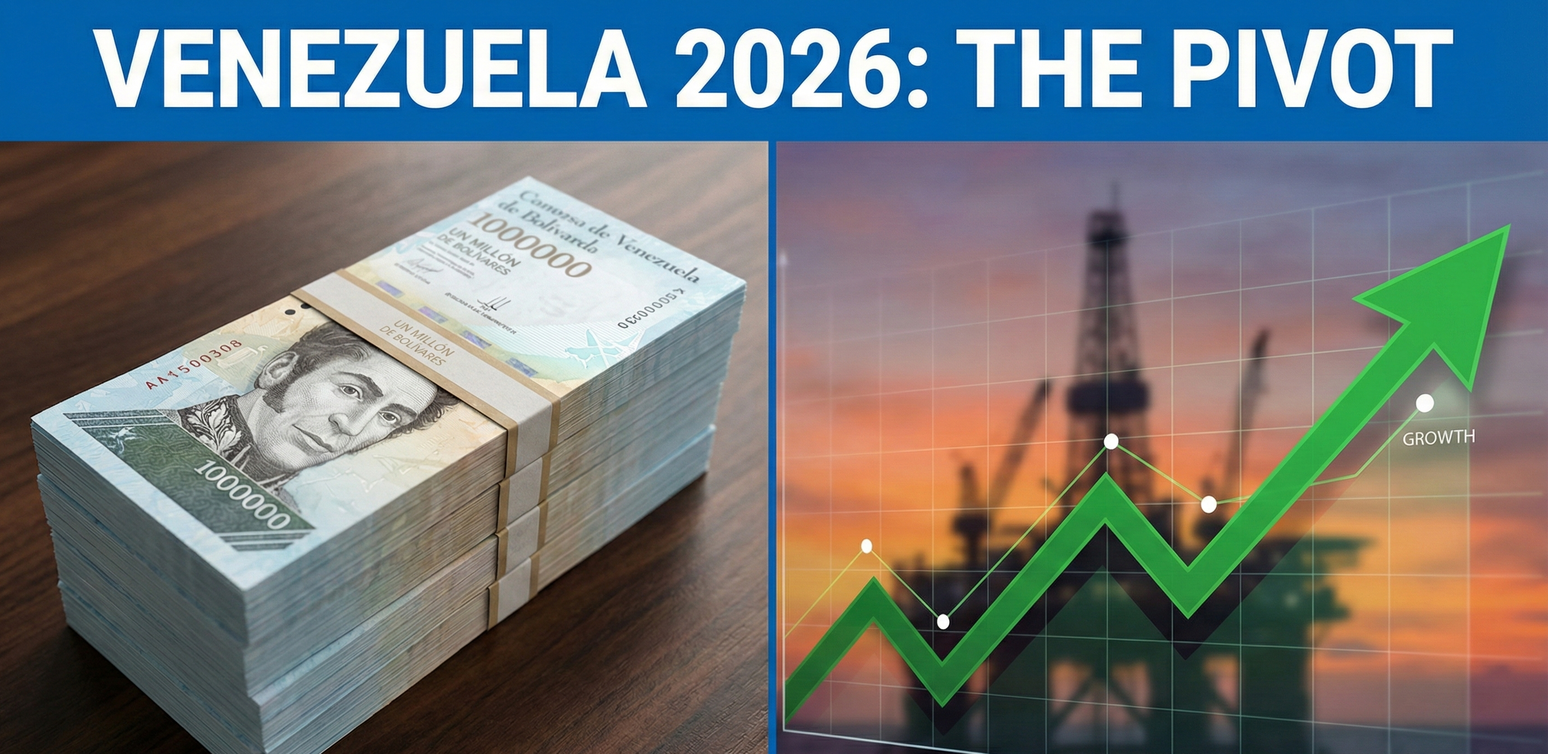
The Venezuelan Pivot (2026)
On January 3, 2026, the geopolitical architecture of the Western Hemisphere underwent a seismic shift with the execution of "Operation Absolute Resolve," a United States military operation that resulted in the capture of Venezuelan President Nicolás Maduro. This event has effectively decapitated the administrative structure that has governed the nation for over two decades. For the global financial community, energy markets, and specifically for holders and observers of the Venezuelan Bolívar (VES/VED), this moment represents a singularity—a point where past trends of isolation may decouple from a future trajectory of reconstruction and revaluation.
This report provides an exhaustive analysis of the post-Maduro landscape. It is designed to interrogate the structural economic realities that will define the coming decade. We view the currency as a distressed asset with significant option value, contingent on specific geopolitical and macroeconomic triggers. We invite the reader to look beyond the headline inflation figures and question the potential asymmetry of a currency backed by 300 billion barrels of oil in a world hungry for energy security.
Part I: The Geopolitical Event Horizon
1.1 Operation Absolute Resolve
The morning of January 3, 2026, will likely be recorded as the definitive end of the previous era. Following months of escalating signals, U.S. forces executed a precision extraction operation within Caracas. The operation was framed by the U.S. administration not as a political regime change, but as the enforcement of standing criminal indictments.
- The Culmination of Intelligence: Penetration of security circles allowed for a targeted operation.
- The Legal Nexus: Designations regarding narco-terrorism provided the domestic legal justification for action.
- Regional Stability: The need to stabilize the region and halt migration flows by restoring Venezuela's economic engine.
1.2 The Power Vacuum and Transitional Authority
The immediate aftermath of the capture created a power vacuum in Caracas. President Trump’s statement that the U.S. would oversee the country until a "safe, proper, and judicious transition" can be organized indicates a suspension of traditional sovereignty in favor of a reconstruction mandate.
For the currency markets, this transitional period is the point of maximum potential. The "risk premium" on Venezuelan assets is high, but the involvement of the U.S. Treasury and the potential unfreezing of assets held abroad could provide the first injection of liquidity the country has seen in a decade.
Part II: The Macroeconomic Landscape
2.1 The Oil Industry: The Sleeping Giant
The bullish case for Venezuela—and by extension, its currency—rests entirely on its geology. Venezuela holds the world’s largest proven oil reserves, estimated at over 300 billion barrels. This endowment exceeds that of Saudi Arabia. The capture of Maduro changes the calculus for the oil sector fundamentally, implying the potential lifting of sanctions and the return of majors like ExxonMobil and ConocoPhillips.
Table 1: Venezuela Oil Sector Snapshot
| Metric | Current Status (2026) | Potential Future (2030+) |
|---|---|---|
| Proven Reserves | ~303 Billion Barrels | ~303 Billion Barrels |
| Daily Production | ~1 Million bpd | ~3 Million bpd |
| Primary Partner | Limited Markets | United States / Global |
| Infrastructure | Needs Repair | Modernized / Foreign Investment |
If production can be restored, the revenue inflow would be sufficient to back a new monetary regime. In a restructuring scenario, these reserves can be securitized to support the value of the national currency, providing a tangible floor to the unit.
2.2 The Current Currency Landscape
The Venezuelan currency system has undergone multiple redenominations. Currently, physical banknotes exist and circulate. For the investor or collector, this multiplicity creates a unique landscape. The "old" notes exist as physical assets, and the "new" notes are legal tender but deeply undervalued. In a reconstruction scenario, the question becomes: how will these vintages be recognized? A conversion window for Bolívars could provide significant opportunities for holders of the physical currency.
Part III: The Reconstruction Playbook
With the removal of political blockages, the reconstruction of Venezuela becomes a technical challenge. The U.S. administration will likely deploy a playbook focused on rapid stabilization.
- Exchange Rate Unification: Eliminating the distinction between official and parallel rates, allowing the currency to find its true market price.
- Anchor Implementation: Choosing a monetary anchor to restore trust, potentially backed by reserves.
- Oil-for-Reconstruction: Comments regarding U.S. oil companies investing suggest a model where oil revenues are channeled into reconstruction. This mechanism would be incredibly bullish for the currency, essentially "backing" the Bolívar with the integrity of the global energy market.
Part IV: Historical Precedents for Resurrection
History is replete with examples of currencies that were distressed, only to be revived or exchanged for value once the political regime changed and economic orthodoxy was restored.
The German Miracle: The Rentenmark (1923)
The Iraqi Dinar (2003)
Following the events of 2003, the Iraqi Dinar was in a state of flux. The Coalition Provisional Authority issued a New Iraqi Dinar and established an exchange window where old Dinars could be swapped. The currency stabilized and appreciated from its wartime lows.
Part V: Scenarios for the Bolívar (2026-2030)
- Scenario A: The "Panama" Option (Full Dollarization). Venezuela adopts the U.S. Dollar. Existing Bolívars would likely be exchanged for dollars at a set market rate for a limited time.
- Scenario B: The "Argentina" Option (Currency Board). Venezuela retains the Bolívar but pegs it irrevocably to the U.S. Dollar. This provides a hard floor for the currency, preserving the national symbol.
- Scenario C: The "Petro-Sovereign" Revaluation. This is the "blue sky" scenario. The new government, backed by rising oil production and U.S. guarantees, issues a new currency (or revalues the existing one) that is explicitly backed by a basket of energy commodities.
Part VI: The Asymmetric Value Proposition
For the specialized collector or observer, the Venezuelan Bolívar currently represents a unique asset class. It is a "distressed sovereign equity." The country is insolvent, but its assets (oil) vastly exceed its liabilities.
6.1 The "Option Value" Theory
Acquiring Venezuelan currency today is akin to holding a call option on the country's recovery. The cost of entry is negligible. The potential upside, should a favorable conversion, stabilization, or revaluation occur, is significant relative to the initial position.
6.2 Numismatic and Historic Value
The Bolívar has established itself as a historic collectible. The "Hyperinflation Series" of notes are traded globally as significant artifacts of financial history. The capture of Maduro puts a "bookend" on this era. Notes printed prior to the liberation become closed sets of historical significance. High-grade, uncirculated notes often appreciate as time passes and they become harder to find in pristine condition.
Making an Informed Decision: The "Buy" thesis rests on asymmetry. The world's largest oil reserves are coming back online. The currency that holds the claim to that economy is currently priced at distressed levels. For those who believe in the cyclical nature of history—that nations eventually revert to the mean—the Venezuelan Bolívar in 2026 offers a fascinating wager on the resurrection of a nation.
Conclusion
The capture of Nicolás Maduro signifies the end of a specific economic model and the beginning of reconstruction. While the recent reality of the Bolívar has been difficult, the forward-looking reality involves open markets, recapitalized oil fields, and international reintegration.
Whether the Bolívar rises as a revalued sovereign unit or is replaced by a stable instrument remains to be seen. But for the first time in a generation, the trajectory is not inevitably downward. The floor has been reached. For the informed observer, the question is no longer "how low can it go?" but "what happens when the oil starts flowing again?"
Disclaimer: This report analyzes geopolitical and economic scenarios based on available data as of January 2026. It does not constitute financial or investment advice. Currency markets in distressed nations are volatile and carry risks.
Secure Your Piece of History
Explore our collection of authentic Venezuelan banknotes, from the Hyperinflation Series to the current issues. Own the asset before the reconstruction begins.
Shop Venezuelan CurrencyExplore Popular Articles

Numismatic Futures
Numismatic Futures 2027: Top 10 Banknotes & Countries to Watch CBDC Impact, Collector Demand & Mar...

Beginner's Guide to World Banknote Collecting
Beginner’s Guide to World Banknote Collecting in 2026 How to Start, What to Buy First & Common Mis...

Guide to Venezuelan Bolivar Digitale
Ultimate Collector’s Guide to Venezuelan Bolívar Digitale Varieties, Hyperinflation History & 2026...