
The Collector's Hierarchy
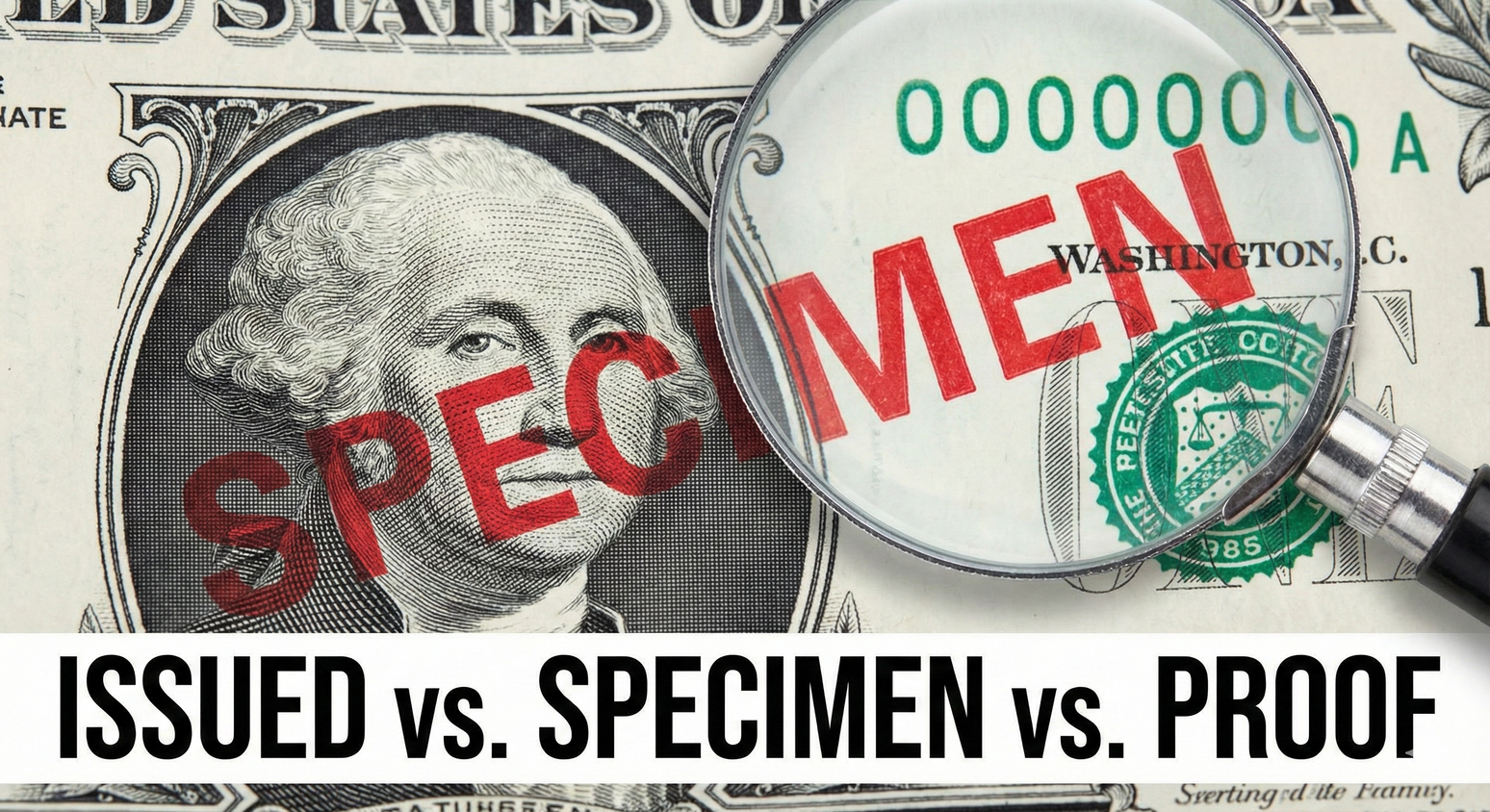
The Collector’s Hierarchy
In the sophisticated and historically rich realm of numismatics—specifically the specialized discipline of notaphily, or the study and collection of paper currency—the distinction between a mere financial instrument and a coveted historical artifact often relies upon a nuanced classification of its production stage.
To the uninitiated, a banknote is simply a medium of exchange, a promissory note guaranteed by a central bank to facilitate commerce. It is a utilitarian object, designed for velocity, durability, and eventual redemption.
However, to the seasoned philatelist of paper money and the astute investor, the "Collector’s Hierarchy" reveals a deeper, more stratified world where value is inverted: the notes that never circulated, the designs that were never finalized, and the samples stamped "No Value" frequently command the highest premiums in the global marketplace.
This comprehensive report serves as the definitive guide to navigating the three primary tiers of high-level banknote collecting: the Issued Note, the Specimen, and the Proof. By deconstructing these categories, we expose the underlying mechanics of rarity—explaining why a banknote with a serial number of all zeros can fetch fifty times the price of its circulating counterpart, and why a "Colour Trial" represents the fascinating "road not taken" in a nation's economic history.
The hierarchy of paper money is not merely a rigid classification system; it is a chronological map of the printing process itself. From the engraver’s initial artistic vision (the Essay and Proof) to the printer’s quality control and bank distribution samples (the Specimen), and finally to the mass-produced currency in our wallets (the Issued Note), each stage represents a contraction in artistic purity and an expansion in utility. Paradoxically, as utility increases, numismatic value often decreases.
Part I: The Issued Banknote – The Foundation of Notaphily
Defining the Issued Note: The Survivor of Commerce
The issued banknote is the fundamental unit of the numismatic world. By definition, these are notes that have been authorized, printed, and formally released into circulation by a monetary authority to serve as legal tender. They bear the signatures of current treasury officials, specific serial numbers intended for tracking and authentication, and legal clauses promising payment to the bearer.
While this category represents the vast majority of banknotes in existence, dismissing them as "common" is a mistake that novice investors often make. The value of an issued note is driven principally by two aggressive factors: survivorship and condition.
Unlike specimens or proofs, which are often preserved in archives from the moment of creation, issued notes face the immediate and brutal ravages of circulation. They are folded into wallets, crumpled in pockets, pinned to invoices, stapled in bundles, and soiled by thousands of hands. Therefore, high-grade issued notes—particularly those from the 19th and early 20th centuries—are examples of statistical improbability. They are survivors.
The Mechanics of Serial Numbers: Tracking Value
Within the category of issued notes, the serial number acts as a primary differentiator of value and a key diagnostic tool for collectors. The serial number is the unique fingerprint of the banknote, applied during the final stage of the printing process, typically via letterpress, distinct from the intaglio printing of the main design.
- Low Serial Numbers: The allure of the "Low Number" is universal. Notes with serial numbers under 100 (e.g., 00000005) are highly prized. A "Number 1" note is considered a trophy asset, bridging the gap between a standard issue and a presentation piece.
- Star Notes (The Economics of Replacement): When a sheet of currency is identified as defective during the printing process, it is replaced by a "Star Note," indicated by a star suffix. A star note from a run of 640,000 or fewer is considered rare, creating a market within a market.
Table 1: Comparative Attributes of Note Classifications
| Feature | Issued Banknote | Specimen Banknote | Proof Banknote |
|---|---|---|---|
| Legal Tender | Yes (unless demonetized) | No (Demonetized/Invalid) | No (Artistic Concept) |
| Serial Numbers | Unique, sequential | 00000000 or Range | None / 00000000 / Hand-written |
| Signatures | Official authorized | Official or Cancelled | Often Missing / Hand-signed |
| Primary Purpose | Commerce / Spending | Identification / Archival | Design / Approval / Testing |
| Production Stage | Final Output | Pre-Distribution / Reference | Pre-Production / Design |
Part II: The Specimen – The Banknote That Never Was Money
Defining the Specimen
Moving up the hierarchy, we encounter the Specimen. A specimen banknote is a fully finished note, printed with the same master plates, high-quality paper, and specialized inks as the issued currency, but intended for a completely different purpose. These notes were printed in strictly limited quantities for distribution to central banks, law enforcement agencies, and commercial banks globally to aid in the recognition of new currency designs and the detection of counterfeits.
Because they were never intended to circulate as money, specimens are intentionally demonetized or invalidated at the source. This invalidation is the defining characteristic of the genre and creates a unique aesthetic that collectors prize. A specimen is, in essence, the "Platonic Ideal" of the banknote.
Visual Identifiers: The Language of the Specimen
To the expert, these "defacements" are marks of authenticity and rarity. There are three primary identifiers that distinguish a specimen from an issued note.
- The Zero Serial Number: The most ubiquitous identifier of a specimen is the all-zero serial number (e.g., 00000000 or A0000000A). Instead of a transaction number, they function as a design template.
- The Overprint: Specimens are almost invariably overprinted with a declaration of their status, often in red or black ink.
- English: "SPECIMEN" is standard for the UK, US, and British Commonwealth.
- Spanish: "MUESTRA" (meaning sample) is the standard for Latin American issues.
- Punch Cancellations (Perfins): This involves punching holes through the note, often specifically through the signature block to invalidate the legal authority of the signers. More elaborate cancellations involve punching the word "SPECIMEN" or "PAID" into the paper itself.
The "Altered Specimen" Danger: A critical warning for collectors: because specimens command high prices, unscrupulous actors may attempt to manufacture them. Genuine specimens have zero serials printed during the production process, not overprinted later. Under high magnification (10x-30x), the ink of a genuine zero serial will show the same embedding characteristics as the rest of the intaglio printing.
Part III: The Proof – The Blueprint of Currency
Defining the Proof: The Artist's Vision
At the apex of the hierarchy lies the Proof. If the issued note is the product and the specimen is the sample, the proof is the prototype. A proof is a print made during the design process to test the engraving, the color, or the overall composition before the design is finalized for mass production. Proofs are not legal tender, nor were they ever intended to be. They are artistic concepts.
Proofs are often printed on special card stock or "India paper" to verify the quality of the engraving plate. Categories include:
- Die Proofs: Printed directly from the master die, typically showing only the artwork without surrounding text.
- Plate Proofs: Printed from the finished printing plate, essentially verifying that the transfer from the master die was successful.
- Colour Trials: Printers often produce the same design in multiple color variations. A "Colour Trial Specimen" is a fully finished note printed in a non-standard color (e.g., a blue $10 note that was eventually issued in green).
The Rarity of the Proof: The rarity of proofs cannot be overstated. While specimens may have print runs of 50 or 100, proofs are often unique or exist in single-digit quantities.
Part IV: Value & Rarity – The Economics of Scarcity
The valuation of paper money is a complex derivative of scarcity, demand, and historical significance. The "Collector's Hierarchy" typically correlates with price, but not always in a linear fashion.
Case Study: Zimbabwe $100 Trillion – The Hyperinflation Icon
The Zimbabwe $100 Trillion Dollar note (2008) is a modern classic.
- Issued Note: Millions were printed. A high-grade (PMG 66/67) issued note can fetch $150 - $200.
- Specimen Note: The Specimen version (P-91s) features the "SPECIMEN" overprint and a serial number of AA0000000. Certified Specimens can command prices in the thousands.
Case Study: U.S. 1928 Gold Certificates
The 1928 Gold Certificates represent the "Holy Grail" for many US collectors.
- Issued $10 Gold Certificate: A pristine Uncirculated example can reach $3,000+.
- The Specimen: US Gold Certificate specimens are exceedingly rare. A Specimen of a high-denomination Gold Certificate (like the $1,000 or $10,000) is virtually priceless or trades privately for six figures ($100,000+).
Part V: Investment Potential – Tangible History as an Asset Class
Investing in rare banknotes requires a shift in mindset from "accumulating" to "curating." The astute investor uses this hierarchy to diversify their holdings.
- Blue-Chip Issued Notes: High-grade notes from major economies (US, UK, China). These offer liquidity and steady, linear appreciation.
- Specimens (Growth Stocks): As sophisticated collectors complete their sets of issued notes, they inevitably turn to specimens. We are seeing massive price surges in specimens from the Middle East, India, and China.
- Proofs (Alternative Assets): Proofs are highly targeted by museums and archives. Because they are often unique, they are insulated from general market volatility.
SEO Strategy for the Numismatic Investor
To successfully navigate the digital marketplace, investors must master the "long-tail" search. A novice searches for "old money," but an investor searches for specific, technical terms like:
- "Bradbury Wilkinson specimen banknote auction results"
- "PMG population report 1928 Gold Certificate"
- "Zimbabwe 100 Trillion Specimen vs Issued price"
The conversion to high-value investment happens in these specific queries.
Part VI: The Planet Banknote Guarantee – Trust in Every Fiber
In a market defined by nuance—where a "cleaned" note is worth 50% less than an "original" one—trust is the only currency that matters. At PlanetBanknote.com, we do not merely sell paper; we curate history. Our inventory is vetted through a rigorous, multi-stage authentication process that sets the industry standard.
- Scientific Verification: We employ UV Light Analysis to detect paper quality and hidden fluorescence, and high-magnification examination (10x-30x) to examine the integrity of the intaglio printing.
- Grading Authority Partnership: We deal primarily in notes graded by PMG (Paper Money Guaranty) and PCGS Banknote. We focus on notes designated as EPQ (Exceptional Paper Quality) or PPQ (Premium Paper Quality), confirming the note has not been chemically processed.
- The "Life of the Note" Warranty: We stand behind every item we sell. Whether it is a $50 issued note or a $50,000 Specimen, our guarantee of authenticity is perpetual.
Elevate Your Collection
Whether you are looking for the historical grit of a circulated "Black Eagle," the pristine perfection of a Zero-Serial Specimen, or the unique allure of a Colour Trial, PlanetBanknote.com is your partner in this pursuit.
Invest in History. Collect with Confidence.
Browse Our InventoryExplore Popular Articles
Paper Vs. Gold
Paper vs. Gold The Liquidity Ratio of Numismatics The global financial architecture has undergone a...

Iran Update
The Iran Liquidity Freeze Why the 5 Million Rial Note is Vanishing The global financial landscape o...

The Texas Trophy
The Numismatic Genesis of Freestone County A Comprehensive Analysis of the Serial Number 1 Teague N...