
The Iraqi Dinar: 5000 Years of History
The Iraqi Dinar: A Collector’s Guide to the Banknotes of Mesopotamia
History, Designs, Security Features & What Makes These Notes Unique
Very few nations on Earth can claim over 5,000 years of continuous civilization. Iraq is one of them. The land between the Tigris and Euphrates rivers — ancient Mesopotamia — gave humanity its first writing system, its first codified laws, and its first cities. That history lives on in an unexpected place: Iraqi dinar banknotes.
The modern Iraqi dinar series, introduced in 2003 by the Central Bank of Iraq, carries imagery that spans millennia — from the Code of Hammurabi and the Lion of Babylon to the Great Mosque of Samarra and the waterfalls of Kurdistan. Each denomination is essentially a miniature canvas depicting a different chapter of one of the world’s oldest and most layered civilizations. For numismatists and history enthusiasts, these notes offer something genuinely rare: a tangible connection to Mesopotamia that you can hold in your hand.
This guide covers the complete modern Iraqi dinar series — every denomination, every design element, the cultural significance behind the imagery, the security features that protect them, and what makes these notes stand out in a world banknote collection.
A Brief History of the Iraqi Dinar
The Iraqi dinar was introduced on April 1, 1932, replacing the Indian rupee that had circulated during the British mandate period. Initially pegged to the British pound at par, the dinar was later re-pegged to the US dollar in 1959 at a rate of 1 dinar to $2.80 — making it one of the most valuable currencies in the world at the time.
Iraq’s early banknotes were printed in England by De La Rue, one of the world’s most respected security printers, and featured portraits of the Iraqi monarchy. Following the 1958 revolution that ended the Hashemite dynasty, royal imagery was replaced with national symbols — palm trees, allegorical figures, and cultural landmarks.
The banknotes issued during the Saddam Hussein era (1979–2003) are a distinct chapter. After the 1991 Gulf War and the imposition of international sanctions, Iraq lost access to De La Rue and high-quality printing materials. Notes were printed domestically and in China using wood-pulp paper and inferior lithography. The quality was so poor that counterfeits sometimes looked better than genuine notes. Despite hyperinflation eroding the currency’s purchasing power, the highest denomination printed during this period was just 250 dinars — forcing Iraqis to carry enormous stacks of notes for everyday transactions.
The 2003 Currency Reform
Between October 15, 2003 and January 15, 2004, the Coalition Provisional Authority oversaw one of the most ambitious currency replacements in modern history. Multiple trillions of dinars in new banknotes were printed by De La Rue (UK) and Giesecke+Devrient (Germany), shipped to Iraq, and exchanged for the old Saddam-era notes at a 1:1 rate. The new series deliberately removed all political portraiture, replacing it with cultural landmarks, natural wonders, and ancient Mesopotamian artifacts — a conscious decision to depoliticize the currency and unite a diverse nation around its shared heritage.
The Complete Modern Iraqi Dinar Series: Every Denomination & Its Story
The 2003 series launched with six denominations: 50, 250, 1,000, 5,000, 10,000, and 25,000 dinars, with a 500 dinar note added in October 2004 and the landmark 50,000 dinar note introduced in November 2015. In 2018, the Central Bank of Iraq released updated designs for the 250, 500, 1,000, 10,000, and 25,000 dinar notes with enhanced security features. Together, these notes tell the story of Iraq from ancient Sumer to the modern era.
| Denomination | Pick # | Obverse (Front) | Reverse (Back) | Color |
|---|---|---|---|---|
| 250 Dinars | P-97 | Astrolabe (medieval Islamic astronomical instrument) | Spiral Minaret of the Great Mosque of Samarra | Blue |
| 500 Dinars | P-98 | Dukan Dam (Kurdistan Region) | Winged bull (lamassu) — an Assyrian protective deity | Blue-green |
| 1,000 Dinars | P-104 | Al-Mustansiriya University (Baghdad, est. 1227 AD) | Ikhlas Surah calligraphy (2003); Assyrian star (2018 redesign) | Brown |
| 5,000 Dinars | P-100 | Gali Ali Beg waterfall (Kurdistan Region) | Desert scene with palm trees | Blue-purple |
| 10,000 Dinars | P-101 | Abu Ali al-Hasan Ibn al-Haytham (10th-century “Father of Optics”) | Hadba Minaret, Al-Nuri Mosque (Mosul) | Green |
| 25,000 Dinars | P-102 | Kurdish farmer with jug; tractor plowing a field | King Hammurabi receiving the law from Shamash the Sun God (from the Code of Hammurabi stele) | Red-yellow |
| 50,000 Dinars | P-103 | Water wheel on the Euphrates; Gali Ali Beg waterfall | Great Mosque of Samarra; outline map of Iraq with Tigris & Euphrates rivers | Purple-rose |
The Cultural Heritage on Every Note
What makes Iraqi dinar notes remarkable from a numismatic perspective is the depth and range of civilization they represent. Few countries can put 4,000 years of history on a single banknote — Iraq can, and does.
The Code of Hammurabi (25,000 Dinars)
The reverse of the 25,000 dinar note depicts one of the most significant legal artifacts in human history: King Hammurabi of Babylon receiving the law from Shamash, the Sun God. This image is taken from the upper portion of the diorite stele that contains the Code of Hammurabi — a set of 282 laws dating to approximately 1754 BC that established concepts of justice, property rights, and contractual obligation that still underpin legal systems today. The original stele stands in the Louvre in Paris, but its image lives on every 25,000 dinar note in circulation. The same note also features the Lion of Babylon, a basalt statue from the reign of Nebuchadnezzar II (605–562 BC) that has become one of Iraq’s most recognizable national symbols.
The Great Mosque of Samarra (250 & 50,000 Dinars)
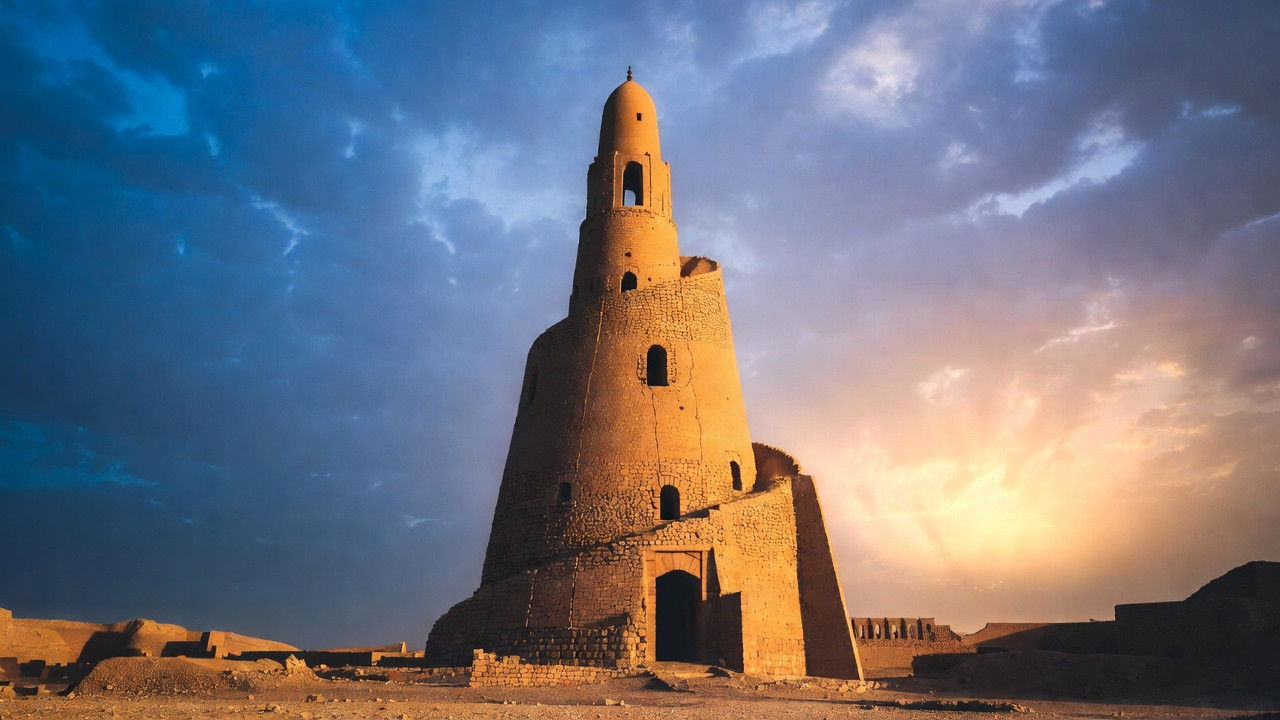
The Spiral Minaret (Malwiya Tower) of the Great Mosque of Samarra appears on both the 250 dinar and 50,000 dinar notes. Built in the 9th century during the Abbasid Caliphate, it was once the largest mosque in the world. The minaret’s distinctive conical spiral form — rising 52 meters with an external helical ramp — is one of the most iconic architectural silhouettes in Islamic civilization and a UNESCO World Heritage Site. Its repeated appearance across denominations speaks to its significance as a symbol of Iraq’s role in the Golden Age of Islam.
Ibn al-Haytham — The Father of Optics (10,000 Dinars)
The 10,000 dinar note is the only denomination in the series to feature a historical figure: Abu Ali al-Hasan Ibn al-Haytham (965–1040 AD), the Basra-born polymath universally regarded as the father of modern optics. His seven-volume Kitab al-Manazir (Book of Optics) laid the groundwork for the scientific method and influenced European scholars including Roger Bacon, Johannes Kepler, and René Descartes. The reverse of the note shows the Hadba Minaret of the Al-Nuri Mosque in Mosul — a structure that tragically suffered severe damage during the 2017 battle to liberate the city from ISIS, making surviving notes that depict the intact minaret particularly poignant artifacts.
Al-Mustansiriya University (1,000 Dinars)
The 1,000 dinar note features Al-Mustansiriya University in Baghdad, established in 1227 AD by Abbasid Caliph Al-Mustansir Billah. It is one of the oldest universities in the world and was the first institution in history to teach all four major schools of Islamic jurisprudence under one roof. The 2018 redesign of this denomination replaced the Ikhlas Surah calligraphy on the reverse with an Assyrian star — a deliberate acknowledgment of Iraq’s Assyrian Christian heritage and the diversity of the nation’s cultural identity.
The Lamassu — Assyrian Winged Bull (500 Dinars)
The 500 dinar note’s reverse features the lamassu — the winged bull with a human head that served as a protective deity in ancient Assyrian civilization. These massive stone sculptures once flanked the gateways of palaces in Nineveh and Nimrud (near modern Mosul), dating to the 8th and 7th centuries BC. The lamassu is one of the most powerful symbols of ancient Mesopotamian art and appears in major museums worldwide, including the British Museum, the Louvre, and the Metropolitan Museum of Art.
Gali Ali Beg Waterfall & the Kurdistan Region (5,000 & 50,000 Dinars)
Multiple denominations feature the natural beauty of Iraq’s Kurdistan Region, which surprises many who associate Iraq exclusively with desert landscapes. The Gali Ali Beg waterfall, located in the Rawandiz area of Erbil province, cascades through a dramatic gorge surrounded by lush mountain vegetation. The Dukan Dam on the 500 dinar note represents Iraq’s modern engineering and water management infrastructure. Together, these images showcase the geographical diversity of a country that spans from snow-capped Kurdish mountains to the Mesopotamian marshlands of the south.
The Arabian Horse Watermark
Every denomination in the modern Iraqi dinar series carries a watermark of an Arabian horse’s head. Iraq is considered one of the ancestral homelands of the Arabian horse breed, with documented breeding lineages dating back centuries among Bedouin tribes of the Mesopotamian region. The choice of watermark is both a security feature and a cultural statement — connecting the currency to one of Iraq’s most treasured living traditions.
Security Features: World-Class Protection
The post-2003 Iraqi dinar series was printed by De La Rue (UK) and Giesecke+Devrient (Germany) — two of the most respected security printers on the planet. These are the same firms that produce banknotes for dozens of central banks worldwide. The 2014 and 2018 upgrades introduced additional cutting-edge features that place Iraqi dinars among the most secure banknotes in the Middle East.
| Feature | Found On | What to Look For |
|---|---|---|
| Arabian Horse Watermark | All denominations | Hold note to light — a detailed horse head profile appears in the blank area. Should show fine detail in mane and features. |
| SPARK® Optical Feature | 25,000 dinars (2014+) | A color-changing element on the obverse that shifts from purple to green when tilted. Manufactured by SICPA, one of the world’s leading security ink producers. |
| VARIFEYE® Window Thread | 25,000 dinars (2014+) | A 16mm wide windowed security thread that appears as a series of reflective windows on the surface, shifting color when tilted. |
| RollingStar® Cube Thread | 25,000 dinars | A 4mm wide purple-to-green windowed security thread with demetalized Arabic text, created by Giesecke+Devrient. |
| Braille Embossing | All denominations (2014+) | Raised tactile marks for vision-impaired users — a feature that demonstrates the CBI’s commitment to accessibility. |
| UV-Reactive Elements | All denominations | Under ultraviolet light, fluorescent fibers and hidden design elements become visible. Serial numbers and security features respond distinctly. |
| Intaglio Printing | All denominations | Run your fingertip across the main imagery and denomination numerals — genuine notes have distinct raised ridges from the intaglio printing process. |
| See-Through Register | All denominations | Partial designs on the front and back align perfectly when held to light to form a complete image. |
The combination of these features — from multiple world-leading security technology providers — makes the modern Iraqi dinar series one of the most difficult currencies in the region to counterfeit. For collectors, verifying these features is straightforward and provides immediate confidence in a note’s authenticity. Every Iraqi dinar sold by Planet Banknote is inspected through our Planet Banknote Verified authentication process and ships with a Certificate of Authenticity.
Three Eras of Iraqi Banknote Printing
For collectors, one of the most fascinating aspects of Iraqi dinar banknotes is how dramatically the quality and character of the notes has changed across three distinct eras of production.
| Era | Period | Printer | Character |
|---|---|---|---|
| “Swiss Dinar” | Pre-1991 | De La Rue (UK) | High-quality cotton paper, fine intaglio engraving, detailed portraits. These are the most sought-after among vintage Iraq collectors. Continued circulating in the Kurdistan Region until 2004. |
| Saddam Era | 1991–2003 | Domestic / China | Wood-pulp paper, crude lithography, wildly inconsistent color and detail. Saddam’s portrait on every denomination. Collectors value these for their historical significance despite the low print quality. |
| Modern Series | 2003–Present | De La Rue & Giesecke+Devrient | World-class cotton paper, advanced security features (SPARK, VARIFEYE, RollingStar), culturally rich designs free of political imagery. Updated with enhanced features in 2014 and 2018. |
The contrast between the Saddam-era notes and the modern series is striking and educational in itself. Holding a 250 dinar note from 1995 next to a 25,000 dinar note from 2023 is a tangible lesson in how political circumstances, international access, and security technology shape the physical currency a nation produces. Many collectors seek examples from all three eras to tell the complete story.
The 50,000 Dinar: Iraq’s Largest Denomination
Introduced in November 2015, the 50,000 dinar note is the highest denomination ever issued by the Central Bank of Iraq and the first new denomination added since the 2003 series launched. Printed jointly by De La Rue and Giesecke+Devrient, it measures 156 × 65 mm and features the most advanced security features of any Iraqi banknote.
The obverse depicts a water wheel on the Euphrates River, surrounded by palm trees, alongside the Gali Ali Beg waterfall — representing both the ancient agricultural traditions of Mesopotamia and the natural splendor of Kurdistan. The reverse features an outline map of Iraq showing the Tigris and Euphrates rivers alongside the Great Mosque of Samarra — a design that visually unifies the country’s geography and heritage on a single note.
For collectors, the 50,000 dinar is significant as the flagship denomination of the modern series. Its relatively recent introduction, high-quality printing, and comprehensive security features make it an excellent centerpiece for an Iraqi dinar collection.
Building an Iraqi Dinar Collection
Iraqi dinar banknotes offer collectors multiple entry points and collecting strategies, whether you are drawn to the historical imagery, the security technology, or the breadth of the complete series.
| Approach | What It Includes | Why Collectors Choose It |
|---|---|---|
| Single Note | One denomination — typically the 25,000 or 50,000 dinar | The most accessible entry point. The 25,000 dinar with its Hammurabi reverse is the most culturally rich single note in the series. |
| Complete Modern Set | One of each denomination from 250 to 50,000 dinars | Tells the full story of modern Iraq across 7–8 notes. Each denomination features different historical and cultural imagery. |
| Date Variety Set | Same denomination across multiple print years | Track the evolution of security features and design refinements from the 2003 originals through the 2014 and 2018 upgrades. |
| Three-Era Set | One note from each printing era: Swiss Dinar, Saddam-era, and Modern | A powerful side-by-side comparison of how a nation’s currency reflects its political and economic circumstances. |
| PMG Graded | PMG-encapsulated specimens at Gem Uncirculated grades | Independent authentication, permanent preservation, and documented provenance. Ideal for serious collectors and long-term holdings. |
Condition & Storage
As with all banknote collecting, condition is paramount. Uncirculated (UNC) notes command the strongest interest — look for notes that are perfectly flat with no folds, sharp corners, and full original crispness. Store your Iraqi dinar notes in acid-free, PVC-free currency sleeves to prevent degradation. Our PBGrade semi-rigid currency sleeves are designed specifically for world banknotes of this size and provide UV protection and archival-quality preservation.
Why Iraqi Dinars Belong in a World Banknote Collection
The Iraqi dinar is more than a medium of exchange. It is a canvas that carries the visual history of Mesopotamia — from the 4,000-year-old Code of Hammurabi to the medieval brilliance of Ibn al-Haytham, from the Assyrian lamassu to the waterfalls of modern Kurdistan. The notes are printed by two of the finest security printers in the world, protected by technology that rivals any currency in circulation, and designed with imagery that no other nation’s banknotes can match in historical depth.
Whether you start with a single 25,000 dinar note or build a complete set spanning all three eras of Iraqi banknote production, these are notes that tell a story every time you look at them. And that, for any collector, is the point.
Explore Popular Articles
The Iraqi Dinar: 5000 Years of History
The Iraqi Dinar: A Collector’s Guide to the Banknotes of Mesopotamia History, Designs, Security Fea...

Collectors Guide to Zimbabwe AA 100 Trillion Dollar Banknote
The Complete Collector’s Guide to the Zimbabwe 100 Trillion Dollar Note History, Authentication, Gr...

Defeating Counterfeits with Tech
The Future of Authentication Defeating Counterfeits with Tech in the 2026 Monetary Landscape The gl...