
Enjoy Privacy? Strategic Report
The Death of Cash & The Rise of Privacy
Date: January 2026
Subject: The Emergence of Physical Currency as a Non-Correlated "Freedom Asset" Class
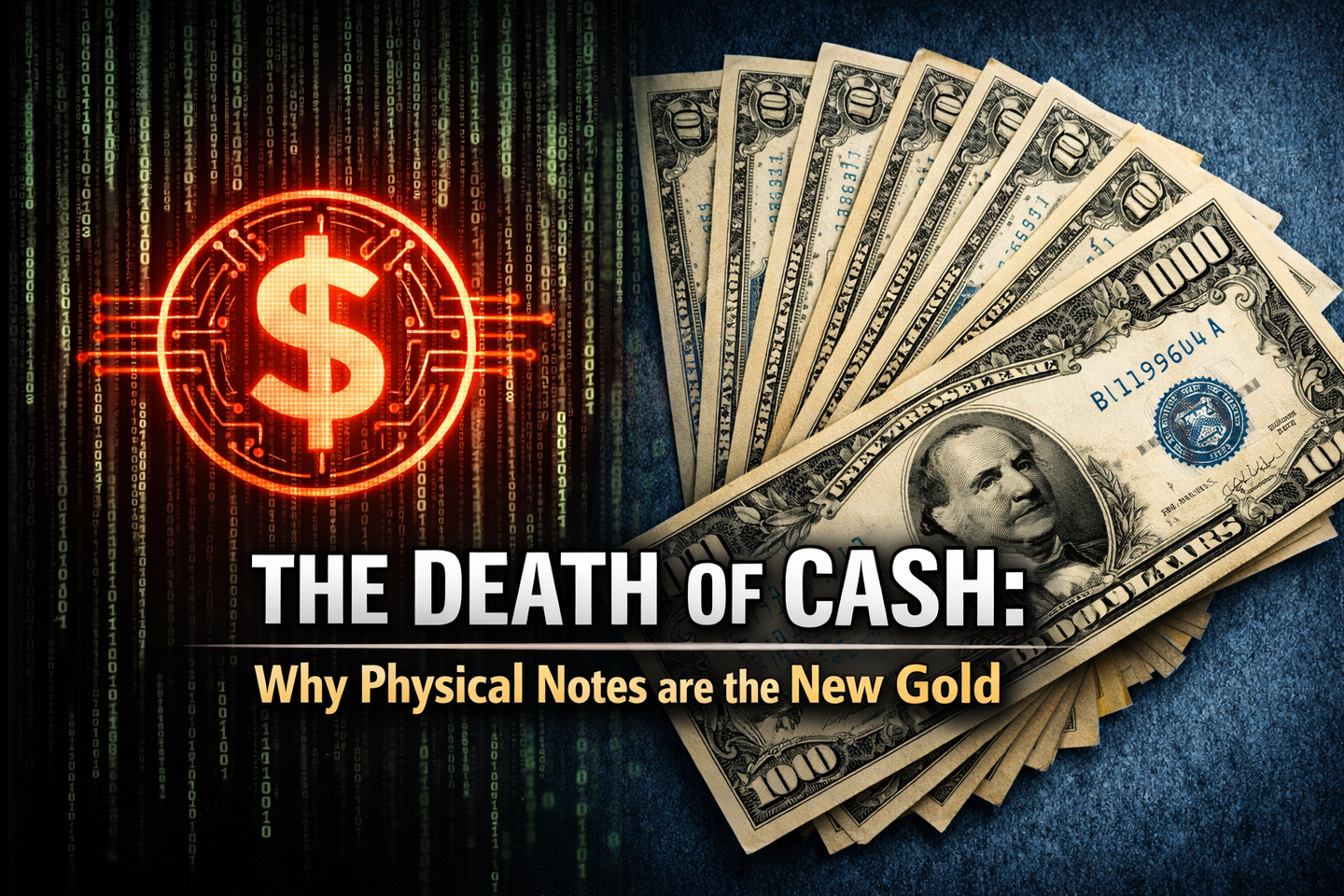
The financial landscape of 2026 is defined by a singular, overarching tension: the collision between the digitization of sovereign currency and the individual’s demand for financial privacy. As global central banks transition from the theoretical exploration of Central Bank Digital Currencies (CBDCs) to active implementation, the utility of physical cash has undergone a fundamental transformation.
The "Death of Cash," a narrative propagated by fintech advocates for two decades, has paradoxically catalyzed a "Flight to Physicality" among privacy-conscious collectors. The statistical decline of transactional cash usage at the point of sale is undeniable, yet it masks a divergent trend: the hoarding of high-value banknotes as a hedge against the panopticon of the digital ledger.
Part I: The Architecture of Control
The year 2026 marks the definitive "crossing of the Rubicon" for the global monetary order. We are no longer asking "if" money will be digitized, but "who" will control the ledger and to what extent that control will infringe upon civil liberties.
The Global March Toward Digital Sovereignty
By the onset of 2026, the global march toward CBDCs has shifted from exploration to implementation. Major financial bodies have championed CBDCs as tools for efficiency, yet the practical rollout reveals a focus on surveillance and control. Over 130 jurisdictions are formally examining digital currencies, with many in advanced development or pilot phases.
China remains the leader in CBDC deployment. The e-CNY (Digital Yuan) illustrates the "programmability" risk that drives the Freedom Asset narrative. The system allows for real-time visibility into transactions, enabling authorities to freeze funds or impose spending limits. The integration of "smart contracts" allows the currency to potentially have expiration dates—a feature that fundamentally alters the store-of-value property of money.
The United States: The Legislative Standoff
The situation in the United States in 2026 is defined by a fierce legislative and cultural standoff. While the Federal Reserve's "Project Hamilton" demonstrated that a US CBDC could technically handle millions of transactions per second, political backlash has been severe.
The "privacy vs. surveillance dilemma" remains the central critique. The default setting for most Digital Dollar architectures is "traceability" to combat illicit finance. This implies the potential end of financial privacy for significant purchases. With a CBDC, the central bank is the ledger; every transaction is visible in real-time.
Part II: The Death of Cash & Financial Censorship
While the CBDC infrastructure is being laid, the traditional cash infrastructure is heavily pressured. Global cash usage at the point of sale is projected to hit historic lows by the end of 2026. This decline is driven by convenience, digital wallets, and incentivized disuse by merchants.
The ultimate driver of the "Freedom Asset" thesis is the fear of Financial Deplatforming. The ability of institutions to disconnect an individual from the economy has moved from a theoretical risk to a demonstrated reality. In a fully digital system, deplatforming can be automated. This reality creates the demand for an asset that has no "off" switch: physical cash.
Part III: The Rise of "Freedom Assets"
In response to these converging threats, a new asset class has emerged. It is not cryptocurrency, which is dependent on internet infrastructure, but vintage physical cash. These notes are being re-priced by the market not just for their rarity, but for their utility as anonymous, bearer instruments of wealth.
The Taxonomy of Freedom Assets
| Tier | Asset Type | Primary "Freedom" Utility |
|---|---|---|
| Tier 1 | Silver Certificates & Red Seal Notes | Daily transactional privacy; recognizable US tender. |
| Tier 2 | Large Denominations ($500, $1,000) | High wealth density; privacy in transport. |
| Tier 3 | Hyperinflation Notes (Venezuela, Zimbabwe) | Speculative hedge; educational tool. |
Tier 1: Silver Certificates – The People's Privacy
United States Silver Certificates, issued between 1878 and 1964, have become the bedrock of the movement. Distinguished by their blue treasury seals, these notes represent a pre-1964 era of "sound money." Collectors hoard these because they carry the historical lineage of commodity backing. This distinction fuels a speculative bet: if the US government were to recall Federal Reserve Notes to force a switch to a CBDC, would "Silver Certificates" be exempted? The perception creates value.
Tier 2: The High-Denomination "Whales"
In the "Fear of CBDC" era, the primary utility of $500 and $1,000 notes is Wealth Density. Carrying $100,000 in modern $100 bills requires 1,000 notes—a stack roughly 4.3 inches high. Carrying $100,000 in $1,000 bills requires only 100 notes—a stack less than half an inch thick. For individuals concerned with the ability to store significant purchasing power outside the banking system, high-denomination notes are the ultimate tool.
Tier 3: Hyperinflation Notes – The Ultimate Hedge
The third tier comprises banknotes from distressed fiat regimes, such as the Venezuelan Bolivar and Zimbabwean Trillion-Dollar Notes. In 2026, these notes serve a dual purpose: as a speculative asset for revaluation events, and as a psychological hedge—a physical reminder of what happens when central banks lose control.
Part IV: The Ecosystem of Tangible Wealth
The "Freedom Asset" thesis extends beyond paper money into its metallic cousins. The synergy between collectible banknotes and "Junk Silver" (pre-1964 US dimes, quarters, and half-dollars) forms a robust defensive collection.
Part V: Market Dynamics & Valuation Analysis
The numismatic market in 2026 is no longer defined just by hobbyists. It has been validated by individuals seeking non-correlated assets. Demographics have shifted as Millennials and Gen Z investors, disillusioned by the volatility of crypto and the surveillance of CBDCs, view physical notes as "analog privacy tech."
The "Fancy Serial Number" Phenomenon
A sub-sector that has exploded is "Fancy Serial Numbers" (e.g., solid 8s, low numbers). In a digital world dominated by NFTs, fancy serial numbers are viewed as "Physical NFTs." A solid serial number note is mathematically unique and cannot be replicated.
Conclusion: The Last Bastion of Privacy
As we navigate the fiscal landscape of 2026, the battle lines are drawn. On one side stands the CBDC complex: efficient, programmable, and omniscient. On the other side stands the Tangible Wealth alliance: physical, heavy, and silent. It promises nothing but possession.
The rise of physical banknotes as "Freedom Assets" is a direct market response to the overreach of the surveillance state. For the individual who fears the "off switch," a stack of 1957 Silver Certificates is not just a collection of old paper—it is a battery of financial sovereignty. In the era of the "Digital Dragnet," the rustle of a 100-year-old banknote is the sound of liberty. The window to acquire these assets at reasonable valuations is open, but as the CBDC noose tightens, scarcity will only increase.
Disclaimer: This report is for educational, historical, and entertainment purposes only. It does not constitute financial, investment, legal, or tax advice. The views expressed regarding the future of CBDCs and cash are based on market analysis and speculative scenarios. Collectible currencies are volatile assets. Past performance is not indicative of future results.
Start Your Freedom Collection
Explore our inventory of historic Silver Certificates, High Denomination notes, and hyperinflation currency. Tangible assets for a digital world.
Shop CurrencyExplore Popular Articles

The Iraqi Dinar: 5000 Years of History
The Iraqi Dinar: A Collector’s Guide to the Banknotes of Mesopotamia History, Designs, Security Fea...

Collectors Guide to Zimbabwe AA 100 Trillion Dollar Banknote
The Complete Collector’s Guide to the Zimbabwe 100 Trillion Dollar Note History, Authentication, Gr...
Defeating Counterfeits with Tech
The Future of Authentication Defeating Counterfeits with Tech in the 2026 Monetary Landscape The gl...