




-


1991 Cuba Banco Nacional Specimen 10 & 20 Pesos P-109s P-110s PMG 67 EPQ Set
$299.001991 Cuba Banco Nacional Specimen 10 & 20 Pesos P-109s P-110s PMG 67 EPQ Set This listing features a vibrant two-note specimen set from the Banco Nacional de Cuba, both dated -


1961 Cuba Banco Nacional Specimen Set 1–100 Pesos PMG 63-65 P-94s 97s 98s 99s
$450.001961 Cuba Banco Nacional Specimen Set 1–100 Pesos P-94s 97s 98s 99s PMG Offered here is a historic four-note specimen set from the Banco Nacional de Cuba, dated 1961 -


1958 Cuba 50 Pesos Banco Nacional PMG 67 EPQ P-81b Calixto Garcia Pre-Revolution Note
$150.001958 Cuba 50 Pesos Banco Nacional PMG 67 EPQ P-81b Calixto Garcia Pre-Revolution Note Offered here is a classic pre-revolutionary 50 pesos issue from the Banco Nacional de Cuba, series of 1958. This... -


1950 Cuba 100 Pesos Banco Nacional PMG 66 EPQ P-82a Aguilera ABNC Pre-Revolution Type Note
$228.001950 Cuba 100 Pesos Banco Nacional PMG 66 EPQ P-82a Aguilera ABNC Pre-Revolution Type Note Presented here is a classic 100 pesos note from the Banco Nacional de Cuba, series of
Description
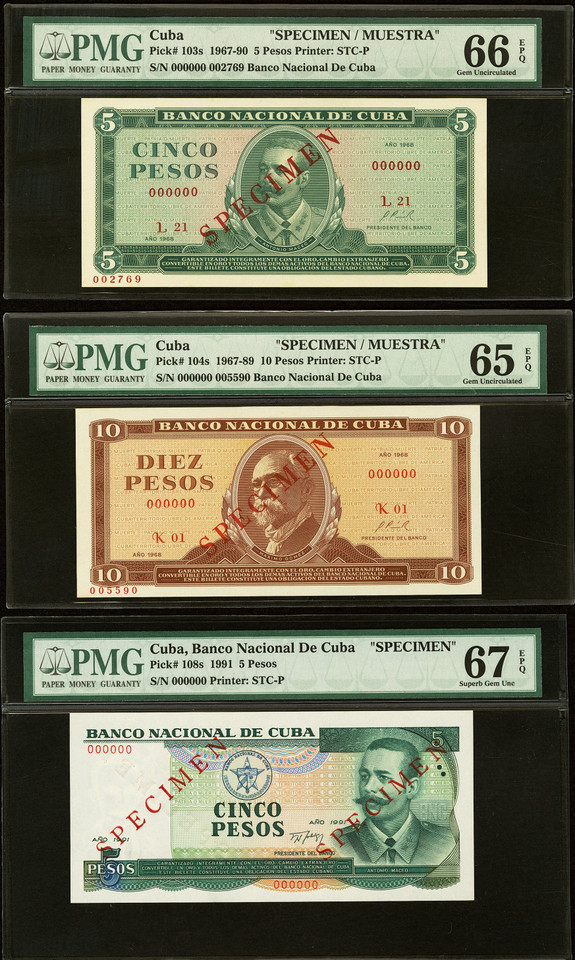
1967-1991 Cuba Banco Nacional Specimen 5 & 10 Pesos P-103s 104s 108s PMG 3-Note Set
This lot brings together three Banco Nacional de Cuba specimen notes spanning the heart of the revolutionary period to the early 1990s:
-
5 Pesos 1967–90 – Pick 103s – Antonio Maceo – PMG 66 EPQ
-
10 Pesos 1967–89 – Pick 104s – Máximo Gómez – PMG 65 EPQ
-
5 Pesos 1991 – Pick 108s – Antonio Maceo – PMG 67 EPQ
All three are printer’s specimens from STC-P, with red diagonal “SPECIMEN / MUESTRA” overprints, all-zero control serials, and PMG encapsulation for authenticity.
Historical significance
The 1967 5 and 10 pesos come from the first full post-revolution design family, issued while Cuba was consolidating its socialist state and tightening ties to the Soviet bloc.
-
The 5 pesos 1967 (P-103s) shows independence hero Antonio Maceo, known as the “Bronze Titan,” whose 19th-century campaigns and later 1958 “Invasion” across Cuba are celebrated in revolutionary iconography. The back recalls the 1958 rebel invasion that helped topple the Batista regime.
-
The 10 pesos 1967 (P-104s) carries the portrait of Máximo Gómez, commander of the Liberation Army in the Ten Years’ War and War of Independence. Its reverse shows Fidel Castro addressing a massive crowd in Havana during the Declaration of Havana on 2 September 1960, a central propaganda image of the early revolution.
The 1991 5 pesos (P-108s) belongs to the 1990–91 issue, printed on the eve of Cuba’s “Special Period” following the collapse of the Soviet Union. It again honors Antonio Maceo, tying the contemporary socialist state back to his 1878 Protest of Baraguá, commemorated in the reverse legend “Cuba será un eterno Baraguá” and the scene of two groups of patriots meeting in defiance.
Together these specimens illustrate how Cuban paper money charts a continuous narrative from 19th-century independence struggles, through Fidel Castro’s revolution, into the late 20th-century socialist era.
Design and features
5 Pesos 1967–90 – Pick 103s
-
Obverse: Dull deep green on a subtle pink underprint with Antonio Maceo in an oval at center; “CINCO PESOS” is spelled out at left and in all four corners, with Banco Nacional legends along the top border.
-
Reverse: The vignette “Invasión de 1958” shows columns of armed revolutionaries marching beneath palm trees, framed by angular borders and bold “5 CINCO PESOS” counters. Security features include fine guilloché, repeating microtext, and precise intaglio linework.
10 Pesos 1967–89 – Pick 104s
-
Obverse: Brown on tan and yellow underprint with Máximo Gómez at center; the denomination “DIEZ PESOS” appears at left within a framed panel, while ornate scroll corners hold large “10” numerals.
-
Reverse: A dramatic view of Fidel Castro speaking to a vast sea of supporters in Revolution Square during the Declaration of Havana, flags raised in the crowd. The design emphasizes mass participation and revolutionary legitimacy.
5 Pesos 1991 – Pick 108s
-
Obverse: Updated multi-color design in vibrant greens and yellows. The national arms appear at center under “CINCO PESOS”, with Antonio Maceo now moved to the right and identified by name. The layout introduces modern security elements and a tactile mark for the visually impaired.
-
Reverse: Intricate geometric patterns frame a scene of patriots gathered at Baraguá, referencing Maceo’s refusal to accept peace without independence; a ribboned rosette and repeated “SPECIMEN” overprint make clear this is a non-circulating example.
Each note bears bold red SPECIMEN overprints and diagnostic all-zero serial numbers typical of Cuban specimen issues, while PMG’s labels confirm printer, type, and catalog references.
Remarkable denominations & catalog data
-
5 Pesos 1967–90 – P-103s – Large-format mid-value note, often used in everyday transactions in revolutionary Cuba.
-
10 Pesos 1967–89 – P-104s – A higher-value workhorse denomination, effectively a wage note for many Cubans of the era.
-
5 Pesos 1991 – P-108s – New-design 5-peso type introducing refreshed security and layout for the difficult economic years ahead.
All three are official Banco Nacional de Cuba specimens printed by STC-P, referenced in major world paper-money catalogs and widely collected as type pieces and reference examples.
Collector’s value
For a collector specializing in Cuba, Latin America, or world specimen notes, this three-note group is a compact but powerful mini-collection: two classic 1967 revolutionary designs plus the 1991 redesign, each with important national heroes, strong propaganda-style reverses, and clear specimen markings. The matching PMG holders with SPECIMEN / MUESTRA designations make them ideal for display or long-term reference. As a ready-made, historically rich trio, this set offers an attractive way to upgrade a Cuban collection in one purchase.