



-
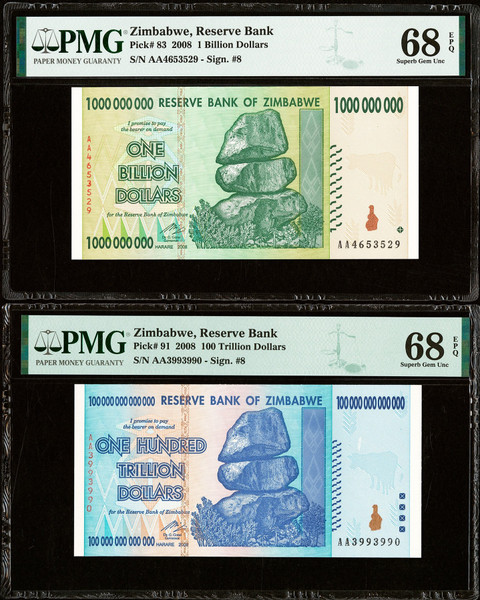

2008 Zimbabwe 1 Billion & 100 Trillion Dollars PMG 68 EPQ Hyperinflation P-83 P-91 Set
$274.002008 Zimbabwe 1 Billion & 100 Trillion Dollars PMG 68 EPQ Hyperinflation P-83 P-91 Set This 2-note graded set brings together two of the most dramatic pieces of modern paper money: Zimbabwe’s 1... -
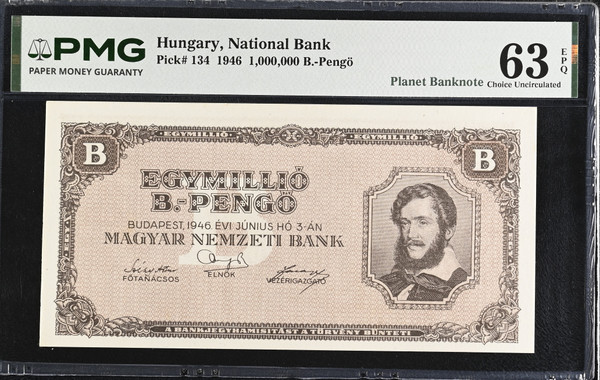
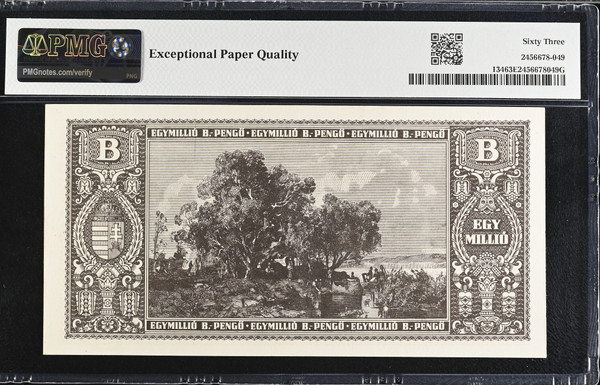
1946 Hungary 1000000 B-Pengo Banknote Pick 134 PMG 63 EPQ Hyperinflation Issue
$189.001946 Hungary 1000000 B-Pengo Banknote Pick 134 PMG 63 EPQ Hyperinflation Issue This authentic 1946 Hungary 1,000,000 B-Pengő banknote is a dramatic survivor from the final stage of the most -


1993 Yugoslavia 5,000,000,000 Dinars PMG 66 EPQ P-135a Gem Uncirculated Hyperinflation Note
$169.001993 Yugoslavia 5,000,000,000 Dinars PMG 66 EPQ P-135a Gem Uncirculated Hyperinflation Note Offered here is an extraordinary 1993 Yugoslavia 5,000,000,000 (5 Billion) Dinars banknote, certified PMG... -

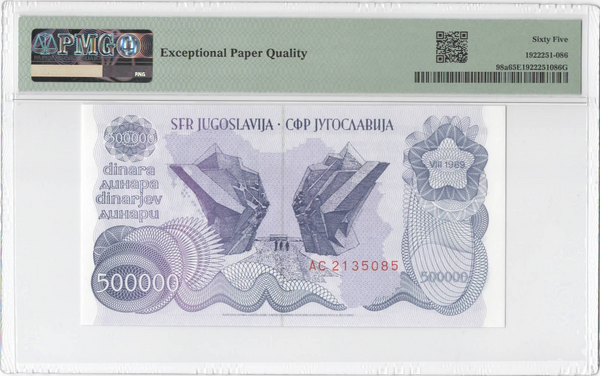
1989 Yugoslavia 500,000 Dinars PMG 65 EPQ P-98a Gem Uncirculated Pre-Hyperinflation Note
$139.001989 Yugoslavia 500,000 Dinars PMG 65 EPQ P-98a Gem Uncirculated Pre-Hyperinflation Note Offered here is a 1989 Yugoslavia 500,000 Dinars banknote, certified PMG 65 EPQ Gem Uncirculated, catalogued... -


1993 Yugoslavia 500 Million Dinars PMG 67 EPQ P-134 Superb Gem Unc Hyperinflation Note
$142.001993 Yugoslavia 500 Million Dinars PMG 67 EPQ P-134 Superb Gem Unc Hyperinflation Note Presented here is a 1993 Yugoslavia 500,000,000 (500 Million) Dinars banknote, graded PMG 67 EPQ Superb Gem...
Description
1942-44 Greece WWII 1000-10 Billion Drachmai PMG 63 EPQ 4-Note Hyperinflation Set
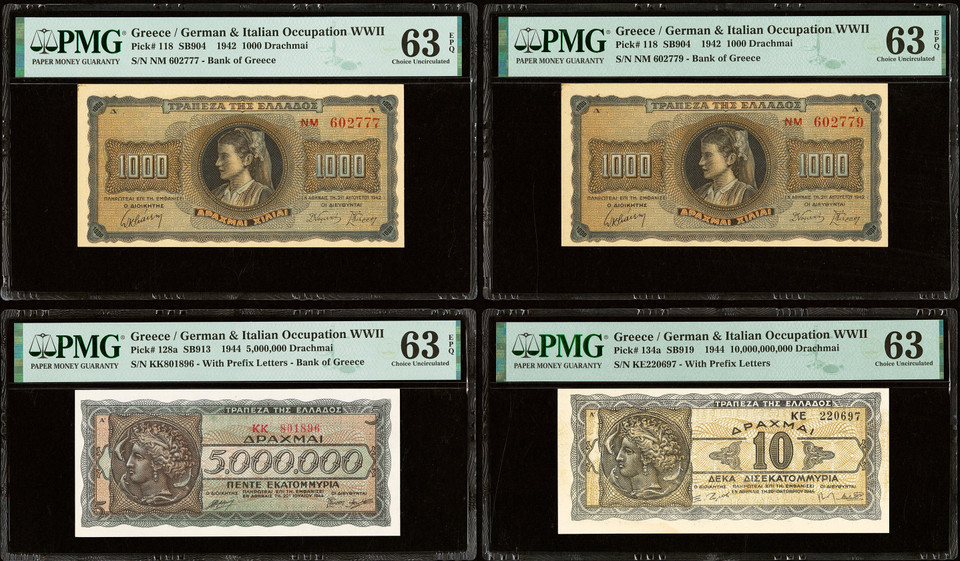
This 4-note, PMG-certified set follows Greece’s catastrophic World War II hyperinflation from a modest 1,000 drachmai denomination to a staggering 10,000,000,000 (10 billion) drachmai. All four notes are labelled “Greece / German & Italian Occupation WWII” and graded PMG 63 EPQ Choice Uncirculated.
You receive:
-
(2) 1000 Drachmai 1942 – Pick 118 – Bank of Greece
-
Consecutive serials NM 602777 & NM 602779.
-
-
5,000,000 Drachmai 1944 – Pick 128a – with prefix letters
-
10,000,000,000 Drachmai 1944 – Pick 134a – with prefix letters
All are securely encapsulated by PMG, guaranteeing authenticity and originality.
Historical significance – occupation & runaway inflation
During the German–Italian–Bulgarian occupation of Greece (1941–44), the economy collapsed under requisitions, famine, and the costs of occupation. With taxation almost impossible and production crippled, the authorities simply printed money, triggering one of history’s longest hyperinflations.
From 1942 onward, the Bank of Greece rushed out ever-larger denominations, culminating in 100 billion drachmai notes by late 1944. After liberation, a drastic reform exchanged 50 billion occupation drachmai for 1 new drachma, instantly wiping out these huge face values.
This set captures that story in four steps: a “normal” 1,000-drachmai note from 1942, a multi-million note from mid-1944, and a 10-billion note from the very peak of the crisis.
Note 1 & 2 – 1000 Drachmai 21.8.1942, Pick 118 (pair, consecutive)
-
Series: 1941–44 occupation inflation series.
-
Obverse: Bust of a young girl from Thassos in traditional dress at centre, framed by guilloche patterns and dual “1000” counters.
-
Reverse: Statue of the Lion of Amphipolis in Macedonia, a 4th-century BC funerary monument likely linked to one of Alexander the Great’s generals.
-
Colours: Black on blue-grey and pale orange underprint.
-
Date & legend: Dated 21 August 1942, payable at sight in Athens, with signatures of the governor and directors of the Bank of Greece.
These two notes form an attractive consecutive serial-number pair, ideal for display as a matched mini-set within the larger group.
Note 3 – 5,000,000 Drachmai 20.7.1944, Pick 128a
-
Series: 1944 inflation issue, first issue (“Α΄”) with prefix letters in the serial.
-
Obverse: Striking classical head of Arethusa from an ancient silver dekadrachm of Syracuse, surrounded by dolphins – a direct reference to the celebrated 5th–4th century BC coinage.
-
Reverse: Bold numeric “5,000,000” with intricate brown and grey guilloche work and the inscription “ΠΕΝΤΕ ΕΚΑΤΟΜΜΥΡΙΑ” (Five Million).
-
Date & text: Dated 20 July 1944, payable on demand in Athens, with signatures of Governor Spyridon Chatzikyriakos and the directors.
By mid-1944, a 5-million-drachmai note had become necessary just to keep up with market prices, a vivid illustration of the currency’s collapse.
Note 4 – 10,000,000,000 Drachmai 20.10.1944, Pick 134a
-
Series: 1944 occupation inflation issue; the second-highest Greek denomination, just below the 100-billion note (P-135).
-
Obverse: Again features Arethusa on the dekadrachm of Syracuse at left, connecting this extreme modern inflation note with a masterpiece of ancient Greek coin art.
-
Colours: Black and blue-black on tan underprint; reverse in dull dark blue with bold “10 ΔΙΣΕΚΑΤΟΜΜΥΡΙΑ” (“10 billion”) numerals.
-
Date & legend: Dated 20 October 1944—just weeks before liberation— and designated “ΕΚΔΟΣΙΣ ΠΡΩΤΗ” (First issue).
This note represents one of the iconic hyperinflation types of Europe: within days of its issue, a monetary reform would render it essentially worthless in everyday trade.
Remarkable denominations – from 1,000 to 10,000,000,000
Together, these four notes trace the explosive growth in face values during Greece’s occupation hyperinflation:
-
1,000 drachmai (1942)
-
5,000,000 drachmai (1944)
-
10,000,000,000 drachmai (1944)
Within just two years the top denominations leapt by seven orders of magnitude, and by late 1944 the state had to replace 50 billion old drachmai with a single new unit.
Collector’s value
This PMG-graded set brings together art, history, and extreme economics in one ready-made four-piece group. The consecutive 1,000-drachmai pair adds a premium touch, while the 5-million and 10-billion notes are essential types for any hyperinflation or WWII-occupation collection. With all four notes certified Choice Uncirculated 63 EPQ, you get guaranteed authenticity and solid eye appeal—an ideal foundation (or upgrade) for a Greece, World War II, or hyperinflation-themed paper-money collection.